January 8, 2012: Lilac-Breasted Roller (Coracias caudata)

The average size of the Lilac Breasted Roller is 14.5 inches, including the tail streamers. The washed green head is large, the neck is short, the greenish yellow legs are rather short and the feet are small. The beak is strong, arched and hooked-tipped. The tail is narrow and of medium length. The back and scapulars are brown. The shoulder of the wing, outer webs of the flight feathers and the rump are all violet. The bases of the primaries and their coverts are pale greenish blue and the outer tail feathers are elongated and blackish. The chin is whitish, shading to rich lilac of the breast. The underparts are greenish blue. The bill is black and the eyes are brown. It has large wings and strong flight.

Lilac-breasted roller is most cases seen hunting for its food which may range from grasshoppers, beetles and small amphibians. Great photographic chances are found when the bird is foraging in the ground.

It is the most commonly seen roller. It well distributed in Samburu, Lake Baringo and Bogoria, Nakuru, Masai Mara, Amboseli, Nairobi and Tsavo National Park.

December 30, 2011: Rufous-naped Lark (Mirafra africana)

 Rufous-naped Lark  (Mirafra Africana)

The Rufous-naped Lark’s head is coloured brown as well as the bill. The Mirafra Africana has a white coloured throat, pink legs and a brown coloured back. The eyes are brown.

The male Mirafra africana has physical features that are slightly different from the female bird. When the bird is excited it has a richly striped rufous crown. In most observatory incidence the bird tends to call from a raised platform or rather on top of a medium sized tree.

In Kenya, the bird is widely distributed in areas around central Kenya, Lake Naivasha, Maasai Mara and Amboseli National park.

Rufous-naped lark Rufous-naped lark song

I recently spotted this Rufous-naped lark in the Maasai Mara National Reserve and recorded it’s song.

– Joe

December 15, 2011: Hunter’s Sunbird (Nectarinia hunteri)

Hunter’s Sunbird is widespread and found in most dry areas of Kenya; especially in wooded and bushed grassland, it will however avoid very dry desert-like environments. It can easily be mistaken for the Scarlet-chested and Amethyst Sunbird.

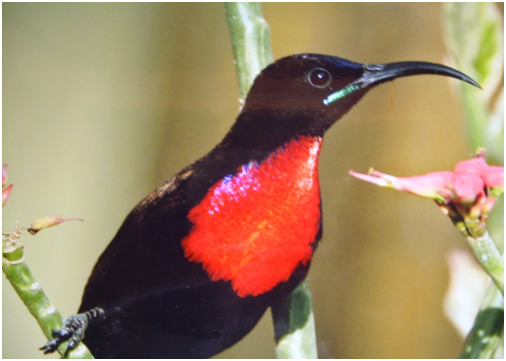
The adult male is a non-reflective velvety black, with more brownish on the back, and a glittering green crown which appears turquoise; the throat as well as the patch on the bend of the wing is metallic ruby or rose-purple.

Hunter's Sunbird

The female is grey-brown above with white edged coverts. The under part is dull white, strongly mottled with sepia-brown on the throat and breast, more faintly on the belly and flanks washed brown, with chin and throat appearing darker .

It has a habit of being shy and solitary. It is widely distributed in dry areas like Samburu and Shaba National Reserve, Lake Baringo, Lake Bogoria and Kerio Valley.

December 6, 2011: Eastern Paradise Whydah

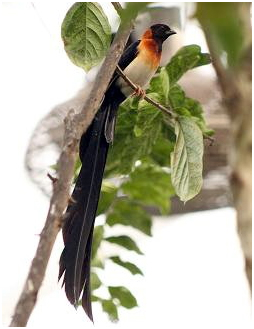
The Eastern Paradise Whydah is a small, widely occurring bird of eastern Africa. It gathers in flocks but separates into pairs during the mating season.Easten Paradise Whydah is a species specific brood parasite with its target being the Green-winged pytilia.

This bird is both dichromatic and dimorphic during the breeding season. When in “breeding mode”, the male has black plumage along its back and tail, with a yellow nape and chestnut colored lower breast and belly. It also grows new long- tail feathers. During the non-breeding season, it loses its striking black and yellow coloration, becoming brownish in color with black streaks on its head. The female has grayish, black-streaked upper-parts with a brown-colored head. Its breast is pale gray and its belly is white.

Eastern Paradise Whydah

The Eastern Paradise Whydah feeds on grass seeds such as millet and wild oats, but will occasionally take termites and grubs.

It inhabits dry thorn scrub and open or woodland savannahs throughout eastern Africa. Fairly common after heavy rains both as a resident and a wonderer , appearing usually near watering areas. Well distributed in the  area of  Samburu, Meru, Lokichokio, Turkana, Tsavo and Amboseli National park.

November 30, 2011: Northern Carmine Bee-eater

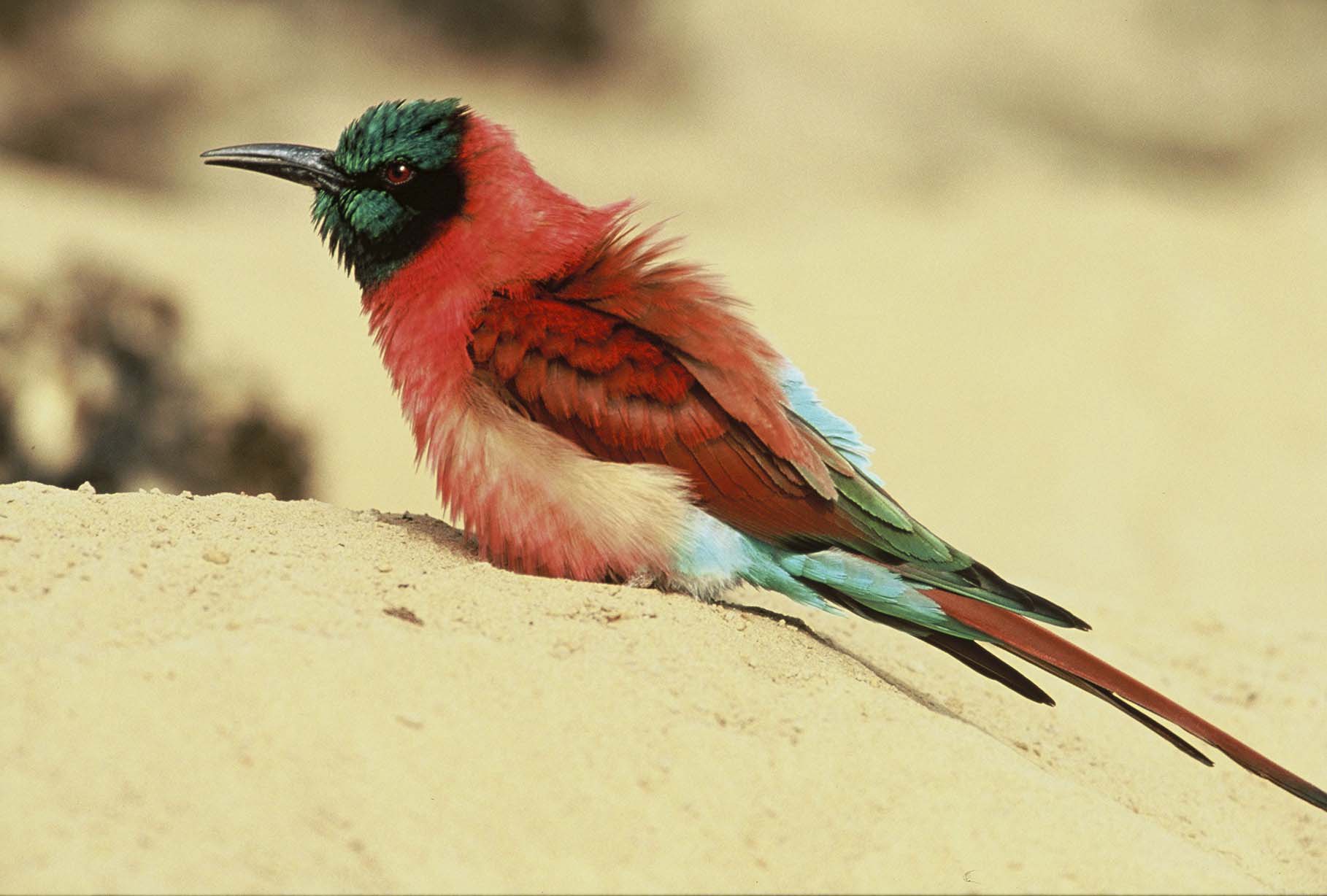
Nothern Carmine Bee-eater

November 30, 2012  bird is Northern Carmine Bee-eater  Merops nubicus                       (photo@ tony crocetta)

Carmine Bee-eaters are carmine in color, except for its greenish blue head and throat, and the bold black mask-like stripe across their eyes. Their eyes are red and they have a black pointed de-curved beak. Their central tail feathers are elongated. Their legs and feet are blackish brown. The sexes are similar in appearance. It is one of the largest species of Merops at 35cm  long. Young birds lack the elongated central tail feathers and are pinkish brown on the mantle, chest to belly, and flanks.

In Kenya they are passage migrant in the area and its distribution is found in the north western part of Kenya, extending  all the way to coast, in areas around Watamu, Tsavo east, Meru national park, Turkana, Nasolot, Kerio Valley and Lake Baringo.

Northern Carmine bee-eaters hunt mainly by keeping watch for flying insects from a perch. The insect is snapped up in the bill, then the bird returns to the perch, where it beats the prey against the perch until it is inactive. A stinging insect is held near the tip of its tail and rubbed on the perch to be relieved of the venom and sting before being swallowed whole. Besides branches, Carmine Bee-eaters use the backs of game or cattle and even large birds, such as Jacksons Bustard or Storks as animate perches, waiting to catch any insects that they disturb. Carmine Bee-eaters also fly freely to bush fires to prey upon fleeing insects.

For the last 10 years of my birding life, I have never came across any species of bee-eater which fails impress!!! Have a great birding week.

Joe

November 21, 2011: Flamingo

Flamingo
Phoenicopterus, the latin name for flamingo, means “Crimson wing”, the flamingo is said to be the inspiration for the crimson-winged phoenix, the ancient symbol of transformation and re-birth. Flamingoes are characteristic species of soda lakes in the Rift Valley in Kenya and Tanzania, especially Nakuru, Bogoria, Elementaita and Turkana. Their breeding ground is Lake Natron, in northern Tanzania.
Two species occur in Africa: Greater flamingo  Phoenicopterus ruber and Lesser flamingo Phoeniconaias minor. They are long legged wading birds adopted to a unique method of filter feeding. The two species avoid direct competition by feeding on different food items at different depths, with major diet being spirulina and diatoms.
Flamingo Lake Bogoria Kenya
A flamingo landing on Lake Bogoria, Kenya.Photo@Jurg Hosang

November 16, 2011: Slender-tailed nightjar

Slender-tailed nightjar is a common and widespread species in dry areas below 2000 metres above the sea level. Very similar to Gabon (Square-tailed) nightjar, but the tail is often paler and greyer, with central rectrices extending beyond the others.

It has a habit of flying low and alights on bare ground, rock or stump, often flying only on a short distance after being flashed. Commonly hawks insects around lights. It sings from the ground or from a low tree. Roosts on ground under scrub cover.

The Slender-tailed nightjar is common and widespread resident in dry bush and ranges throughout the coastal lowland, Rift Valley, Meru and Tsavo National Park.

Slender-tailed nightjar

November 6, 2011: Heuglin’s Courser

Hello birders and twitters,
The bird of the week this Sunday is:
Heuglin’s Courser (Rhinoptilus cinctus)
Tree-banded Courser, as it is also referred to, is secretive and seldom kind of a bird. It is widespread and sometimes common in bush-land and bush grassland in low rainfall areas but sometimes extending into miambo woodland where it normally breeds during the dry season when the grasses are burned to give room for the  growth of the fresh ones.
When breeding, the pair always establish their nest in a bare ground, where most nests are partially buried and partially exposed, with their colour matching the ground perfectly.
This fairly large, cryptically patterned bird has a broad mottled brown breast band bordered below by narrow black, white and chestnut bands; chestnut stripes, one from each side of the neck, converge in a point on the white breast, and the rest of the belly is white. Long pale superciliary stripes contrast with scaly brown crown and buffy-brown face patch.
Heuglins courser is largely nocturnal and roosts under bushes during the day. Two types occur: the nominate and emini. The nominate race is widespread and generally uncommon in semi-arid bush and scrub. While emini is found in Nyanza and  the Maasai Mara National game reserve.
Despite the fact I have seen several, I have never had enough of this beautiful bird.
Enjoy your week.
Heuglin's Courser
Heuglin's Courser