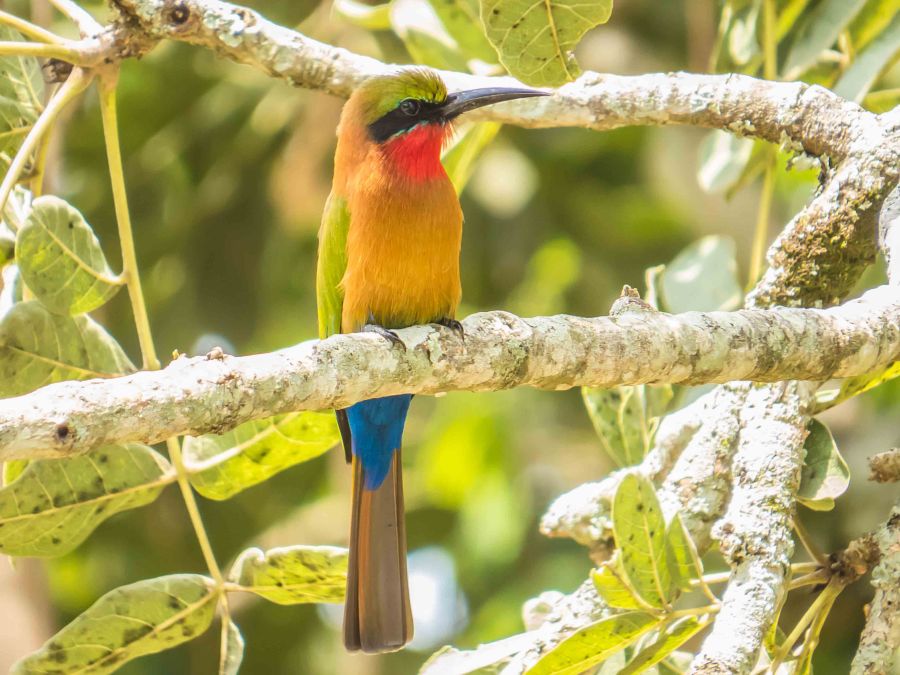
Red-throated Bee-eater (Merops bulocki)

SX50 39112 Red-throated Bee-eater

Red-throated Bee-eater is an incredibly beautiful Bee-eater to watch…in any birding trip to Uganda, with your best bet being in Murchison falls national park in northern Uganda. As soon as you approach the river Nile, their presence there cannot be ignored, where they are frequently seen going in and out of their nest holes.

The above photo was taken during my recent bird trip to Uganda, where we were visited Murchison Falls National Park, Budongo forest reserve where we extensively birded the famous Royal Miles Trail, we easily picked up our much sort after kingfishers( African Pygmy, Blue-breasted and and Chocolate-backed Kingfisher).

Kibale forest reserve, Bigodi swamp and  Samliki  were part of the other areas we visited. Kibale and Bigodi swamp were incredibly productive for us, but the same cannot be said of Samliki forest.  I think our timing was not the best as it had rain heavily the previous night, so we literally had to  walked on the flooded Kirumia trail. We dearly missed our gumboots which we had ignored to bring, next time we will be more clever. Keep birding.
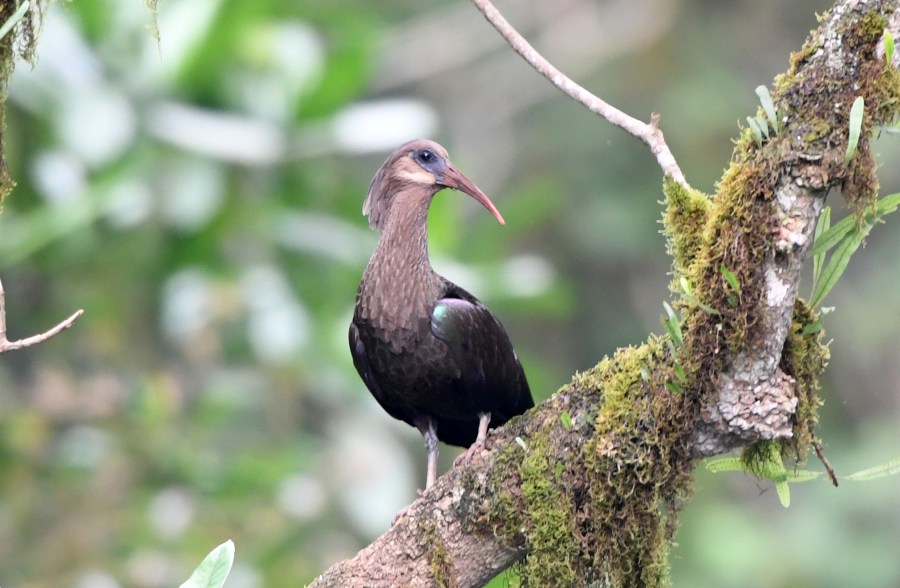
 

Olive Ibis (Bostrychia olivacea)

DSC_2253
Photo by Chin Tong Tan

African Green Ibis as it is mostly known is one of the most infrequent sighted among other species of Ibises we have in Kenya. Sacred, Hadada and Glossy Ibis are easy target to pocket. In Kenya, African Green Ibis is mostly restricted in Montane habitat of Mt.Kenya and Aberdare ranges. All my sighting of this species was in southern section of Mt.Kenya Forest Reserve mostly referred as Castle Forest, where Castle forest lodge is located.

They are mostly heard calling early in the morning and late in the afternoon where with luck you might be able to have some views of this incredible species. The bird photograph appearing above was taken at Castle Forest in June this year.

Abyssinian scimitarbill ( Rhinopomastus minor)

IMG_7347 - CopyAbyssinian Scimitarbill in our region occurs in two races , R.m. minor is found in north eastern part of Kenya, while the race R.m. cabanisi is found in southern Kenya. This species can easily be mistaken for Woodhoopoe, although woodhoope are gregarious while Scimitarbill is solitary in its movement behavior. Its bill is more curved down almost giving the Sunbirds bill impression, and on flight the bright red curved billed contrast with uniformly dark-blue plumage. They inhabit light woodlands, dry Acacia bush and thorn-scrub especially along dry river bed. Generally, it a widespread species.
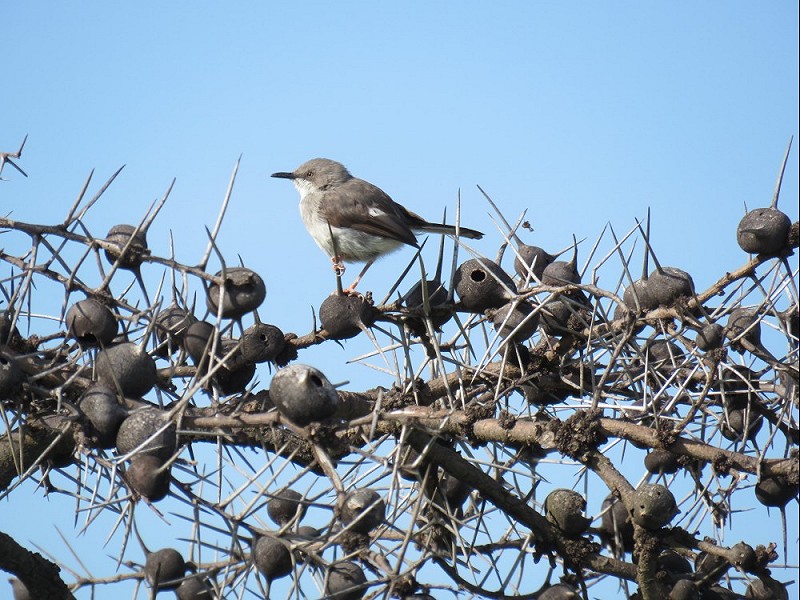
Karamoja Apalis (Apalis karamojae)

Karamoja Apalis

The Karamoja apalis is a globally threatened warbler, which is very poorly known. It was first discovered in 1919 in the Karamoja District of north east Uganda, hence its English name. This bird has greyish upperparts, whitish underparts and a black bill. The wings and tail are dark grey, and the tail has white outermost feathers. The inner secondary feathers of the wing are white, forming a narrow stripe. There are two subspecies or races; Apalis karamojae karamojae is found in Uganda, while Apalis karamojae stronachi is found in Northern Tanzania and Southern Kenya, mostly in the Vachellia drepanolobium habitat found in northern part of Masai Mara game reserve. This photo showing in this page was taken by Arjan Dwarshuis who is currently doing the Big year challenge at Naboisho conservancy .

Doherty’s Bush-shrike (Telophorus dohertyi)

C88Q2226_20160122_082002_57586
Photo@Juhani Vilpo
C88Q2532_20160122_083604_57603
Photo@Juhani Vilpo

Doherty’s Bsuh-shrike is a relatively small-billed bush-shrike. Male of crimson morph has forehead and forecrown, lower cheek, chin and throat bright crimson rump.This bird is very secretive and keeps to the small bushes of around 2300 above sea level especially in Mt.Kenya and Aberdare national park. They are very responsive to calls and quickly pops up to protects its territory from the “purported” intruder.This photo was taken in January this year in Mt.Kenya forest reserve.

Great Blue Turaco (Corythaeola cristata)

Jan Van Duinen
Jan Van Duinen

Great Blue Turaco is the largest species of the Turaco family. The adult has turquoise-blue upperparts, including wings and tail. The tail is long and wide, and shows a broad, black subterminal band. Most birds have narrow blue tips. The outer rectrices are partially edged yellow. The wings lack the crimson primaries of other turacos.On the underparts, neck and upper breast are turquoise-blue. Lower breast and belly are greenish-yellow, as the undertail feathers. The tail has black subterminal band. Lower belly, undertail-coverts and tibial feathers are chestnut.
On the turquoise-blue head, there is a conspicuous blue-black raised crest on forecrown and crown. Chin, throat, cheeks and outer eye-ring are greyish. The large convex bill is bright yellow with red tip. The eyes are reddish-brown, surrounded by bare dark turquoise-blue eye-ring. Legs and feet are blackish. Sexes are similar.
Great Blue Turaco have territories which are maintained throughout the year. Like many of the turacos, Great blues are rather shy and seldom descend to the ground except for drinking and bathing. They are quite agile when climbing throughout the branches. Seldom alone, they may be in pairs, family or social groups of up to seven individuals, with several groups often gathering at a single large fruit tree. These turacos are not good fliers, flying short distances and soaring to lower levels of the forest. Courtship involves calling, chasing, feeding each other, raising the crest and the long tail. They call early in the morning and late in the afternoon. They best seen only in Kakamega forest in western Kenya and all the forest in Uganda.

Black-and-white-casqued Hornbill (Bycanistes subcylindricus)

J.F.L Van Duinen

This species is commonly seen in Kenya especially around Tugen Hills, Kakamega Forest and Cherangani Hills. It is an easy species to identify and birders will have less difficulty spotting this species even in primary forest habitat as its flight betray his presence.These birds are mostly frugivorous, with the fruits of Ficus trees composing more than half of their diet. Overall, they are known to eat the fruits of over 41 plant genera, which they forage by hopping from branch to branch in the rainforest canopy and reaching for fruit with the tip of the bill, which they then swallow whole. They also consume birds, eggs, insects, bats, snails, lizards, molluscs, other small animal prey, mosses, lichens, and fungi. Sexual dimorphism is exhibited by these species, and male tend to be slightly bigger than their female counter parts.

Spotted thick-knee (Burhinus capensis)

Spotted Thick-knee is also referred to as Stone Curlew or Cape Thick-knee. Although it has isolated populations in the Arabian Peninsula, the bulk of its population is in sub-Saharan Africa. In Kenya it is common across much of the region, largely excluding , Mt.Kenya, Aberdare, Kakmega forest , Mt Elgon. It generally prefers open habitats, Baringo special 010Baringo special 015Baringo special 022especially savanna and grassland but also woodland fringes, low stony hills and urban habitats, such as parks, playing fields and parks. This bird is largely resident in our region
It mainly eats insects, doing most of its foraging in a plover-like manner, repeatedly running forward, stopping then jabbing prey with its bill. The following food items have been recorded in its diet; Beetles, crickets ,ear bugs, butterflies and termites and ants.
This species is monogamous, usually territorial solitary nester, although it occasionally forms loose colonies. It often rears two or even three broods in a single breeding season.The nest is a shallow scrape in the ground, sometimes unlined but usually with a lining of a few twigs, animal droppings, leaves or stone chips. It is usually located in grassland, either out in the open or partially concealed beneath a bush.

Papyrus Gonolek (Laniarius mufumbiri)

Photo@Moses Kandie
Photo@Moses Kandie

When we started our journey at the shore of Lake Victoria in such for the seldom Papyrus Gonolek with Titus who was our boat man, we didn’t expect to have such a luck!!we were all surprised after a few minute of calling back its call, the bird made an impressive show off for a cool 1 minute. This is how such a photo was taken. In Kenya, this bird is mostly seen in the extensive shores of Lake Victoria. For this one, we were at hippo point side. But you have an equal chances of seeing it in Sio port too.
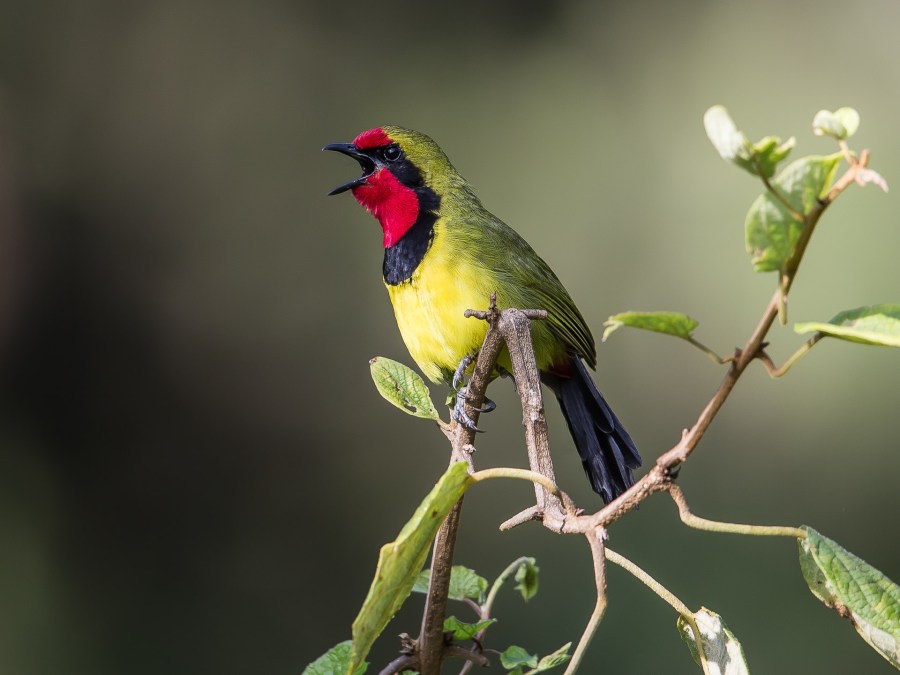
The Papyrus Gonolek is similar to the black headed Gonolek but with a bright-yellow cap complementing her crimson breast, and white bar on the black wing.The bird has specialized habitat requirements, being restricted to papyrus swamps.Papyrus Gonolek is not yet a threatened spicies but she has become rare due to habitat loss and pollution.

Striped kingfisher (Halcyon chelicuti)

photo@Joseph Aengwo
photo@Joseph Aengwo

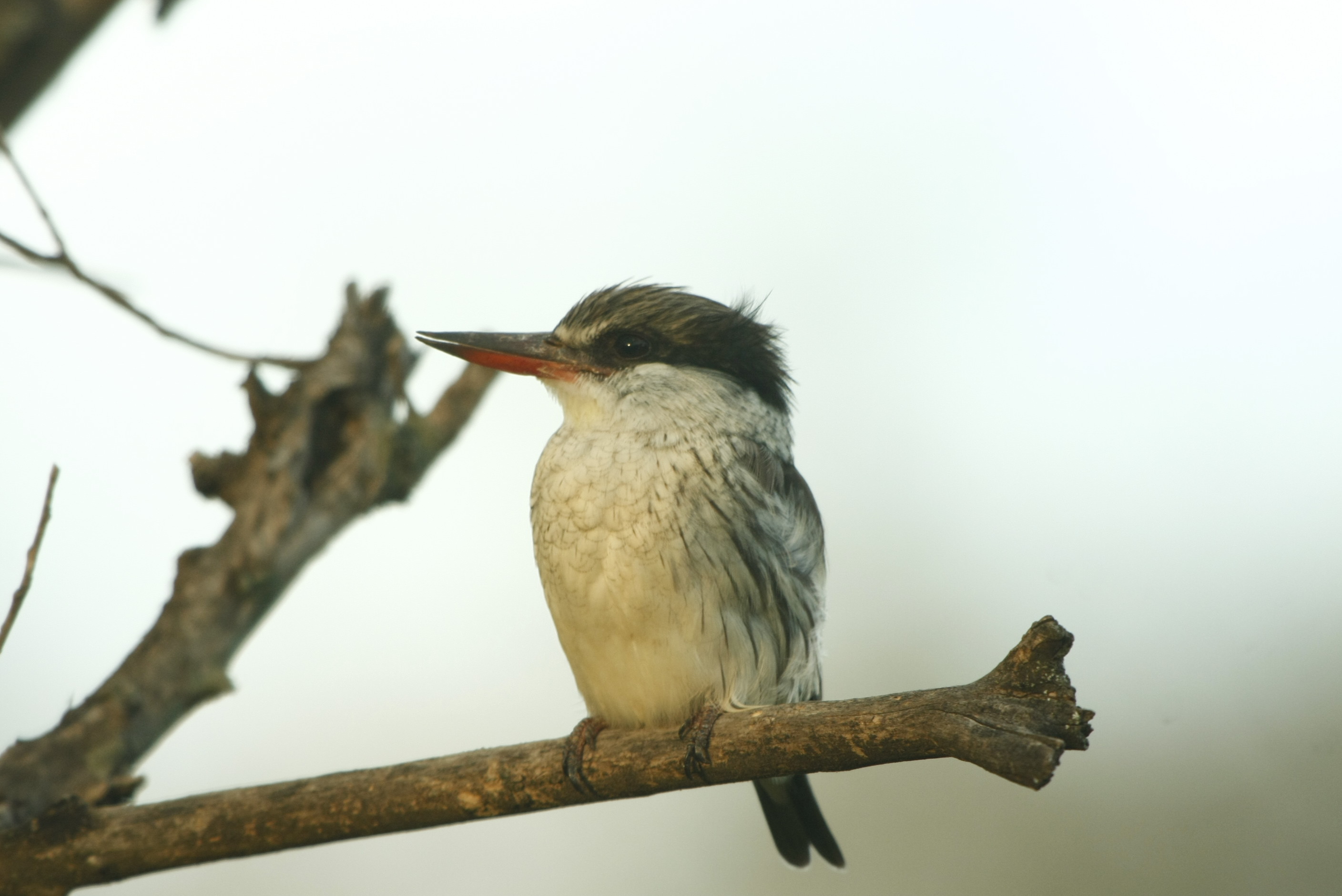
Striped Kingfisher is one of the most brilliantly coloured bird, even though it the smallest and least colourful of the non-aquatic Kingfishers. It has strident voice and dramatic courtship display. This species has some blue plumage on scapulars, brown head with streaky lining. The breast is white with some little strikes black upper and red lower mandible. This species is adapted to wooded habitat of dry country side.