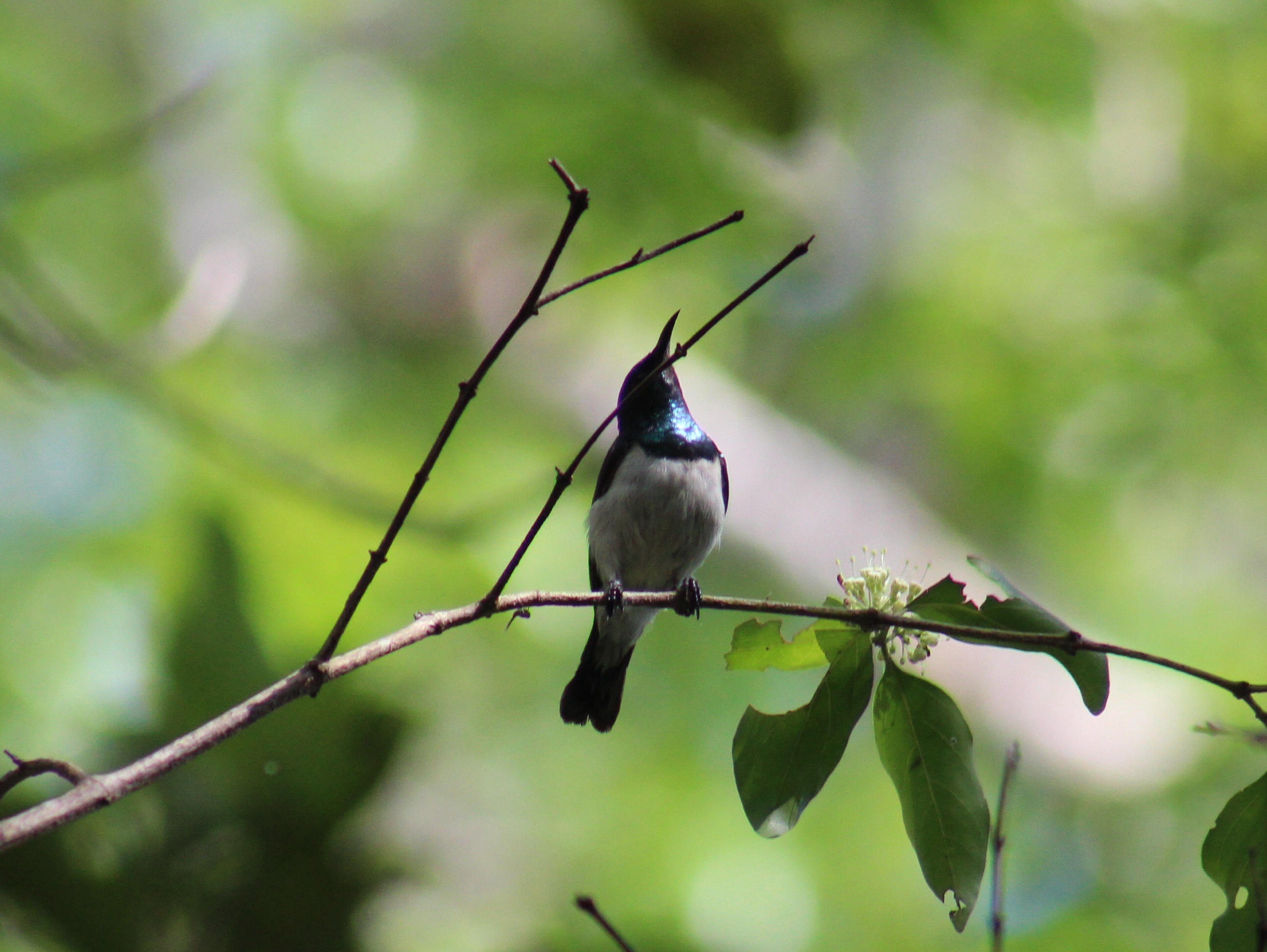
Amani sunbird (Anthreptes pallidigaster)

FullSizeRender
Photo@Moses Kandie


The Amani Sunbird is classified as Endangered (EN), considered to be facing a very high risk of extinction in the wild. This elusive bird if found in Coastal subtropical moist lowland forest especially in Arabuko Sokoke in north coast of Kenya and Eastern Usambara mountains in Tanzania.
Adult male has glossy blue-green head, throat and upper breast. Upperparts are iridescent dark purplish blue-green on upper back, scapulars and upperwing coverts. Lower back and rump are blackish. Short tail and uppertail coverts are glossy purplish-blue. Underparts are greyish-white, with orange-red feathers on upper flanks. Underwings are white. The black bill is down-curved. Eyes are dark brown
You have a high chance of watching this species which is confined to a few remnant Brachystegia woodlands. They prefer the high canopy trees and a lot of patience is advised before you enjoy a great view of this beautiful bird.

Squacco Heron (Ardeola ralloides)

Photo@Jurg Hosang

The squacco heron is a migrant, wintering in Kenya. This is a stocky species with a short neck, short thick bill and buff-brown back. In summer, adults have long neck feathers. Its appearance is transformed in flight, when it looks very white due to the colour of the wings. The squacco heron’s breeding plumage is recognized by sky blue bill as clearly seen in the photo above with a black tip. It prefers marshy wetlands as a breeding site. The birds nest in small colonies, often with other wading birds, usually on platforms of sticks in trees or shrubs. This species being a terrestrial bird, is mostly seen in lakes, river valleys, swamps and other permanent or temporary freshwater wetlands in Kenya Rift Valley, Lake Victoria rice fields, Central highland ponds and on both north east and south cost of Kenya.

Hemprich’s Hornbill (Tockus hemprichii)

J.F.L Van Duinen
J.F.L Van Duinen

Hemprich’s Hornbill is huge dark brown bird, with a massive dark red bill. The breast is dark, with a white-belly and the outer tailed rectrices is white. In Kenya, this bird is sparsely distributed in rocky hillsides and cliffs in arid and semi-arid country with records from Lake Nakuru around Menegai crater, Lake Baringo, West Lake Turkana, Ortum and Kongolei escarpment.

Ross’s Turaco (Musophaga rossae)

Photo@Jan F.L Van Duinen

Ross’s or Lady Ross as it sometime called is a medium-sized bird, with a long tail and broad, round wings. They have three toes on each foot that point forward, while the fourth toe can be rotated forward or backwards. Males and females differ in that females may have a greenish beak. This Beautiful Turaco is seen in mostly on the western side of Kenya Great Rift Valley mostly in areas around Tugen Hills and El geyo escarpment. Ross’s Turaco is a very social bird, seen mostly moving is a small noisy flock of 2 to 7 birds. They spent most of their time among trees in search for fruits until evening when they nest solitary on a plat form of twigs.It is an easy bird to Identify because nothing else in our region is like it.

Northern Red Bishop (Euplectes franciscanus)

Northern Red Bishop (Euplectes franciscanus)

photo@Tony Crocetta

Northern Red Bishop is an African finch that are best known for the males’ habit of weaving complex dome nests, as well as their entertaining displays to attract potential females. Bishop species in Kenya are widespread and are better viewed during breeding season when the males are in their bright red and black breeding plumage, which normally happen in Kenya around May to October, mostly after long rains. As he is building the nests, he also performs display flights and fluffs his feathers to attract females to his nests. Once he sees a preference for one or more of the nests, he will concentrate on those and abandon the others. The females will settle down in her chosen nest and personalize it by lining it with soft grasses, plant material and feathers.
The best birding site to watch this is specie in Lake Baringo, where the above photographed was taken. However, other species of Bishops can be seen in other wetland across Kenya including ; Amboseli National Park, Lake Victoria, Mwea rice plantation, Lake Jipe, and Sabaki Delta in Malindi.

African Darter (Anhinga rufa)

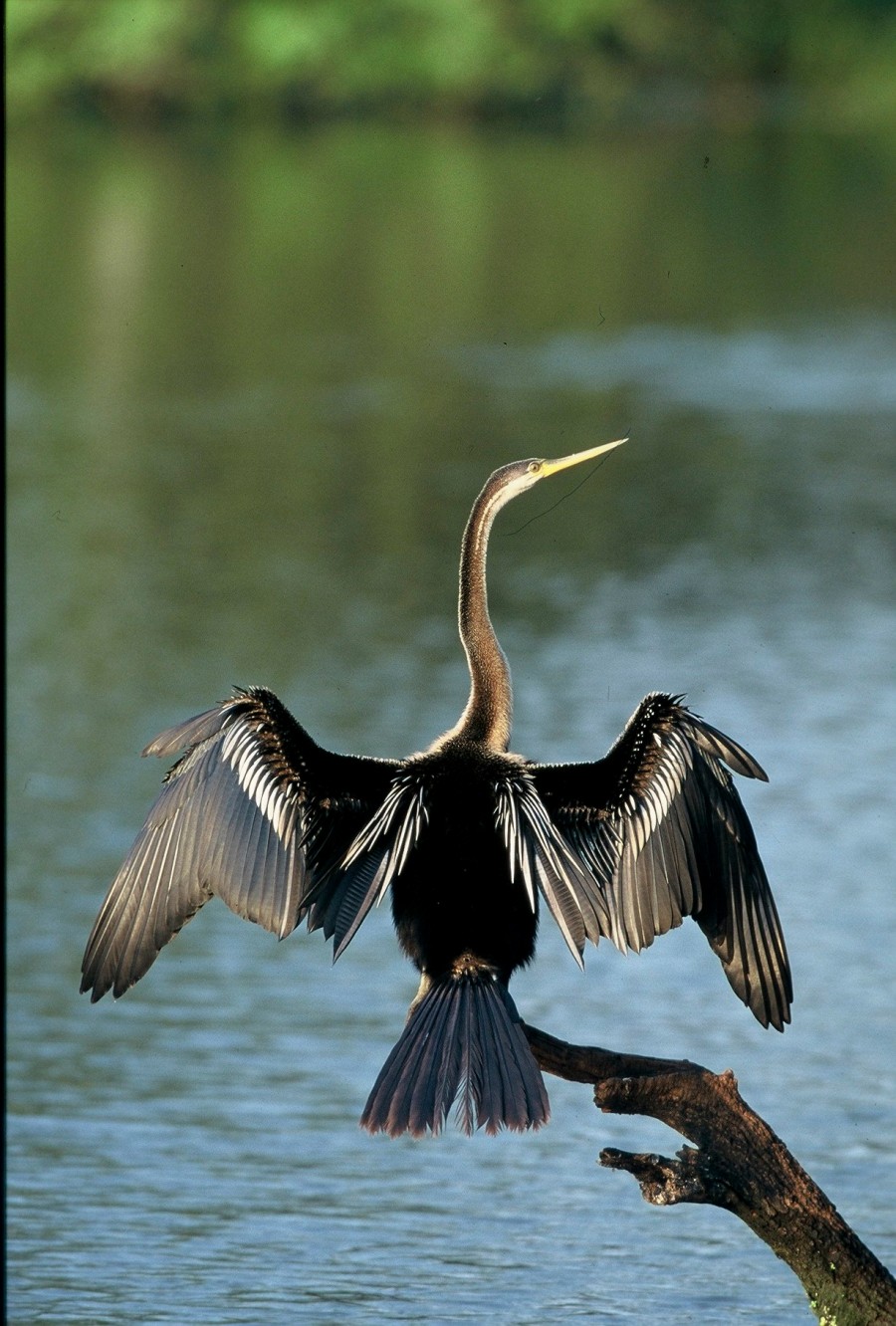
African Darter (Anhinga rufa)

Photo@Tony Crocetta

In Kenya, African Darter is the most commonly seen aquatic bird in Kenya wetland after Long-tailed Cormorant. It frequents fresh and brackish waters, fringed with vegetation, especially near fresh water lakes in Kenya Rift Valley lakes. This species is often seen perched on bare branches or stumps above the water. If alarmed, it drops vertically into the water. It needs to dry its plumage after fishing with wings outstretched.
African Darter dives for long periods, to search for aquatic preys. It swims with the body under water, allowing ambushing prey items. It propels itself with its webbed feet. It spears the fish in flank, and brings it to the surface, where it tosses it into the air, catches it with the bill and swallows it head first.
Anhinga Darter nests and roosts with other species, such as Egrets, Herons and Cormorants.
African Darter male has crown and back of the neck black and chestnut. Rest of the neck is chestnut, with conspicuous white stripe from the sides of the face to mid-neck. Its plumage is glossy black, streaked with white and silver on wings and mantle, and prominently on elongated black scapulars’ feathers. It has long black tail, held fanned when resting. Legs and webbed feet are brown. Female and immature are paler than male, mostly buffy-brown. Female has brown crown and upper neck. She has less distinct white stripe on the neck sides. Chicks are covered with white down. Darters are sometimes referred to as “snake bird”, because it swims very low, with only head and neck above the water.
In Kenya it is commonly seen in Lake Baringo.

White-bellied go-away-bird (Corythaixoides leucogaster)

White-bellied go-away-bird (Corythaixoides leucogaster)

Photo@Jurg Hosang

White-bellied Go-away Bird is one of the two dry land Turacos that we have in Kenya, the other is Bare-faced Go-away Bird.It South Africa they are referred to as Lorries . These birds are non-migratory. They are weak flyers and, therefore, only fly short distances in a dipping motion. They can climb trees and vines and run almost like squirrels over tree limbs. They are often seen single, pairs or small groups. The bird got its name because of its call that sound like “Go Away”. In Kenya this species is commonly found in arid and semi-arid areas and sometimes bushland grassland habitat. White-bellied and Bare-faced Go-Away bird don’t overlap in their distribution in our region.

Bronzy Sunbird (Nectarinia kilimensis)

Bronzy Sunbird (Nectarinia kilimensis)

Photo@Jurg Hosang

Bronzy Sunbird is the commonly seen sunbird in high altitude habitat.This species is sexually dimorphic. The adult male usually have brilliantly colored plumage of shinny green-yellowish breast and all over the entire head, while the belly and back being dark –black while the female has a yellowish belly contrasting with the dark-grey back and wings. The young are duller in coloration.
Sunbirds have long thin down-curved bills and brush tipped tubular tongues – both adaptations to their nectar feeding, although sometimes it take insects particularly during the breeding season to feed their young and to satisfy their own need for increased protein in their diet during this demanding time.
In Kenya, this sunbird is commonly recorded in Nairobi,Mt.Kenya region, Lake Nakuru and Naivasha, Eldoret and Mt.Elgon.

Greater Sand Plover (Charadrius leschenaultii)

Greater Sand Plover (Charadrius leschenaultii

Photo@Joe.Aengwo

Although it has a relatively dull appearance for most of the year, the Greater Sand Plover’s plumage changes during the breeding season. At this time, the crown changes from greyish-brown to a dull brick red, as does the white breast, and the small feathers that cover the ear region change colour from a dusky grey to black. The chin and throat remain white throughout the year, while the nape and forehead are a greyish-brown colour all year round.
The greater sand plover is a carnivorous species that varies its diet seasonally; during the breeding season it feeds mainly on terrestrial insects and their larvae, especially preying on midges, ants, beetles and termites, but also occasionally hunting larger animals such as lizards. During the non-breeding season, the greater sand plover mainly eats marine invertebrates, such as snails, worms, crabs and shrimp. Usually feeding at low tide on wet ground, just away from the water’s edge, the greater sand plover detects and catches prey with the help of good eyesight and the ability to sprint over short distances. A sociable species, the greater sand plover often feeds and roosts in flocks. It typically feeds in flocks of between two and fifty individuals but sometimes congregates in groups as large as one thousand whilst roosting, which is mainly done on sand bars at high tide.
The bird above was photographed at Mida-Creek, when the tide was low and the bird was in mixture of species like Crab Plover, Lesser Sand Plover, Eurasian Curlew, Whimbrel and White-fronted Plover. All my records on this species were in Mida-creek, Watamu.

African Pygmy Kingfisher (Ispidina picta)

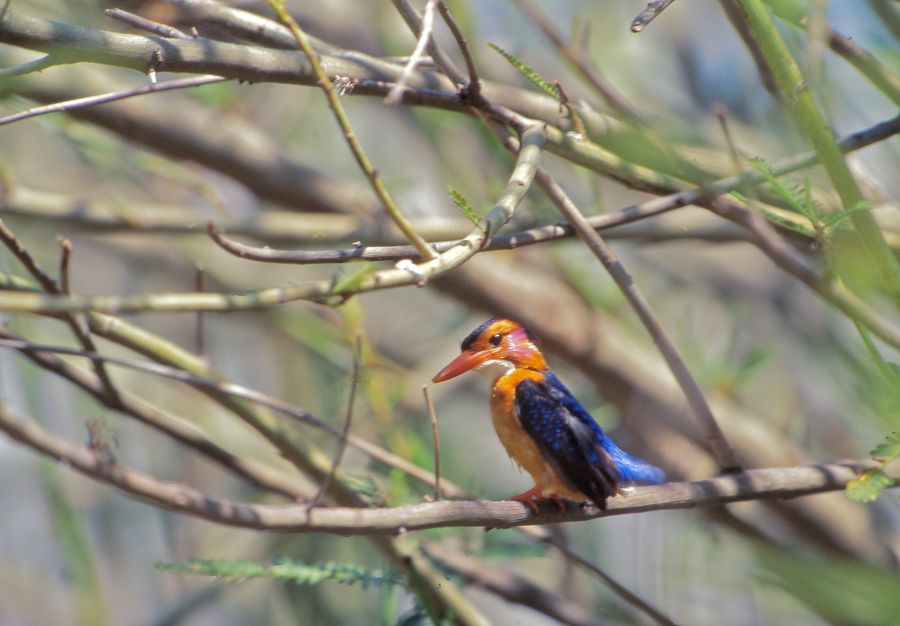
African Pygmy Kingfisher (Ispidina picta)

Photo@Yan Van Duine

African Pygmy Kingfisher is a small insectivorous kingfisher found mostly in woodland habitats and not necessarily restricted to wetland.In Kenya, its range widespread in bushland of Lake Baringo, Kerio Vallye,Samburu,Meru and Nakuru National and southern parks of Amboseli, Tsavo East and West. Its habitat range from woodland habitats, savannas and riverine forests, but also scrublands, grasslands, open rivers and streams, coastal bushes, plantations and gardens.The dark blue crown of the adult separates it from the African Dwarf Kingfisher. The smaller size and violet wash on the ear coverts distinguish it from the similar Malachite Kingfisher.