


The magpie starling is a northeast African endemic and an occasional non-breeding visitor to northeastern Tanzania. The male is black and white; the female, brown and white both with bright red eye which aid identification a great deal. The best place to see them in Kenya is Lake Baringo where is frequently spotted feeding in big fig trees along the cliffs.
Category: Uncategorized

Bare-eyed Thrush has Brownish-grey above; blackish speckles on throat, pale grey breast and rufous belly. The orange-yellow patch of bare skin around the eye is diagnostic. It is widely spread in Arid lowlands, agricultural fields, dry savanna and dry shrubland of Eastern Kenya and monotypic. His behavior is Fairly inconspicuous, although locally common. The diet includes fruit.
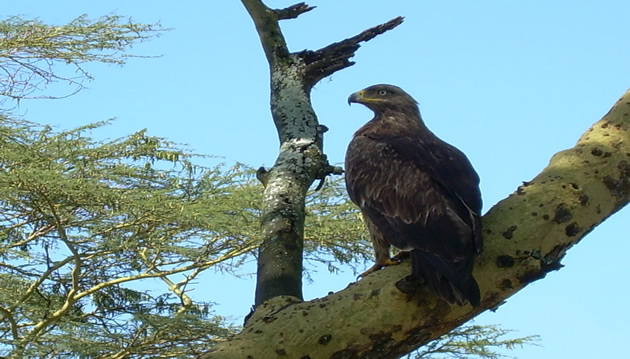
A relatively large, handsome bird of prey, the steppe eagle closely resembles a number of related eagle species such as the tawny eagle, Aquila rapax, that occur within its extensive range . The plumage is mostly dark brown, with well-defined bars on the flight and tail feathers . The main distinguishing features are the reddish-brown patch on the nape of the neck, the oval nostrils, and the long, wide gape. There are two recognised subspecies of steppe eagle, Aquila nipalensis nipalensis and Aquila nipalensis orientalis, the latter being slightly smaller, with paler plumage. The juvenile steppe eagle resembles the adult but is paler brown, with a characteristic broad white band running along the underside of the wing.
Steppe Eagle exclusively breed in Eastern Europe and migrate annually to Africa
Check out my new trip report! It can be found under ‘Birding Trip Reports’
Joe


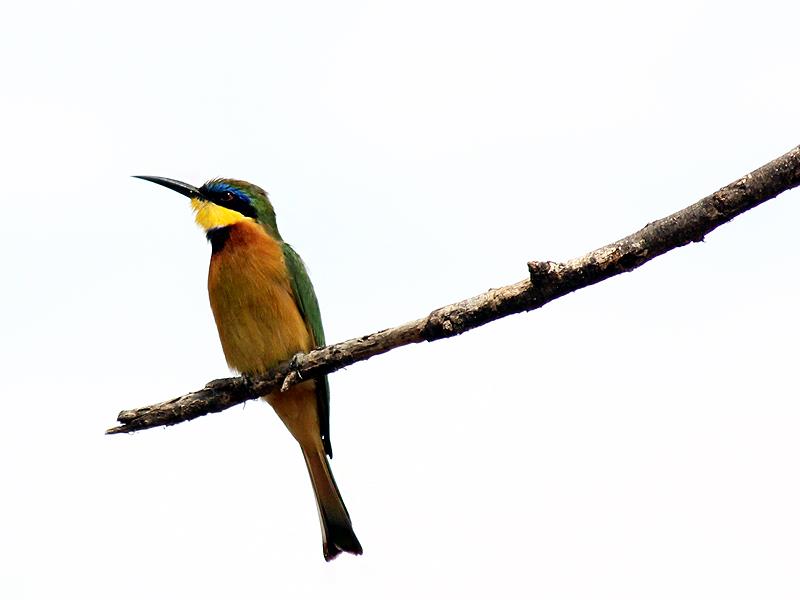
Somali Bee-eater is a small bee-eater, about seventeen centimetres long. It prefers arid country and desert areas where it may be locally common. It feeds on small flying insects which it catches in short dashes from a low perch. It is either solitary or found in pairs. It nests in the banks of road cuttings and in the sides of deep wells. In Kenya it breeds between March and June.
In Kenya it is found in areas like Samburu and Meru National Park, Lake Baringo and Tsavo East.


Photo@Yan Van Dainne
Goliath Heron
The Goliath heron is Africa largest heron, standing 53-to-55 inches tall, with a wingspan of six-to-seven feet. Male and female look similar, with an overall covering of slate gray and chestnut feathers. The head and its bushy crest, face, back and sides of the neck are chestnut. The chin, throat, foreneck and upper breast are white, with black streaks across the foreneck and upper breast. The lower breast and belly are buff with black streaks. The upper mandible is black and the lores and orbital areas are yellow with a greenish tinge. The eyes are yellow and legs and feet are black. Juveniles look similar to the adults, but are paler.
The Goliath heron is territorial, usually living alone near water. A diurnal and often rather inactive feeder, the heron hunts by standing in the shallows, or on floating vegetation, intently watching the water at its feet. As prey appears, the heron rapidly spears it with open mandibles.
Goliath heron nests are found in trees overhanging water, on the ground and in low bushes. Both sexes build the stick and reed platform nest, which measures three-to-four feet across. Both parents incubate two-to-four pale blue eggs for 29 days. The chicks are covered with long white down.
 Kenya Birding