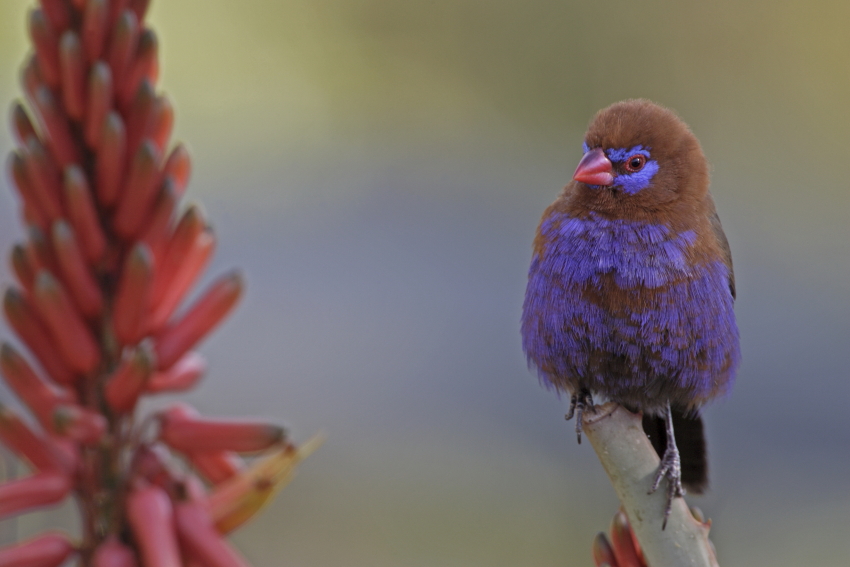
Purple Grenadier (Uraeginthus ianthinogaster)

Purple Grenadier (Uraeginthus ianthinogaster)

Photo@Tony Crocetta

Dark chestnut brown bird with red beak, black tail, and deep purplish blue rump. Male has purplish-blue feathers around the eyes, and purplish-blue breast, belly, and flanks. Female has less extensive (sometimes absent) blue feathering on the face, and often has white feathers around the eyes; female’s breast and belly is spotted or barred white. Juveniles appear similar to the female but paler, duller, and without white markings. The juvenile tends to be paler. Juveniles have blackish bills and their legs are paler than the adults’. Juveniles go through an early partial molt of the face feathers where males obtain their blue feathering and females their pale mauve feathering around the eyes.
This is a dimorphic species; the male sports blue on his face, breast, and belly. The female has less extensive blue on the face and sports white around the eyes as well as on the breast and belly. Usually form pairs and small parties. Courtship usually takes place on the ground with the male holding a stem or feather in his bill, singing and bowing his head as he bobs up and down, hoping to attract a female. An interested female may fly to the male, twist her head and tail toward him and possibly also show a display. Both male and female share nest construction, often building their round nest low in a bush or shrub. The male may continually line the nest with feathers during incubation, which both parents take turns doing through the day, with the hen incubating at night.
This species is widely distributed in Kenya and it should not be difficult to spot and identify this bird.

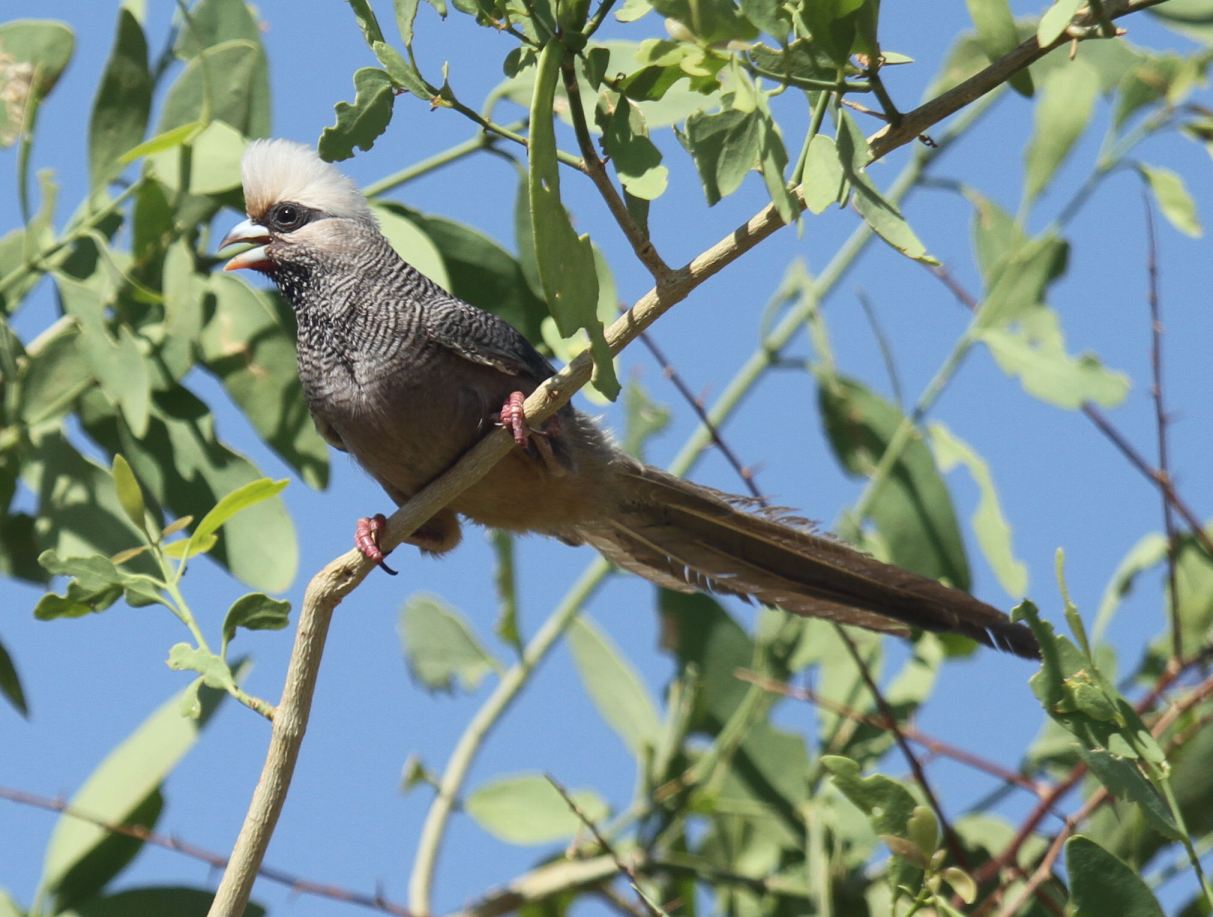
white-headed Mousebird (Colius leucocephalus)

Photo@Jacqui Harrington

Mousebirds, sometimes called colies, are an ancient group of small arboreal birds in Africa. They are so unique in morphological peculiarities that they were proposed as a separate Order of birds as long ago as 1872, and this placement has been confirmed by molecular evidence (Sibley & Ahlquist 1990, Hackett et al. 2008). They are the only Order restricted to sub-Saharan Africa.

In Kenya three species occurs,  White-headed, Blue-naped and Speckled Mousebird.There are only two genera among the mousebirds, and four of the six species are placed in Colius, including White-headed Mouse Bird  of east Africa (left). White-headed Mousebird, like most of this genus, is a bird of arid thornscrub. Its range is limited to a band of such thornscrub from s. Somalia to n.e. Tanzania. The most widespread species, Speckled Mousebird C. striatus, occurs more broadly in a variety of woodlands.

The three  species of Colius mousebirds are essentially allopatric in distribution, without any significant overlap, and where there is a little range overlap, they separate out by habitat.In Kenya it is found  in Samburu, Meru, Tsavo west and Tsavo East National Park.

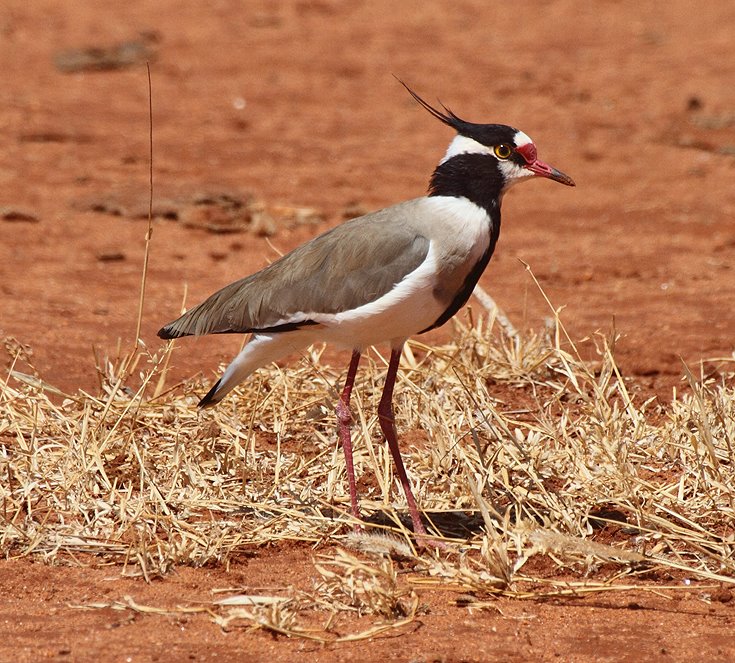
Black-headed Lapwing (Vanellus tectus)

Photo@Michael Sammut

The Black-headed Plover or Black-headed Lapwing (Vanellus tectus) is a species of wading bird of the family Charadriidae. It is found across sub-Saharan Africa.In Kenya specifically, it is found in areas like Tsavo West and East,Lake Baringo, Lake Bogoria,Samburu and Meru National Park. Although not migratory, there is some seasonal movement. Its habitat is wet lowlands close to water. It often feeds in drier habitats, such grassy scrubland.

This bird is readily noticeable and unmistakable. It is medium-large with a mainly black head and white forehead. The lower face and bands across the rear head and nape are also white. The crest is a weak black. The bill and legs are red. The tail is white and tipped black. In flight, the upperwings have black flight feathers and brown coverts separated by a white bar. The underwings are white with black flight feathers.

The diet of the Black-headed Plover consists of insects and other invertebrates that is picked from the ground. The call is a metallic tink-tink.