
The Saddle-billed Stork is a majestic and resilient species, whose stunning appearance and specialized behaviors make it one of the most remarkable birds of sub-Saharan Africa.

Photo by Joe Aengwo

The Saddle-billed Stork is one of the largest storks in the world, standing up to 1.5 meters (5 feet) tall. It is easily recognizable due to its unique black and white plumage, bright red legs, and the large, bicolored bill, which has a black base and a yellow section resembling a saddle. The bill’s distinctive shape helps the bird forage for fish and amphibians, which make up a large part of its diet. This bird also exhibits sexual dimorphism, with males typically being slightly larger than females.

They prefer shallow, slow-moving waters where they can wade and forage for food. The stork is usually solitary or found in small groups, although some may form pairs during the breeding season. They often choose to nest in tall trees near water, constructing large, conspicuous nests that are used year after year.
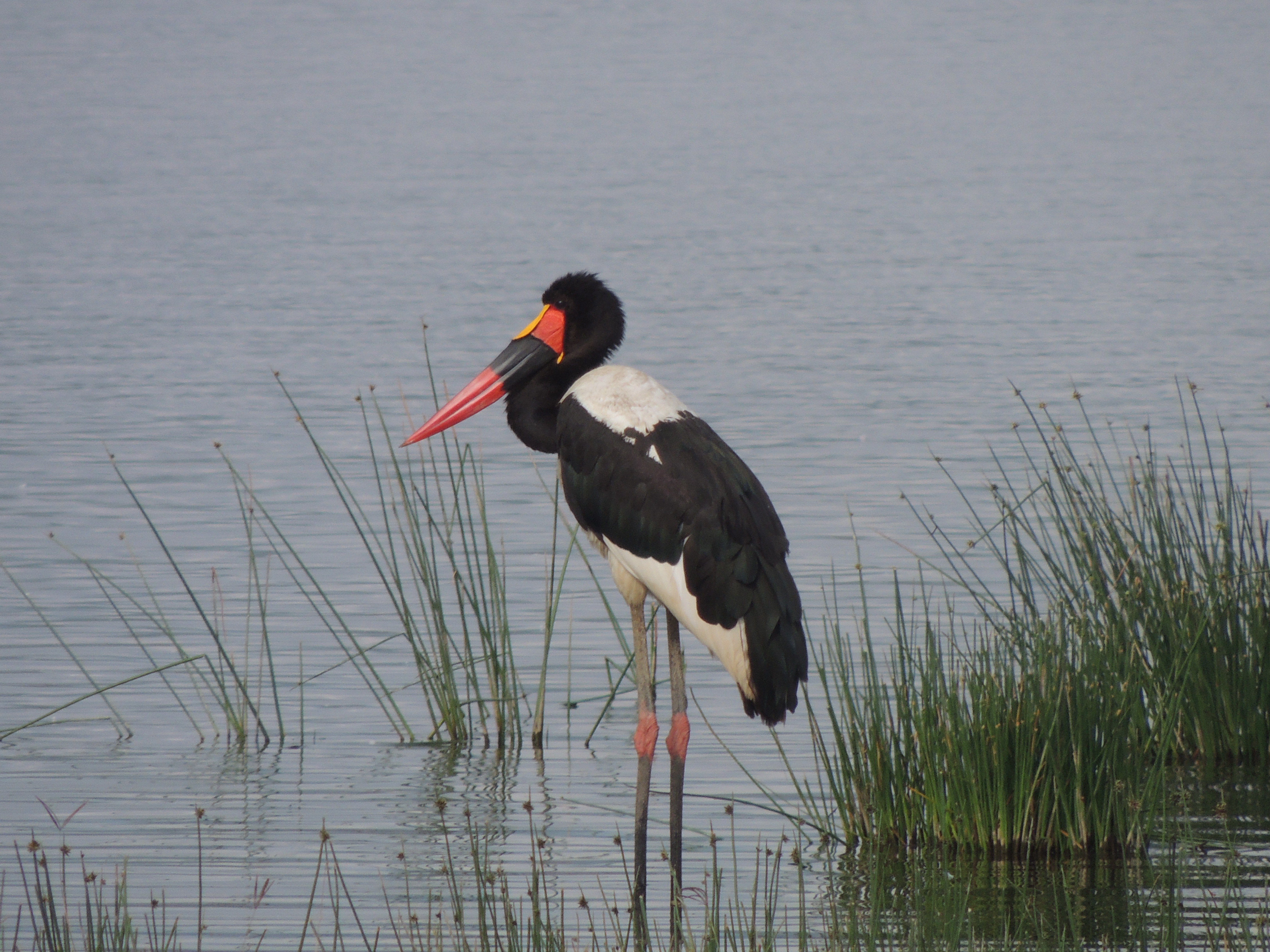
Saddle-billed Storks form monogamous pairs during the breeding season, which typically occurs during the rainy season, when food is abundant. They build large nests in tall trees, and both parents share the responsibility of incubating their eggs. The female typically lays one or two eggs, and both parents take turns keeping them warm for about a month. Upon hatching, the chicks are fed a diet of regurgitated food from both parents until they are able to forage on their own.Though they are not yet considered endangered, the Saddle-billed Stork faces threats from habitat destruction, particularly the draining of wetlands for agriculture and development.

They also face threats from hunting in some areas and the disturbance of their nesting sites.By continuing to protect its wetland habitats, we can help ensure that future generations will be able to admire this iconic and important bird species.Keep birding!.

African Pygmy Kingfisher (Ispidina picta)

African Pygmy Kingfisher (Ispidina picta)

Photo@Yan Van Duine

African Pygmy Kingfisher is a small insectivorous kingfisher found mostly in woodland habitats and not necessarily restricted to wetland.In Kenya, its range widespread in bushland of Lake Baringo, Kerio Vallye,Samburu,Meru and Nakuru National and southern parks of Amboseli, Tsavo East and West. Its habitat range from woodland habitats, savannas and riverine forests, but also scrublands, grasslands, open rivers and streams, coastal bushes, plantations and gardens.The dark blue crown of the adult separates it from the African Dwarf Kingfisher. The smaller size and violet wash on the ear coverts distinguish it from the similar Malachite Kingfisher.

Madagascar Pond Heron (Ardeola idae)

Madagascar Pond Heron (Ardeola idae)

Photo@Raymond Galea

The Malagasy Pond Heron is a buff brown streaked small heron, and when breeding is snow white with a blue bill and red legs.In nonbreeding plumage the crown and back of head are buff, broadly streaked black. The bill is green grey with a black tip. The irises are yellow and the lores are green. The sides of the head and throat are yellow buff streaked narrowly with blackish-brown. The upper and lower back is brown with white or buff streaks. The rump and tail are white. Upper wings are brown with white or buff streaks. The flight feathers, in contrast, are white and are conspicuous in flight. Underparts are heavily streaked black and buff brown, contrasting with the lower belly and under tail coverts. The legs are green yellow or green grey.

In the breeding season the Malagasy Pond Heron becomes entirely snow white. The crown has a dense crest. Dense plumes also occur on the back of the neck, back, fore neck and breast. These give the bird a characteristic fluffy appearance. The bill is a deep azure blue with a black tip. The irises are yellow and the lores are green with some red on the orbital skin. The legs are rose pink, with green toes. The intermediate plumage is a mixture of new brown feathers, starting on the back.
In Kenya, this species can be seen in May-October in birding spot like Lake Baringo, Musiara Swamp, Masai Mara National Reserve, Lake Naivasha , Limuru Oxygenated pond and the seasonal Lake Amboseli and the swamp found in mid-centre of the park.