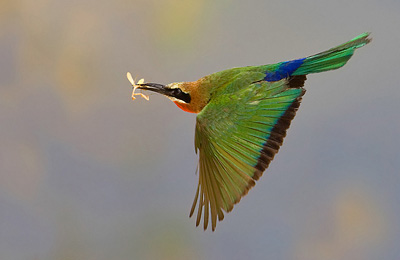
White-fronted Bee-eater is such a colourful bird.It is one of that species you will spend time appreciating its beauty. The upperparts mainly green;black mask offset by whitish forehead, white chin and cheecks. The rump is deep blue with a cinnamon buff breast and belly. An easily seen and identified bird mostly confined in areas around northern part of Lake Nakuru National where it normally nest on the cliff burrows. Other than Lake Nakuru, they are also found in Hell’s Gate Park and sometime is Lake Baringo and Kerio Valley.
Mousebirds, sometimes called colies, are an ancient group of small arboreal birds in Africa. They are so unique in morphological peculiarities that they were proposed as a separate Order of birds as long ago as 1872, and this placement has been confirmed by molecular evidence (Sibley & Ahlquist 1990, Hackett et al. 2008). They are the only Order restricted to sub-Saharan Africa.
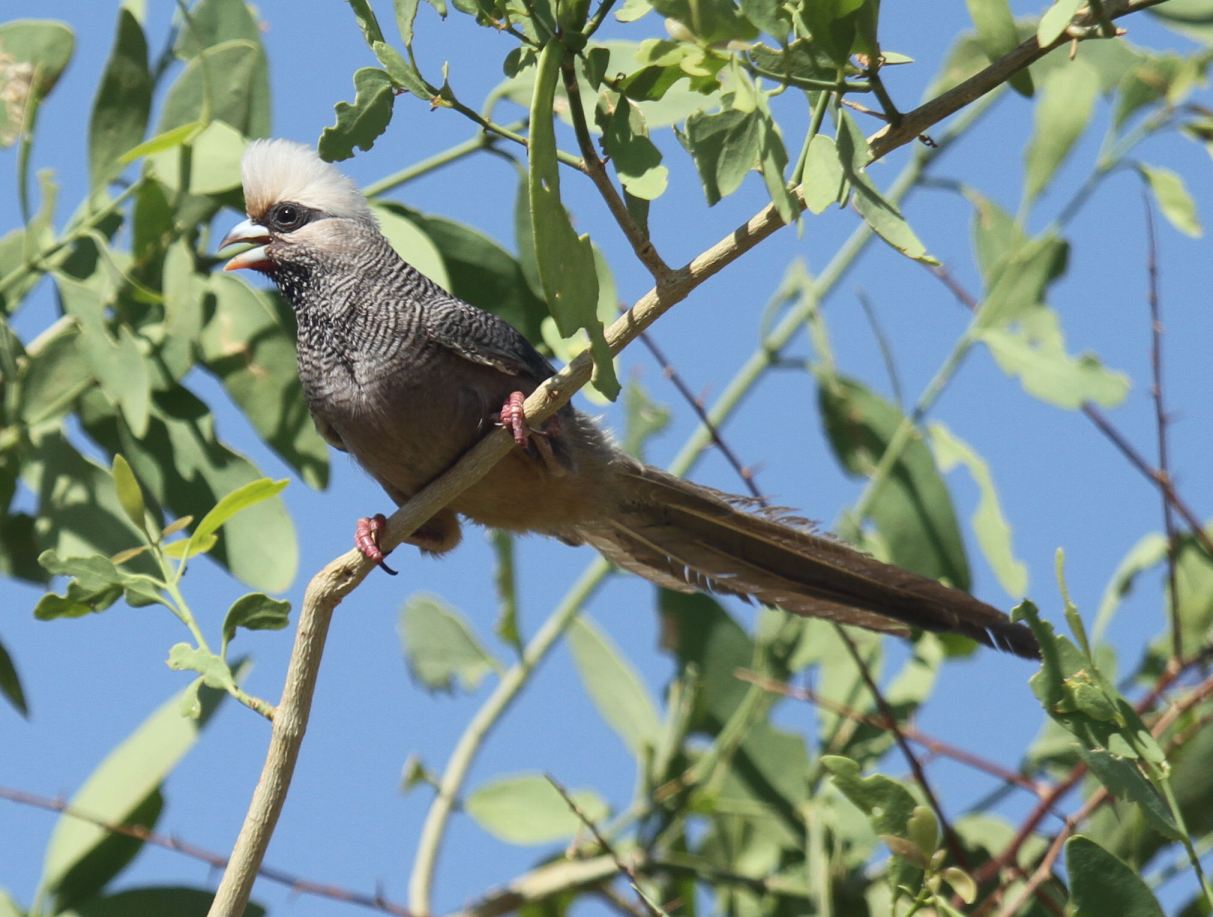
In Kenya three species occurs, White-headed, Blue-naped and Speckled Mousebird.There are only two genera among the mousebirds, and four of the six species are placed in Colius, including White-headed Mouse Bird of east Africa (left). White-headed Mousebird, like most of this genus, is a bird of arid thornscrub. Its range is limited to a band of such thornscrub from s. Somalia to n.e. Tanzania. The most widespread species, Speckled Mousebird C. striatus, occurs more broadly in a variety of woodlands.
The three species of Colius mousebirds are essentially allopatric in distribution, without any significant overlap, and where there is a little range overlap, they separate out by habitat.In Kenya it is found in Samburu, Meru, Tsavo west and Tsavo East National Park.
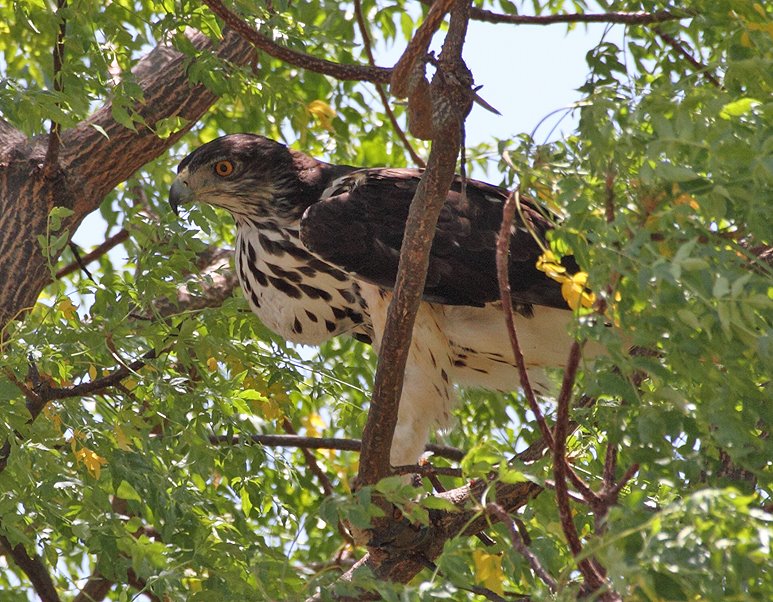
African Hawk Eagle (Aquila spilogaster) are large birds of Prey that occur naturally in Kenya, where they inhabit wooded hills.In Kenya they mostly seen in birding hot spot like Masai Mara,Tsavo West and East,Nairobi National Park,Hell’s Gate, and Lake Nakuru National Park.
African Hawk Eagles are large eagles that measure about 55 – 65cm in length.The plumage above is blackish. Below they are mostly white, heavily streaked with black. Theunderwing feathers are white with a black trailing edge. The wings below are blackish with white spots.Males and females look alike, but young birds are brown above and rufous colored below.
Their large platform nests are built out of sticks and are about 3 meters in diameter.They are typically placed in the forks of large trees.The average clutch consists of one or two eggs.
The Hottentot Teal is a species of dabbling duck of the genus Anas. It is migratory resident in eastern Africa.The Hottentot teal is known for its black-capped head and distinctive blue bill. The duck’s body is speckled brown and black, with black wings.
Monogamous, territorial solitary nester. Interestingly, the pair bond barely lasts beyond incubation, with the male having almost no role in incubation and care of chicks.The female builds the nest, which is a deep bowl in the ground, filled with grass and leaves, often lined with down. It is usually placed in emergent vegetation near water.Laying dates vary with different regions, but usually in February-May.It lays 5-12 eggs, in successive days.Incubation is done solely by the female, for 25-27 days. She will sometimes leave the nest, to join the male in feeding and preening.The chicks are kept hidden in thick reedbeds, which makes them difficult to see. They fledge when they are about 60-65 days old.
Widespread all over Kenya in Swamps like Manguo, Lake Nakuru, Lake Baringo,Lake Bogoria and Lake Naivasha.
Vulturine Guineafowl is Large, unmistakable guineafowl; the bare skin of the head and neck is bluish-gray with a band of short chestnut feathers that extends behind the eyes on the back of the head; long, white striped plumes extend from the breast and back; the upper back and breast is brilliant blue, with a black patch on the center of the chest; wings and rear half of body spotted with a long, drooping tail. Females are similar to the males, but slightly smaller and have smaller tarsal spurs. Chicks much like other guineafowl, but develop light blue underparts in a few weeks.Common in dry savanna and scrub land of northeastern Kenya.This photo was taken in Samburu National Reserve.




 Kenya Birding