Hottentot Teal (Anas hottentota)

c@kelemen marton

The Hottentot Teal is a species of dabbling duck of the genus Anas. It is migratory resident in eastern Africa.The Hottentot teal is known for its black-capped head and distinctive blue bill. The duck’s body is speckled brown and black, with black wings.

Monogamous, territorial solitary nester. Interestingly, the pair bond barely lasts beyond incubation, with the male having almost no role in incubation and care of chicks.The female builds the nest, which is a deep bowl in the ground, filled with grass and leaves, often lined with down. It is usually placed in emergent vegetation near water.Laying dates vary with different regions, but usually in February-May.It lays 5-12 eggs, in successive days.Incubation is done solely by the female, for 25-27 days. She will sometimes leave the nest, to join the male in feeding and preening.The chicks are kept hidden in thick reedbeds, which makes them difficult to see. They fledge when they are about 60-65 days old.

Widespread all over Kenya in Swamps like Manguo, Lake Nakuru, Lake Baringo,Lake Bogoria and Lake Naivasha.

Vulturine Guineafowl ((Acryllium vulturinum))

c@Joseph Aengwo

 Vulturine Guineafowl is Large, unmistakable guineafowl; the bare skin of the head and neck is bluish-gray with a band of short chestnut feathers that extends behind the eyes on the back of the head; long, white striped plumes extend from the breast and back; the upper back and breast is brilliant blue, with a black patch on the center of the chest; wings and rear half of body spotted with a long, drooping tail. Females are similar to the males, but slightly smaller and have smaller tarsal spurs. Chicks much like other guineafowl, but develop light blue underparts in a few weeks.Common in dry savanna and scrub land of northeastern Kenya.This photo was taken in Samburu National Reserve.

Magpie Starling (Speculipastor bicolor)


The magpie starling is a northeast African endemic and an occasional non-breeding visitor to northeastern Tanzania. The male is black and white; the female, brown and white both with bright red eye which aid identification a great deal. The best place to see them in Kenya is Lake Baringo where is frequently spotted feeding in big fig trees along the cliffs.

Jacson’s Hornbill (Tockus jacksoni)

Image

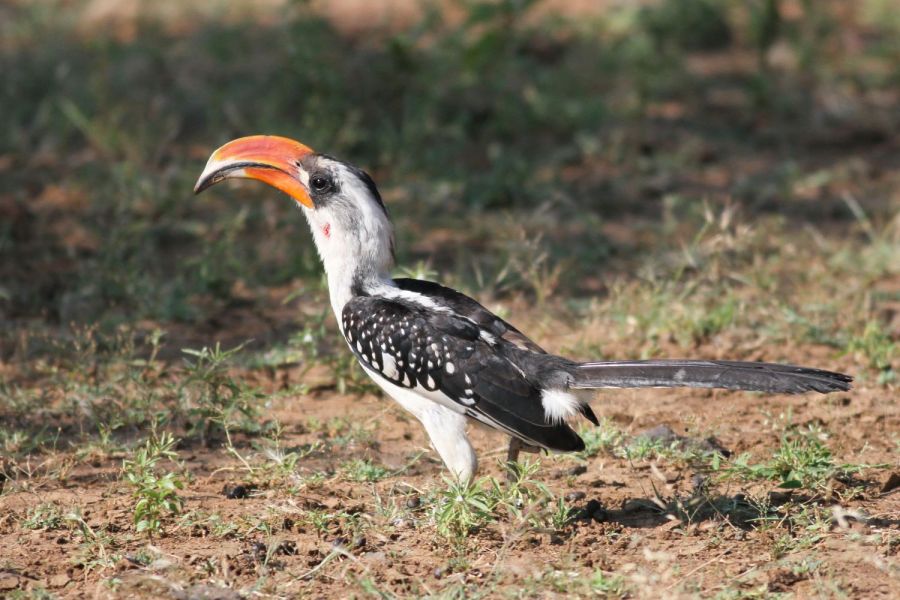
Similar to other hornbills, Jackson’s hornbills have a unique and nearly predator proof way of raising their offspring. Before she lays her eggs, the female is sealed in a tree cavity by her mate. During this time, he passes her food through a narrow slit.The species is an example of sexual dimorphism, meaning there is a difference in form between males and females of the same species. The male Jackson’s hornbill has a red billed with a yellow tip (see above) and the female has a black bill.

In Kenya they are found in Lake Baringo, Lake Bogoria, Kapedo and the the  upper part of the Rift Vally mostly in Turkana area.

Pel’s Fishing-Owl (Scotopelia peli)

Pel's Fishing-Owl (Scotopelia peli)

Photo@Yan Van Dainne

Fish owls differ from other owls in that they have no feathers on their feet. Additionally, they lack the noiseless flight typical of owls, perhaps because their submerged prey is less able to hear their approach.  Three species of fish owl occurs in Africa . Pel’s Fishing Owl snatch their prey while skimming the water surface. In Kenya it is found in Maasai Mara and Samburu national reserve along the the Mara rive and Ewaso Ngiro rivers.

Martial Eagle (Polemaetus bellicosus)

Martial Eagle (Polemaetus bellicosus)

Photo@Yan Van Dainne

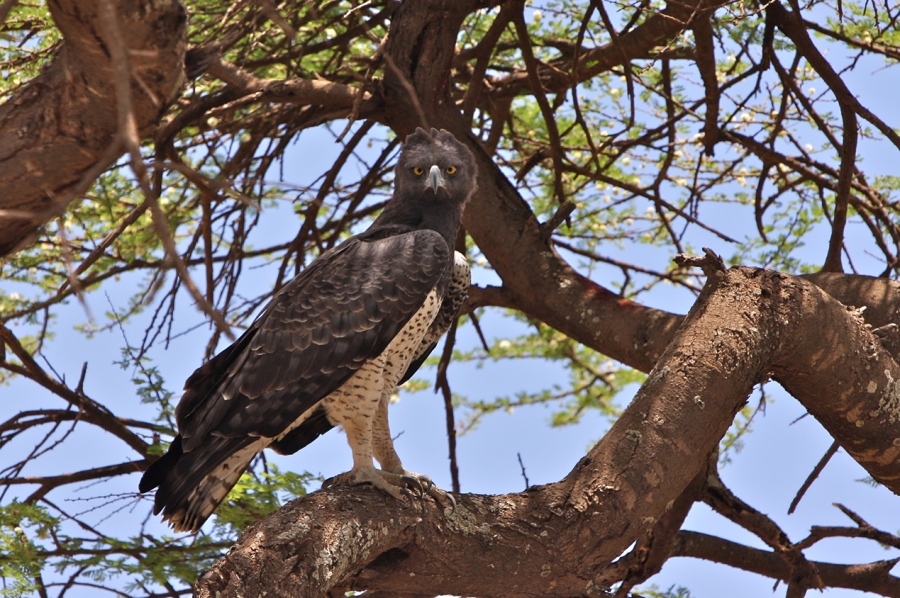
Martial Eagle is the one of the huge eagle we have in Kenya.It is a large eagle, growing to a length of 76-83 cm with a wingspan of 190-260 cm. The adult’s plumage has dark brown upperparts, head and upper chest. The body underparts are white streaked with black. The underwing coverts are brown, with pale flight feathers, also streaked with black. The female is usually larger and more streaked than the male. The immature is paler above and has white underparts. It reaches adult plumage in its seventh year.

The Martial Eagle can be found throughout Kenya, wherever food is abundant and the environment favourable. It is never common, but greater population densities exist in Nairobi, Samburu and Maasai Mara National Parks, these birds are more abundant in protected areas than unprotected. It avoids dense forests but needs trees to nest in. The territory can vary greatly in size from more than 1000 Km² to areas where nests are less than 10 km distant. This disparity is due to differences in food supply.

White-headed Buffalo Weaver (Dinemellia dinemelli)

White-headed Buffalo Weaver (Dinemellia dinemelli)

Photo@Jurg Hosang

Hello birders!!Sorry, I was a way for some time birding with two birders from Indiana and New York state.For that reason, I did not post any bird of the week for the last two weeks!. I am back now with great pictures that I hope you will enjoy!!!for how beautiful are just birds!!.

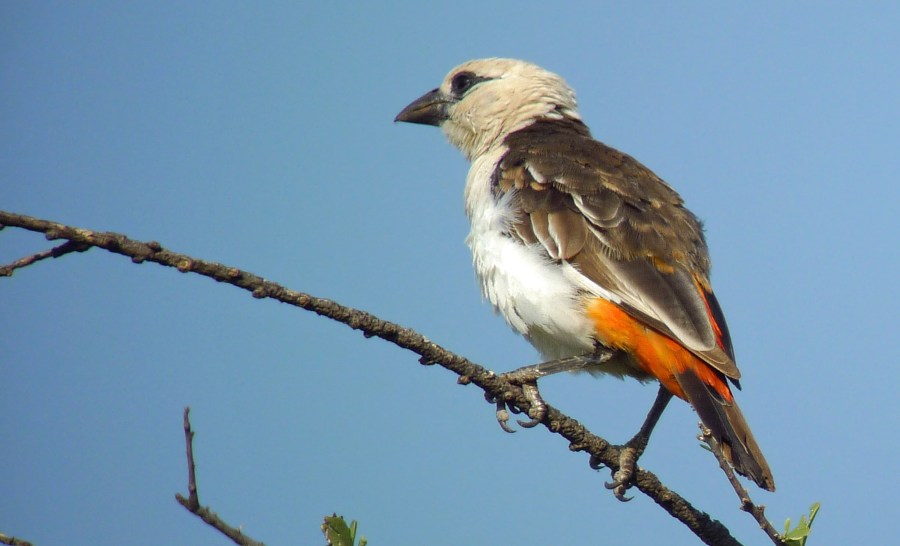
The white-headed Buffalo Weaver is confine to Eastern Africa, and it is brown and white with red rump and vent. Both are stout-bodied, heavy-billed bird. In breeding season the male’s bill become whitish and swollen at the base. Buffalo weavers live in dry regions, where they forage omnivorously on the ground in small noisy flocks, often in the wake of buffalo heards.The nest, a heap of thorny twigs, contains components for two or more pairs;several nest may occupy the same tree.

It is common and widespread in dry part of the arid and semi-arid areas of Kenya.

25 March, 2012:Red-and-Yellow Barbet (Trachyphonus erythrocephalus)

25 March, 2012:Red-and-Yellow Barbet (Trachyphonus erythrocephalus)

Photo@Jurg Hosang

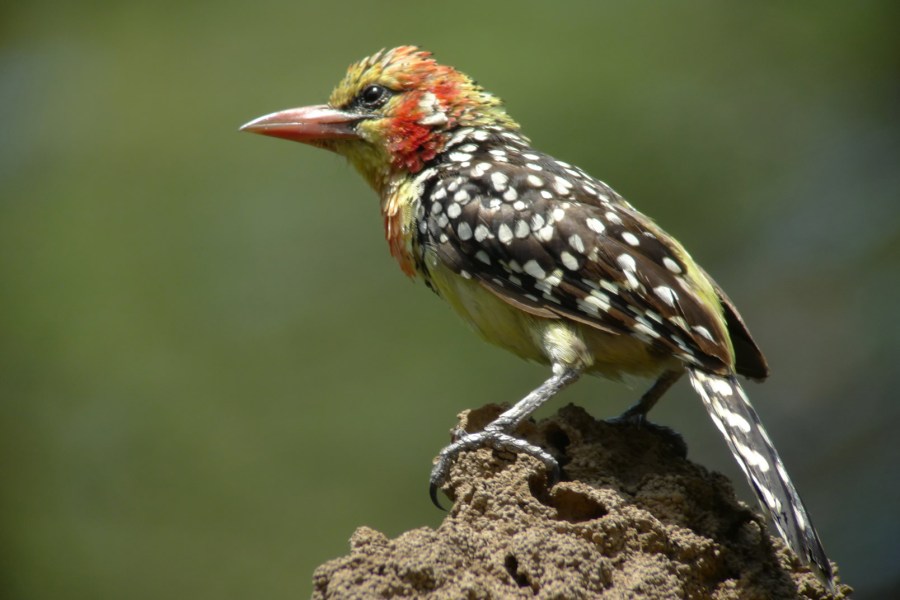
Red-and-Yellow Barbet like so all the other species of Barbet that I have come across are creatures of distinctive beauty. Barbet are closely related to tinkerbirds, woodpecckers,   honeyguides  and wrynecks. They are usually found alone or pairs.

This Barbet has a strong red billed, which is hooked and the face is generally red with bright white eared patches. The nominate race which is generally common is boldly white spotted above, with a black and white  speckled band across the yellow breast, yellow-white tail spots, and boldly barred outer tail feathers; rump yellow, upper tail coverts red and yellow; and under tail coverts red and yellow tips.

Very social species and always prefer hanging around termite mounds where they both derive their food stuff and build their nest is circular holes.

Locally common and widespread in dry bush,  savanna  and woodland scrub of Kerio Valley, Lake Baringo, Lake Bogoria , Meru national park, Olorgesaillie and Magadi road.

February 2, 2012: Greyish Eagle Owl (Bubo cenerascens)

This Greyish Eagle Owl was formerly classed as a race of Spotted Eagle Owl, with the latter found in the southern part of the equator , while former is located in northern part of the equator, this is as far as my Kenyan distribution knowledge is regarding this species.

It is a medium to large greyish (grayish) brown owl with dark eyes. Finely vermiculated above and densely so below with barring.

Greyish Eagle Owl, Photo @ Tony Crocetta

All my records of this species has been from Lake Baringo, Lake Bogoria National Reserve and  Kerio Valley. I have been informed of records from Samburu and Meru too.


Stay tuned as I return later next week from a tour and will be preparing a tour report, new photos, bird songs and much more!


– Joe,

have a happy birding week