Martial Eagle (Polemaetus bellicosus)

Martial Eagle (Polemaetus bellicosus)

Photo@Yan Van Dainne

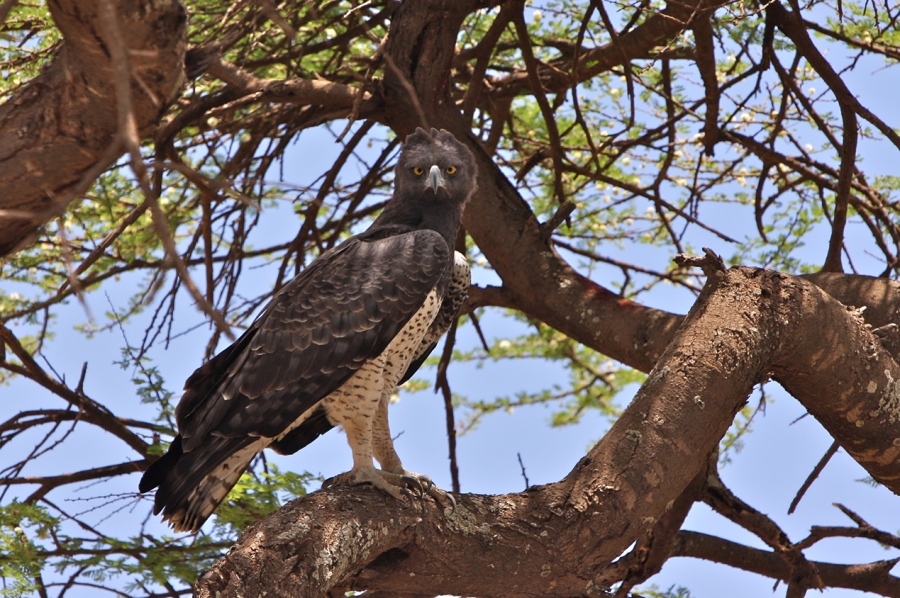
Martial Eagle is the one of the huge eagle we have in Kenya.It is a large eagle, growing to a length of 76-83 cm with a wingspan of 190-260 cm. The adult’s plumage has dark brown upperparts, head and upper chest. The body underparts are white streaked with black. The underwing coverts are brown, with pale flight feathers, also streaked with black. The female is usually larger and more streaked than the male. The immature is paler above and has white underparts. It reaches adult plumage in its seventh year.

The Martial Eagle can be found throughout Kenya, wherever food is abundant and the environment favourable. It is never common, but greater population densities exist in Nairobi, Samburu and Maasai Mara National Parks, these birds are more abundant in protected areas than unprotected. It avoids dense forests but needs trees to nest in. The territory can vary greatly in size from more than 1000 Km² to areas where nests are less than 10 km distant. This disparity is due to differences in food supply.
White-headed Buffalo Weaver (Dinemellia dinemelli)

White-headed Buffalo Weaver (Dinemellia dinemelli)

Photo@Jurg Hosang

Hello birders!!Sorry, I was a way for some time birding with two birders from Indiana and New York state.For that reason, I did not post any bird of the week for the last two weeks!. I am back now with great pictures that I hope you will enjoy!!!for how beautiful are just birds!!.

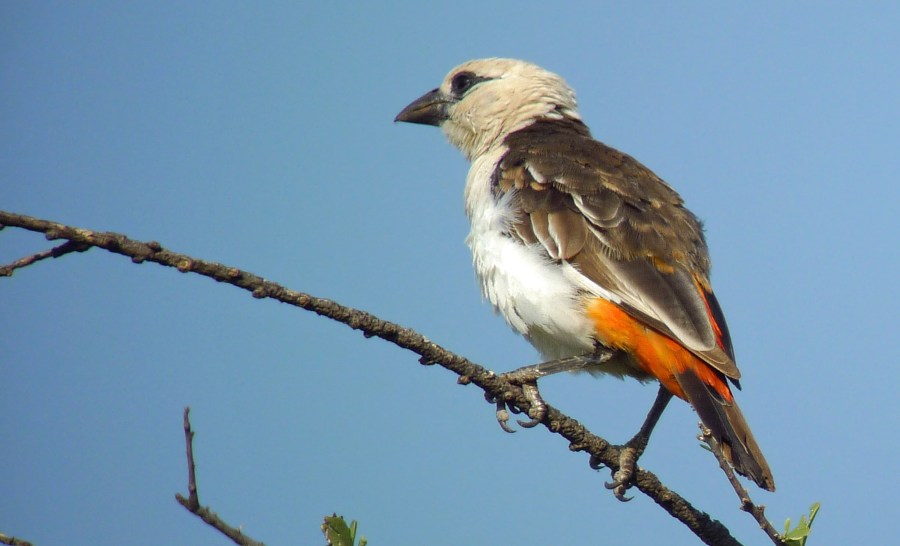
The white-headed Buffalo Weaver is confine to Eastern Africa, and it is brown and white with red rump and vent. Both are stout-bodied, heavy-billed bird. In breeding season the male’s bill become whitish and swollen at the base. Buffalo weavers live in dry regions, where they forage omnivorously on the ground in small noisy flocks, often in the wake of buffalo heards.The nest, a heap of thorny twigs, contains components for two or more pairs;several nest may occupy the same tree.

It is common and widespread in dry part of the arid and semi-arid areas of Kenya.

Green-backed Heron (Butorides striatus atricapillus)

Green-backed Heron (Butorides striatus atricapillus)

Photo@Jurg Hosang

Green-backed or Striated Heron as it is sometimes known is a small,short-legged heron with characteristic of a hunched posture.Adult bird appear dark greyish above with greenish-black erectile crown feathers;grey below with white throat and with a broad chestnut-buff line down foreneck.Legs and feet yellow(orange or red-orange when breeding;bill rather short,blackish with greenish-yellow base and yellow eyes.

Generally Striated heron is a shy and solitary bird, and likes creeping low a long waterside three or roots, and it is mainly diurnal.Well distributed and common in wetlands.

March 11, 2012: Red-Necked Falcon (Falco chicquera)

March 11, 2012: Red-Necked Falcon (Falco chicquera)

Photo@Yan Von Danne

This rare  norrow-winged, Kestrel-sized falcon typically associated with Palm tree.It can easily be identified from its Red-rufous crown that extend all the way to the scapular. This beautiful raptor has a white face, chin and the upper breast, with broad pale rufoous band across upper breast.Pale blue-grey above with fine black barring;primaries and primary covert darker. The wings are pretty short compared to typical falcons like Peregrine.

Uncommon in low open country, especially with palms and acacia of Galana river, Meru and Samburu national park, Lake Turkana and the coastal part of Kenya.This photo was taken by a friend of mine in Samburu National Reserve.

January 8, 2012: Lilac-Breasted Roller (Coracias caudata)

The average size of the Lilac Breasted Roller is 14.5 inches, including the tail streamers. The washed green head is large, the neck is short, the greenish yellow legs are rather short and the feet are small. The beak is strong, arched and hooked-tipped. The tail is narrow and of medium length. The back and scapulars are brown. The shoulder of the wing, outer webs of the flight feathers and the rump are all violet. The bases of the primaries and their coverts are pale greenish blue and the outer tail feathers are elongated and blackish. The chin is whitish, shading to rich lilac of the breast. The underparts are greenish blue. The bill is black and the eyes are brown. It has large wings and strong flight.

Lilac-breasted roller is most cases seen hunting for its food which may range from grasshoppers, beetles and small amphibians. Great photographic chances are found when the bird is foraging in the ground.

It is the most commonly seen roller. It well distributed in Samburu, Lake Baringo and Bogoria, Nakuru, Masai Mara, Amboseli, Nairobi and Tsavo National Park.

December 15, 2011: Hunter’s Sunbird (Nectarinia hunteri)

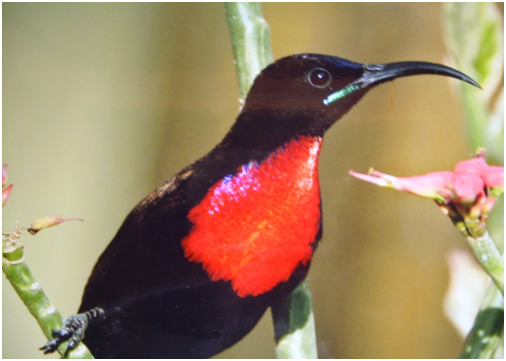
Hunter’s Sunbird is widespread and found in most dry areas of Kenya; especially in wooded and bushed grassland, it will however avoid very dry desert-like environments. It can easily be mistaken for the Scarlet-chested and Amethyst Sunbird.

The adult male is a non-reflective velvety black, with more brownish on the back, and a glittering green crown which appears turquoise; the throat as well as the patch on the bend of the wing is metallic ruby or rose-purple.

Hunter's Sunbird

The female is grey-brown above with white edged coverts. The under part is dull white, strongly mottled with sepia-brown on the throat and breast, more faintly on the belly and flanks washed brown, with chin and throat appearing darker .

It has a habit of being shy and solitary. It is widely distributed in dry areas like Samburu and Shaba National Reserve, Lake Baringo, Lake Bogoria and Kerio Valley.