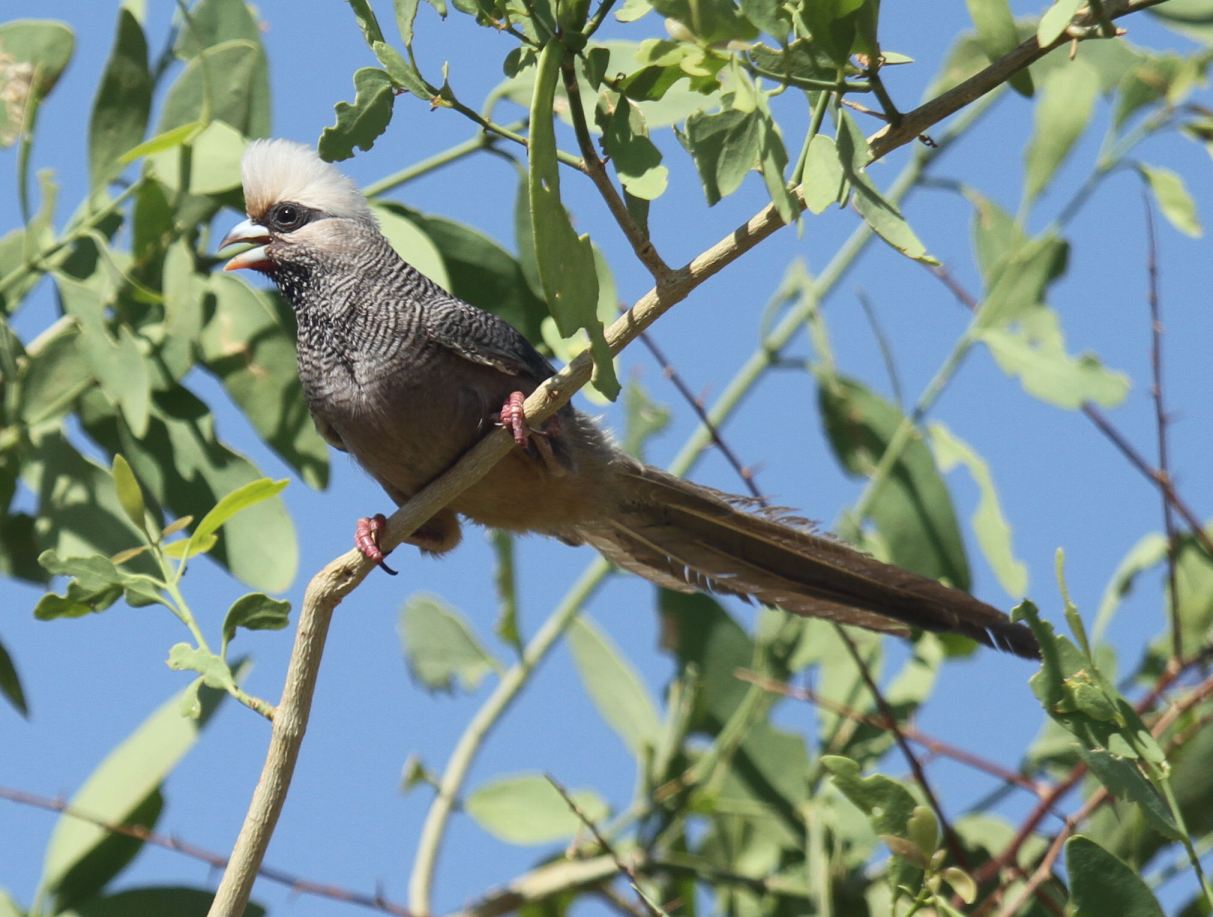
white-headed Mousebird (Colius leucocephalus)

Photo@Jacqui Harrington

Mousebirds, sometimes called colies, are an ancient group of small arboreal birds in Africa. They are so unique in morphological peculiarities that they were proposed as a separate Order of birds as long ago as 1872, and this placement has been confirmed by molecular evidence (Sibley & Ahlquist 1990, Hackett et al. 2008). They are the only Order restricted to sub-Saharan Africa.

In Kenya three species occurs,  White-headed, Blue-naped and Speckled Mousebird.There are only two genera among the mousebirds, and four of the six species are placed in Colius, including White-headed Mouse Bird  of east Africa (left). White-headed Mousebird, like most of this genus, is a bird of arid thornscrub. Its range is limited to a band of such thornscrub from s. Somalia to n.e. Tanzania. The most widespread species, Speckled Mousebird C. striatus, occurs more broadly in a variety of woodlands.

The three  species of Colius mousebirds are essentially allopatric in distribution, without any significant overlap, and where there is a little range overlap, they separate out by habitat.In Kenya it is found  in Samburu, Meru, Tsavo west and Tsavo East National Park.

Golden-winged Sunbird (Nectarinia reichenowi)

Photo@Jacqui Harrington

Golden-winged Sunbird has a bright yellow tail and wings, the shoulders are dark gray, the dark gray extending to the nape and throat, while the head and downturned beak are lighter gray. The tail is long and ends in two long, very narrow parallel feathers.These birds are found in East Africa; Kenya, Tanzania, and Uganda.Golden-winged sunbirds live in grassland, bamboo thickets, and tropical mountain forest.

In Kenya this species if found in Lake Nakuru and Naivasha,Nyahururu,Mt.Kenya and Aberdare National Park.

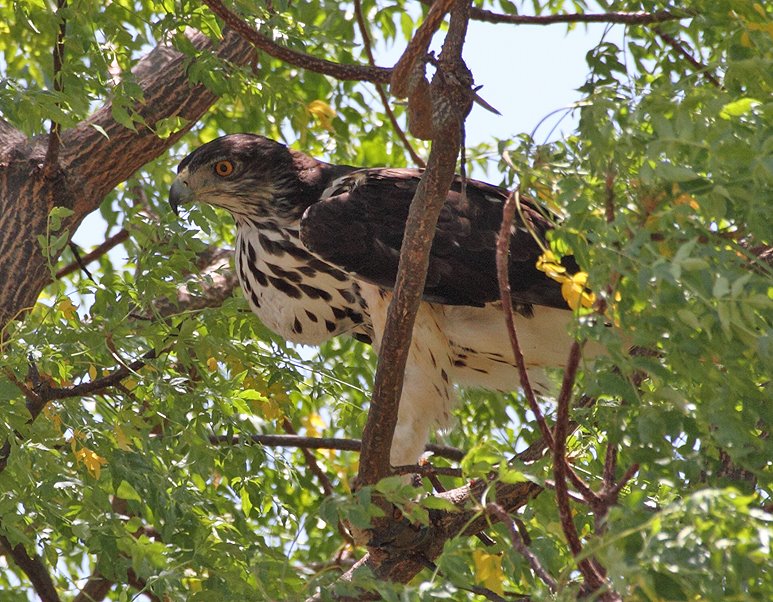
African Hawk Eagle (Aquila spilogaster)

Photo@Michael Sammut

African Hawk Eagle (Aquila spilogaster) are large birds of Prey  that occur naturally in Kenya, where they inhabit wooded hills.In Kenya they mostly seen in birding hot spot like Masai Mara,Tsavo West and East,Nairobi National Park,Hell’s Gate, and Lake Nakuru National Park.

African Hawk Eagles are large eagles that measure about 55 – 65cm in length.The plumage above is blackish. Below they are mostly white, heavily streaked with black. Theunderwing feathers are white with a black trailing edge. The wings below are blackish with white spots.Males and females look alike, but young birds are brown above and rufous colored below.

Their large platform nests are built out of sticks and are about 3 meters in diameter.They are typically placed in the forks of large trees.The average clutch consists of one or two eggs.

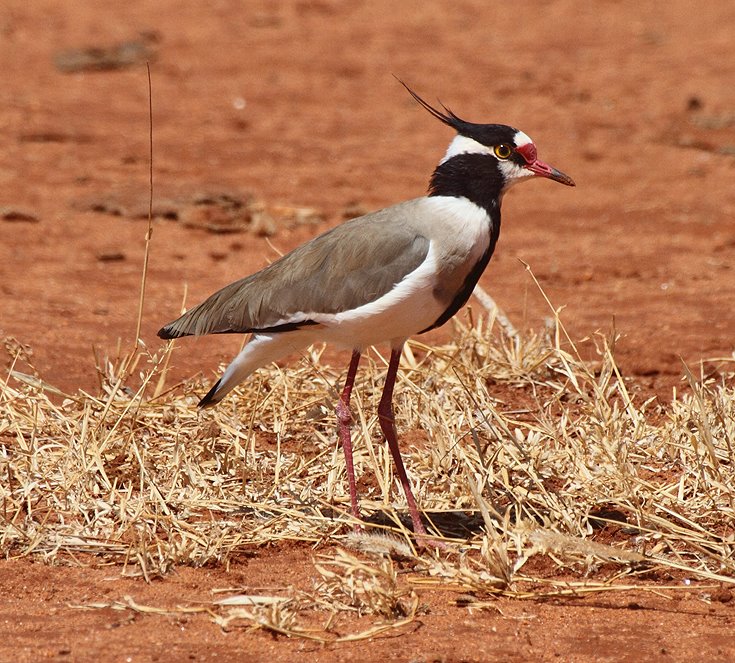
Black-headed Lapwing (Vanellus tectus)

Photo@Michael Sammut

The Black-headed Plover or Black-headed Lapwing (Vanellus tectus) is a species of wading bird of the family Charadriidae. It is found across sub-Saharan Africa.In Kenya specifically, it is found in areas like Tsavo West and East,Lake Baringo, Lake Bogoria,Samburu and Meru National Park. Although not migratory, there is some seasonal movement. Its habitat is wet lowlands close to water. It often feeds in drier habitats, such grassy scrubland.

This bird is readily noticeable and unmistakable. It is medium-large with a mainly black head and white forehead. The lower face and bands across the rear head and nape are also white. The crest is a weak black. The bill and legs are red. The tail is white and tipped black. In flight, the upperwings have black flight feathers and brown coverts separated by a white bar. The underwings are white with black flight feathers.

The diet of the Black-headed Plover consists of insects and other invertebrates that is picked from the ground. The call is a metallic tink-tink.


The Birding Big Year!

Kenya birding blog is trying to inspire people all over the world to enjoy, appreciate and protect birds and its natural habitat.Today, amid a host of environmental threats, our mission is more important than ever. Fortunately, there are many new and exciting ways to get involved. Together we can  shape a healthier tomorrow-for birds, other wildlife and the environment we share.2013 is indeed going to be a big year!!

Magpie Starling (Speculipastor bicolor)


The magpie starling is a northeast African endemic and an occasional non-breeding visitor to northeastern Tanzania. The male is black and white; the female, brown and white both with bright red eye which aid identification a great deal. The best place to see them in Kenya is Lake Baringo where is frequently spotted feeding in big fig trees along the cliffs.