

Yellow-billed Stork is an African species but there are records from Spain and Eastern Europe which may relate to wild vagrants. This is the mostly seen and easily identified stork in Kenya wetlands after Marabou Stork.Breeding adult birds are brightly coloured, while the juvenile one are greyer with a bit of a dull bills.In Kenya they mostly concentrated in the Rift-Valley Lakes, Amboseli National park, Lake Victoria and the coastal wet areas.

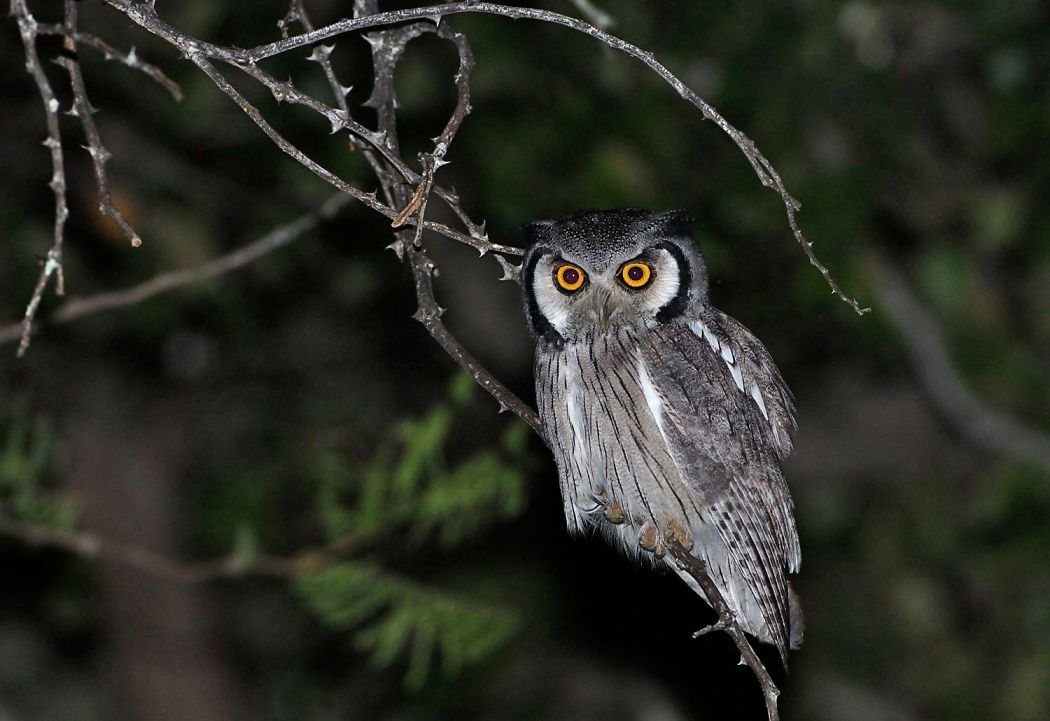
The Northern White-Faced Scops Owl is a smallish owl easily recognizable by its very striking white facial disc, with a border of black plumage. It has large, bright orange eyes, which are also surrounded with black. (Juveniles have greyish plumage on their faces, and their eyes are yellow). These owls have prominent ear-tufts. Bigger than the Scops Owl, they are on average 25cms in height, weighing around 200gms. The feathers of their upper parts are mostly pale grey: their under parts are lighter and more streaked. The female of the species is larger than the male.Like so many other species of owl, northern white faced scops owl is a nocturnal. In Kenya they are found in Samburu and Baffalo springs National reserve , Meru National Park, Kerio Valley, Lake Baringo and Bogoria .
This species is found singly or in pairs. The female will lay a clutch of 2 or 3 eggs in the old stick-nests of many other bird species, including small raptors such as goshawks and kites – or even herons, dove or crow’s nests. If these are not available, they will nest in natural tree holes. The 30 day incubation is mainly by the female, although the male may assist. Young chicks will start to fly at roughly 33 days, leaving the nest area two weeks thereafter.

Crested Guinea fowl has a wide range in Kenya and northern Tanzania. In Kenya it is found mostly in western tropical rain forest remnant of Kakamega forest and Lake Manyara national park in Northern Tanzania, Body plumage is much like a typhical Guinea Fowl, with whitish spot; most recognizable features is the short, curly “mop” of black feathers on the head, the rest of the head and neck are bare with blue skin, red skin arond the eyes and on the neck;eyes are red;legs dark brown to black.The species is mono morphic.

Mousebirds, sometimes called colies, are an ancient group of small arboreal birds in Africa. They are so unique in morphological peculiarities that they were proposed as a separate Order of birds as long ago as 1872, and this placement has been confirmed by molecular evidence (Sibley & Ahlquist 1990, Hackett et al. 2008). They are the only Order restricted to sub-Saharan Africa.
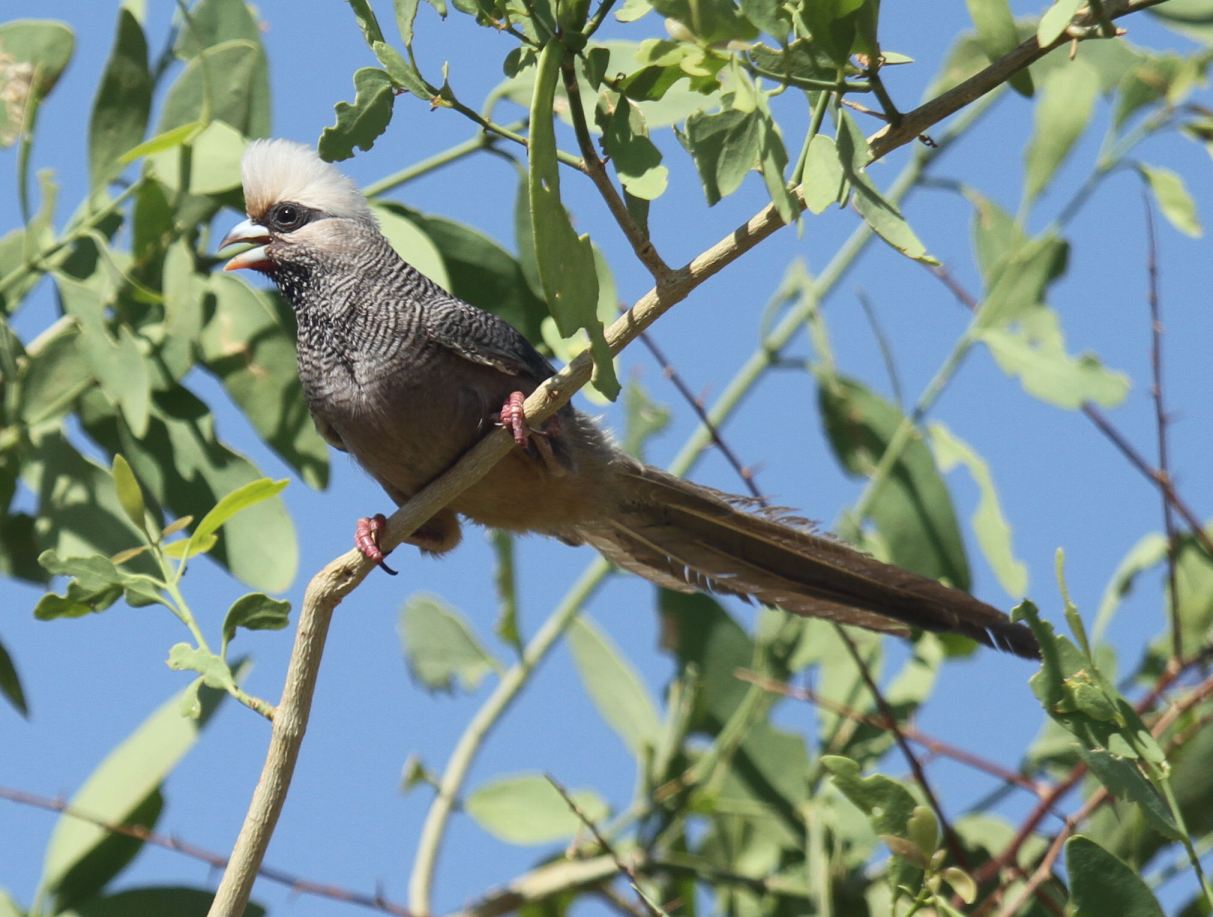
In Kenya three species occurs, White-headed, Blue-naped and Speckled Mousebird.There are only two genera among the mousebirds, and four of the six species are placed in Colius, including White-headed Mouse Bird of east Africa (left). White-headed Mousebird, like most of this genus, is a bird of arid thornscrub. Its range is limited to a band of such thornscrub from s. Somalia to n.e. Tanzania. The most widespread species, Speckled Mousebird C. striatus, occurs more broadly in a variety of woodlands.
The three species of Colius mousebirds are essentially allopatric in distribution, without any significant overlap, and where there is a little range overlap, they separate out by habitat.In Kenya it is found in Samburu, Meru, Tsavo west and Tsavo East National Park.

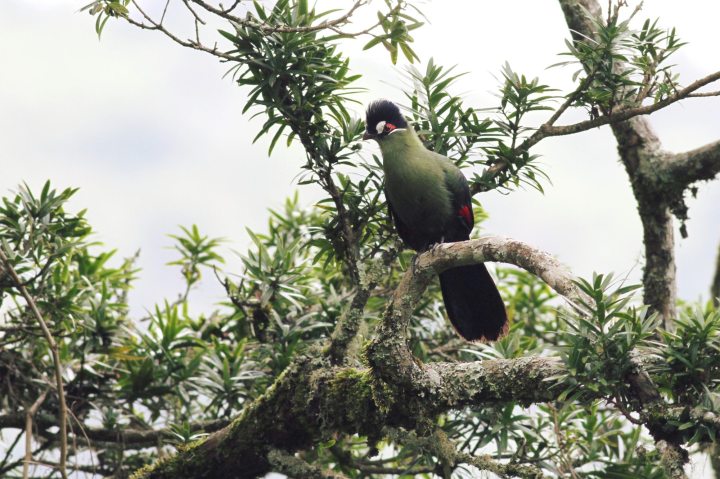
Hartlaub’s Turaco (Tauraco hartlaubi) is a medium sized turaco, an endemic family to sub- Sahara Africa. In Kenya it is a resident breeder in the Montane forests of the central part of the country.

Golden-winged Sunbird has a bright yellow tail and wings, the shoulders are dark gray, the dark gray extending to the nape and throat, while the head and downturned beak are lighter gray. The tail is long and ends in two long, very narrow parallel feathers.These birds are found in East Africa; Kenya, Tanzania, and Uganda.Golden-winged sunbirds live in grassland, bamboo thickets, and tropical mountain forest.
In Kenya this species if found in Lake Nakuru and Naivasha,Nyahururu,Mt.Kenya and Aberdare National Park.

Buff-crested bustards are small in size compared to other species that we have in Kenya. They are cryptically colored to help them blend into their environment. They also are sexually dimorphic. Male buff-crested bustards have an olive colored crown, a black stripe down the front of the neck, and a black chest and belly. The upper feathers contain light orange-brown coloration. The females have brown heads, a much reduced crest, and are buff colored in the throat, chin, and breast area.The buff-crested or crested bustard prefers drier acacia scrub and woodland of northern arid and semi-arid regions of Kenya, especially in regions like Samaburu and Meru National park, Lake Baringo and Bogoria and further north in areas like Kapedo.