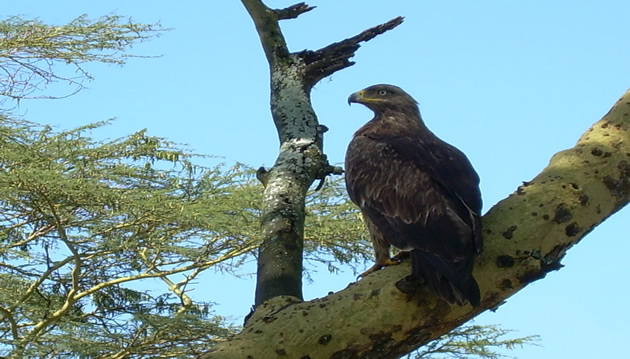
Steppe Eagle (Aquila Nipalensis)


A relatively large, handsome bird of prey, the steppe eagle closely resembles a number of related eagle species such as the tawny eagle, Aquila rapax, that occur within its extensive range . The plumage is mostly dark brown, with well-defined bars on the flight and tail feathers . The main distinguishing features are the reddish-brown patch on the nape of the neck, the oval nostrils, and the long, wide gape. There are two recognised subspecies  of steppe eagle, Aquila nipalensis nipalensis and Aquila nipalensis orientalis, the latter being slightly smaller, with paler plumage. The juvenile steppe eagle resembles the adult but is paler brown, with a characteristic broad white band running along the underside of the wing.

Steppe Eagle exclusively breed in Eastern Europe and migrate annually to Africa

Joe guided Nigel Marven of Animal Planet on a Kenya Birding Trip

photo@Joe Aengwo

Nigel Marven went Birding in Kenya

When Moses, a colleague of mine informed me that I was to guide a client from England for 8 days birding safaris, I had no idea that my client will torn out to be Nigel Marven, the famous Animal Planet natural history presenter.  We had good time birding together in Kakamega forest, Tugen hills,Lake Baringo, Bogoria, and Nakuru and finally Nairobi National Park. We managed to spot over 300 species of birds and lucky enough, we managed to see most of our sort after species with exception of four or five species.

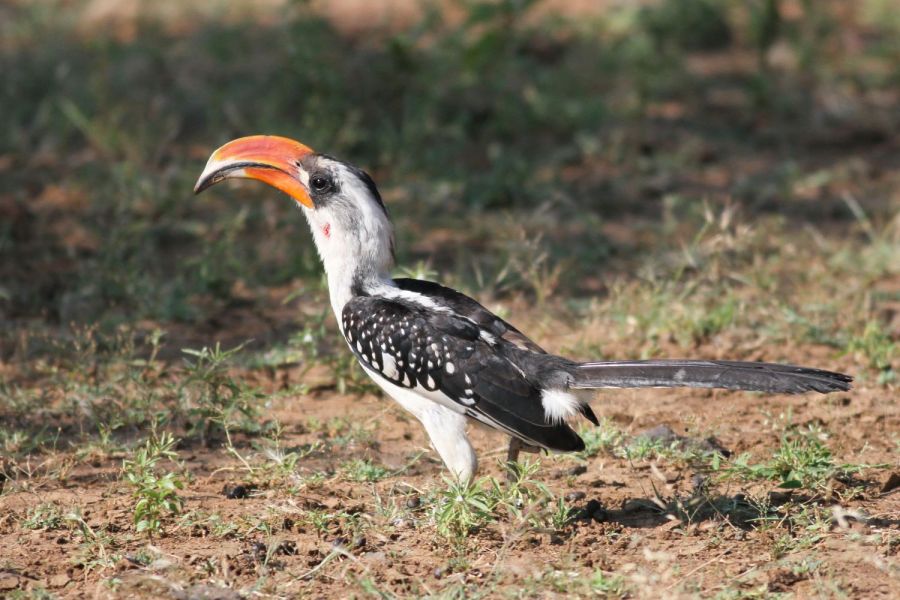
Jacson’s Hornbill (Tockus jacksoni)

Image

Similar to other hornbills, Jackson’s hornbills have a unique and nearly predator proof way of raising their offspring. Before she lays her eggs, the female is sealed in a tree cavity by her mate. During this time, he passes her food through a narrow slit.The species is an example of sexual dimorphism, meaning there is a difference in form between males and females of the same species. The male Jackson’s hornbill has a red billed with a yellow tip (see above) and the female has a black bill.

In Kenya they are found in Lake Baringo, Lake Bogoria, Kapedo and the the  upper part of the Rift Vally mostly in Turkana area.

Black-faced Sandgrouse (Pterocles decoratus)

Image

The sandgrouse are distributed across northern, southern and eastern Kenya, Specifically in desert and semi-arid areas of Samburu, Meru, Marsabit, Turkana,Lake Baringo,Tsavo west and east, and Amboseli

Sandgrouse have compact bodies, but small, pigeon-like heads and necks. The different species range in length from 24 – 40 cm and weigh from 150 – 500 g.

Males and females look alike, Some species are also polymorphic .

They have long pointed wings and short legs that are feathered down to the toes, and members of the genus Syrrhaptes also have feathered toes.

Sandgrouse mostly feed on seed and are often seen in large feeding flocks with up to 100 birds.

Sandgrouse are monogamous (form life-long pair bonds). They make their nest on a slight depression in the ground. The average clutch consists of 2 eggs, occasionally up to 4. The male and female share the incubation duties; with the male incubating during the night and early mornings, and the female taking over during the day.

The young hatch after about 20 – 25 days; and are able soon able to leave the nest.

They are able to feed themselves from the day they hatch, but have to learn foraging skills from their parents for several months.

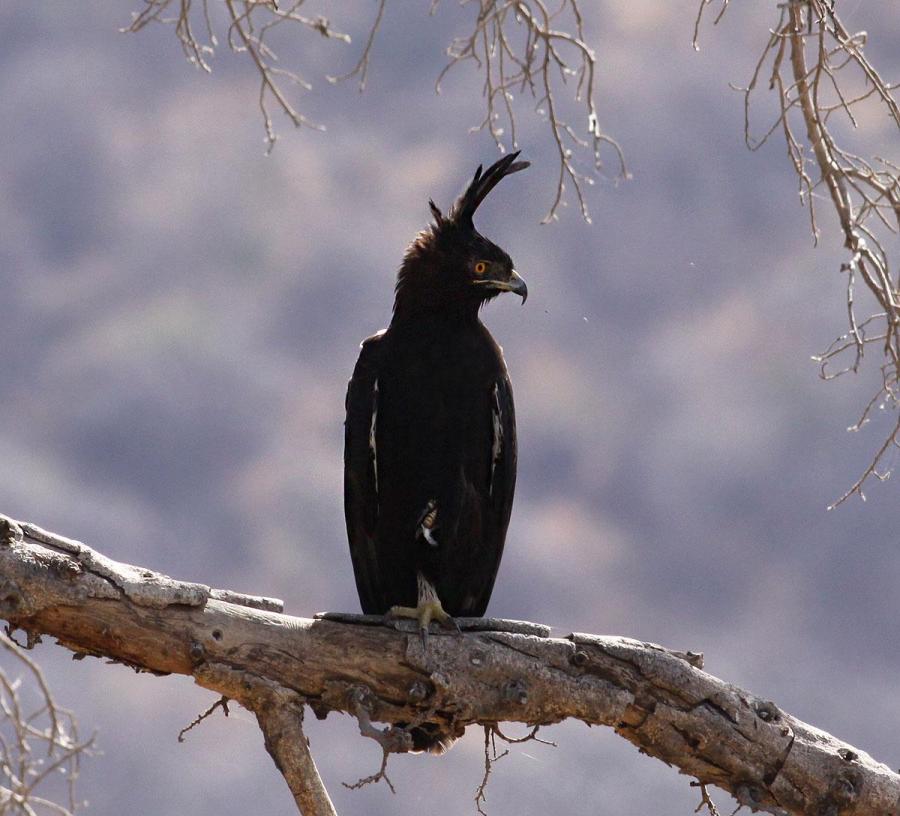
Long-crested Eagle (Lophaetus occipitalis)

Long-crested Eagle (Lophaetus occipitalis)

Photo@Raymond Galea

The adult Long-crested Eagle is overall very dark brown or black, except for white patches at the joint of the wing both above and below, white under-wing coverts spotted with black, a white base to the tail and greyish brown tarsi. The eyes golden to reddish brown, the cere and feet yellow.
Immatures can be distinguished from the adult by the whiter tips of the neck feathers, the less prominent crest, and a generally more mottled appearance. The eyes are dark olive-brown, the feet and cere pale ochre-yellow.

Long-crested Eagle can easily be seen in Kenya thought out Nairobi, Maasai Mara, Lake Nakuru National Park,Amboseli, Tsavo East and West National Park.

Black-Cheeked Waxbill (Estrilda erythronotos)

Black


Head and throat grey, being darker on the crown, with black side patches. Bill is black at tip, fading to blue-gray at base. Back is brown, faintly barred. Wing coverts and secondaries striped black and white. Rump and tail coverts red, underparts grey with pink tinge becoming red on flanks and belly, with black vent. Female is paler, with brown vent. Juveniles resemble the female, with a darker bill. There are several geographical variants with subtle plumage differences.


Frequents dry grassland with thornbush or acacia scrub, the edges of woodland and sometimes cultivated areas. Feeds on (or close to) the ground, mainly on grass seeds and millet. Will also take small insects, fruit and buds and the blossoms of fruit trees (possibly to obtain pollen or nectar).


Widely distributed in Kenya in places Samburu National Reserve, Meru National Park, Lake Baringo, and Lake Bogoria.