Lake Baringo Birdwatching Chitchat!!Early June, 2012

On the 8th June the birds were out in force with 57 different species recorded on the morning Birdwalk, some of the more notable ones being Lanner Falcon, Dark-chanting Goshawk, Common Kestrel, White-faced Scops Owl, Red-fronted Tinkerbird, Red-fronted Barbet, Lesser Honeyguide, Nubian Woodpecker, Brown-tailed Rock Chat, Pygmy Batis, Northern Crombec, Purple Grenadier, Red-headed Weaver and Yellow-spotted Petronia.

Early in the month, the water level in the Lake increased tremendously to an extent where of most us have never experienced it before in our days there (29 Years) . Goliath, Purple and Squacco  Heron with their rich blue billls acquired when breeding are all gathered along the numerous floating Island frequently seen in several part of the lake.The Bee-eaters species of Blue-cheeked, Madagascar, Little and Somali are flying up and down to some of their unlucky prey, a most magnificent sight.

On another evening a Bat-hawk flew past the Lake Baringo Club, to God knows where !It was probably an ideal hunting time considering that most the Yellow-winged Bat were starting to be active, a surprise indeed!!.Toward the far end of our air strip, a woolly-necked Stork flew overhead and later eight ostriches were seen.Other interesting birds seen from around the air strip include; Pygmy Falcon, Heuglin’s  Courser and Spotted Thicknee. The Thicknee’s must have had a nest in the rocks because on hearing us approach they would dart away from the rocks then stand frozen, out in the open, their luminous legs glowing like neons.

  Three young Rufouse Chatterers come one evening to feed with the weavers and starlings. These charming youngsters had no  fear and bravely waited their chance to snatch at the proffered crumbs regardless of the jostling competition surrounding them. Thereafter they were often seen around the garden and have grown rapidly since the fist sighting.

For several days the shoreline was the the meeting place for  a small gathered Egyptian Geese.. Large flock of White-throated Bee-eaters fly in most evening at about 6:00p.m and feed quickly before roosting in the Prosopis trees for the night.

At last the Verreaux’s Eagle have returned to the cliff face.The first sighting was on 28 May when they were seen parched low on the rocks. The next day one was flying around, the other was on their old nest. A few days later a terrific clamour  drew attention to the skies, the Eaglea were flying a long the cliffs being mobbed by a pair of Lanner Falcon and Common Kestrel.As the Lanner Falcon had used the Eagle nest whilst the Eagles were absent and they obviously regarded this area as their territory.

One evening the adult Verreaux’s Eagle Owl was parched on the branches of a dead tree, a wonderful opportunity for photographers. Then the young Owl, which had been hiding in the foliage of a nearby tree, swooped down, hopped a long the ground and pounced on a Hedgehog.

The long rains have slightly stopped and the lake is full and super green!!amazing view. Hopefully, the lake will stop to raising!!This I believe is the prayers of the guys who own and run Lake Baringo Club and Robert’s Camp, and obviously their employees are putting their fingers crossed!!!no big fun. White-faced Whistling Duck, African Jacana, Allen’s Gallinule and Winding Cisticolas have been recorded in the southern shore. Northern Red Bishop are coming into breeding plumage and these fiery little and black birds may be seen darting across the grasslands. A little more rain in July and maybe Lake Baringo will restore the bustling bird paradise, I wonder if the same will be said of the accommodation facilities located along the western shore of the lake!!Keep birding.

  Joseph Aengwo

  Resident Ornithologist

 

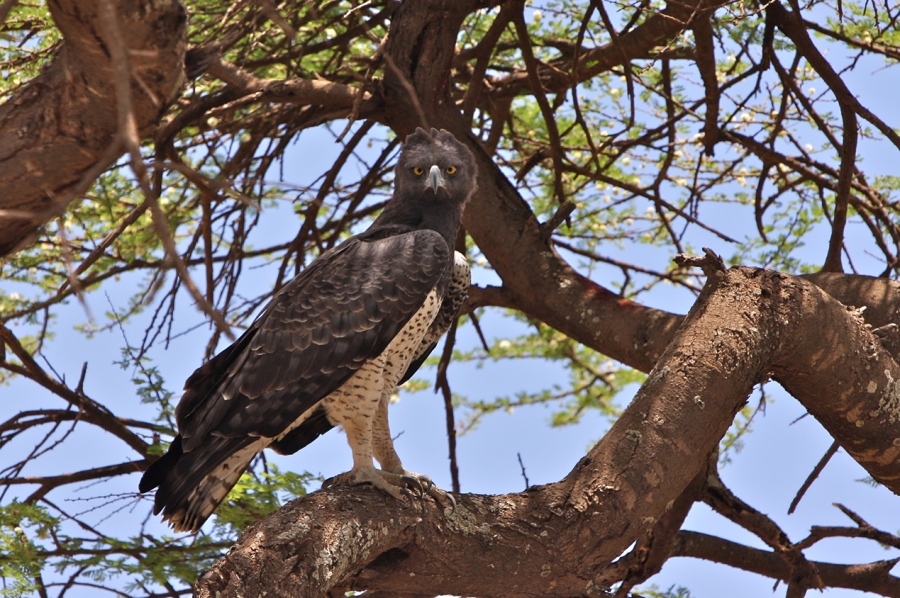
Martial Eagle (Polemaetus bellicosus)

Martial Eagle (Polemaetus bellicosus)

Photo@Yan Van Dainne

Martial Eagle is the one of the huge eagle we have in Kenya.It is a large eagle, growing to a length of 76-83 cm with a wingspan of 190-260 cm. The adult’s plumage has dark brown upperparts, head and upper chest. The body underparts are white streaked with black. The underwing coverts are brown, with pale flight feathers, also streaked with black. The female is usually larger and more streaked than the male. The immature is paler above and has white underparts. It reaches adult plumage in its seventh year.

The Martial Eagle can be found throughout Kenya, wherever food is abundant and the environment favourable. It is never common, but greater population densities exist in Nairobi, Samburu and Maasai Mara National Parks, these birds are more abundant in protected areas than unprotected. It avoids dense forests but needs trees to nest in. The territory can vary greatly in size from more than 1000 Km² to areas where nests are less than 10 km distant. This disparity is due to differences in food supply.

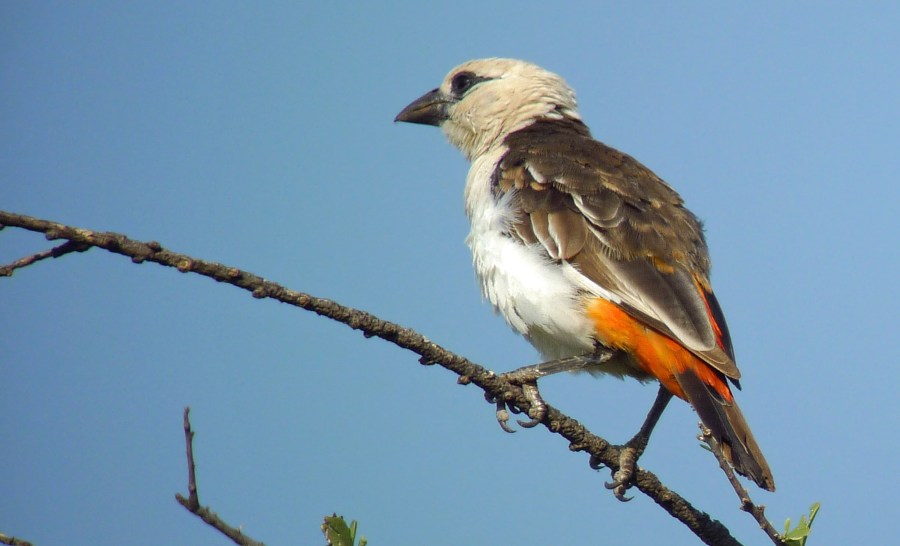
White-headed Buffalo Weaver (Dinemellia dinemelli)

White-headed Buffalo Weaver (Dinemellia dinemelli)

Photo@Jurg Hosang

Hello birders!!Sorry, I was a way for some time birding with two birders from Indiana and New York state.For that reason, I did not post any bird of the week for the last two weeks!. I am back now with great pictures that I hope you will enjoy!!!for how beautiful are just birds!!.

The white-headed Buffalo Weaver is confine to Eastern Africa, and it is brown and white with red rump and vent. Both are stout-bodied, heavy-billed bird. In breeding season the male’s bill become whitish and swollen at the base. Buffalo weavers live in dry regions, where they forage omnivorously on the ground in small noisy flocks, often in the wake of buffalo heards.The nest, a heap of thorny twigs, contains components for two or more pairs;several nest may occupy the same tree.

It is common and widespread in dry part of the arid and semi-arid areas of Kenya.

Green-backed Heron (Butorides striatus atricapillus)

Green-backed Heron (Butorides striatus atricapillus)

Photo@Jurg Hosang

Green-backed or Striated Heron as it is sometimes known is a small,short-legged heron with characteristic of a hunched posture.Adult bird appear dark greyish above with greenish-black erectile crown feathers;grey below with white throat and with a broad chestnut-buff line down foreneck.Legs and feet yellow(orange or red-orange when breeding;bill rather short,blackish with greenish-yellow base and yellow eyes.

Generally Striated heron is a shy and solitary bird, and likes creeping low a long waterside three or roots, and it is mainly diurnal.Well distributed and common in wetlands.

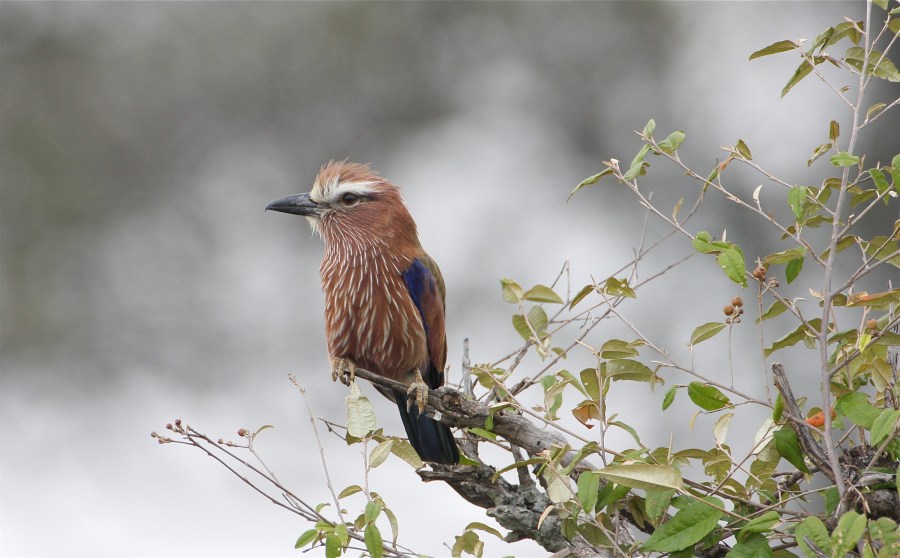
Rufous-crowned Roller (Coracias naevius)

Rofouse-crowned Roller

Photo@Yan Van Danne

Rufous-crowned or Purple Roller has it is sometimes referred to is a very uncommon compared to other species of Rollers, with exception of Abyssinian Roller.It feed on big insect and it can be observed from one spot for some time as it scanned and goes for his prey and returning to the same location .

The bird is generally purple as the name suggest with violet tailed and a little spot on the wing shoulder.It is the biggest roller we have in East Africa, therefore identifying this bird should never be a problem at all.

It is very common in areas around Lake Baringo, Lake Bogoria, Kerio Valley, Kapedo, Samburu National reserve and Meru National Park.


Southern Ground Hornbill (Bucorvus leadbeateri)

Southern Ground Hornbill (Bucorvus leadbeateri)

Photo@Joseph Aengwo

Southern Ground Hornbill is a large, turkey sized terrestrial bird, black-plumaged except for white primaries, conspicuous in flight. Adult bird has a bright red bare skin around eyes and on the neck, where usually somewhat inflated;eyes pale yellow; bill back, with small casque at the base above.

Pairs or small groups walk about in search for insects and small vertebrates.It will tend to take flight only when disturbed or alarmed.Widespread but partially distributed in open grassland and savanna around Nairobi  National Park, Maasai Mara, Central Rift Valley a round Lake Nakuru and Naivasha and Kakamega forest, Mt.Elgon and Kapenguria.