Taita Apalis (Apalis fuscigularis)

photo@Michael Sammut

Taita Apalis (Apalis fuscigularis), a Critically Endangered bird endemic to patches of natural forest in the Taita Hills of Southern Kenya. The entire world range of the Taita Apalis is less than 500 ha (5 km²).

The Taita Hills of South Eastern Kenya are the northernmost reach of the Eastern Arc, one of the world’s 34 biodiversity hotspots (Mittermeier et al. 2004). Human impact is strong in the Taita, where deforestation hits 95% or more (Rogo & Oguge, 2000). The Taita are one of the key sites for biodiversity conservation in Kenya, with numerous endemic plants, vertebrates and invertebrates.
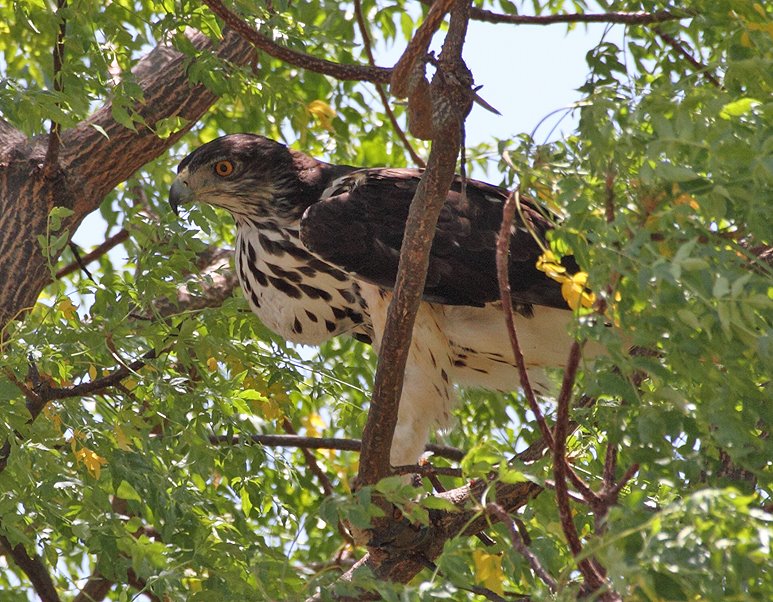
African Hawk Eagle (Aquila spilogaster)

Photo@Michael Sammut

African Hawk Eagle (Aquila spilogaster) are large birds of Prey  that occur naturally in Kenya, where they inhabit wooded hills.In Kenya they mostly seen in birding hot spot like Masai Mara,Tsavo West and East,Nairobi National Park,Hell’s Gate, and Lake Nakuru National Park.

African Hawk Eagles are large eagles that measure about 55 – 65cm in length.The plumage above is blackish. Below they are mostly white, heavily streaked with black. Theunderwing feathers are white with a black trailing edge. The wings below are blackish with white spots.Males and females look alike, but young birds are brown above and rufous colored below.

Their large platform nests are built out of sticks and are about 3 meters in diameter.They are typically placed in the forks of large trees.The average clutch consists of one or two eggs.

Hottentot Teal (Anas hottentota)

c@kelemen marton

The Hottentot Teal is a species of dabbling duck of the genus Anas. It is migratory resident in eastern Africa.The Hottentot teal is known for its black-capped head and distinctive blue bill. The duck’s body is speckled brown and black, with black wings.

Monogamous, territorial solitary nester. Interestingly, the pair bond barely lasts beyond incubation, with the male having almost no role in incubation and care of chicks.The female builds the nest, which is a deep bowl in the ground, filled with grass and leaves, often lined with down. It is usually placed in emergent vegetation near water.Laying dates vary with different regions, but usually in February-May.It lays 5-12 eggs, in successive days.Incubation is done solely by the female, for 25-27 days. She will sometimes leave the nest, to join the male in feeding and preening.The chicks are kept hidden in thick reedbeds, which makes them difficult to see. They fledge when they are about 60-65 days old.

Widespread all over Kenya in Swamps like Manguo, Lake Nakuru, Lake Baringo,Lake Bogoria and Lake Naivasha.

Magpie Starling (Speculipastor bicolor)


The magpie starling is a northeast African endemic and an occasional non-breeding visitor to northeastern Tanzania. The male is black and white; the female, brown and white both with bright red eye which aid identification a great deal. The best place to see them in Kenya is Lake Baringo where is frequently spotted feeding in big fig trees along the cliffs.

Joe guided Nigel Marven of Animal Planet on a Kenya Birding Trip

photo@Joe Aengwo

Nigel Marven went Birding in Kenya

When Moses, a colleague of mine informed me that I was to guide a client from England for 8 days birding safaris, I had no idea that my client will torn out to be Nigel Marven, the famous Animal Planet natural history presenter.  We had good time birding together in Kakamega forest, Tugen hills,Lake Baringo, Bogoria, and Nakuru and finally Nairobi National Park. We managed to spot over 300 species of birds and lucky enough, we managed to see most of our sort after species with exception of four or five species.

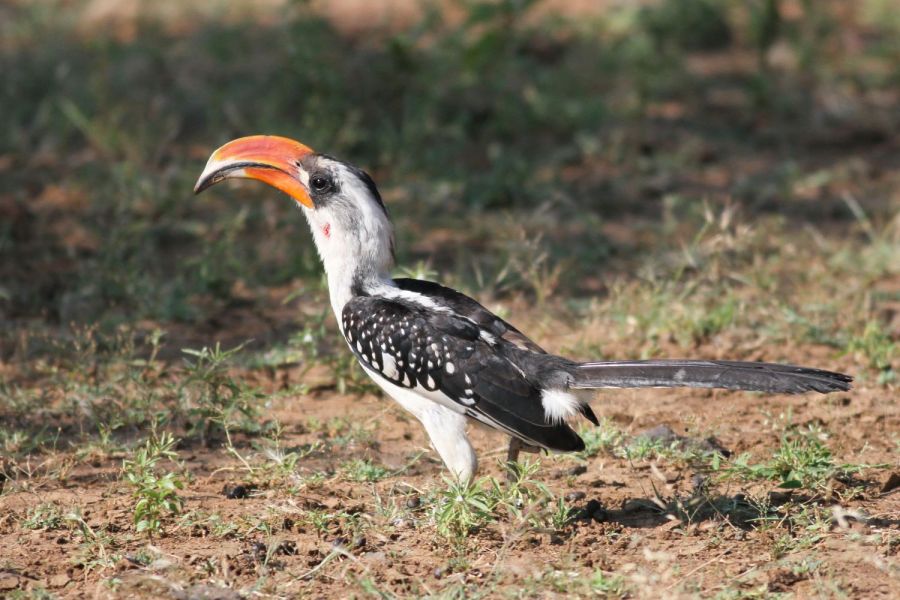
Jacson’s Hornbill (Tockus jacksoni)

Image

Similar to other hornbills, Jackson’s hornbills have a unique and nearly predator proof way of raising their offspring. Before she lays her eggs, the female is sealed in a tree cavity by her mate. During this time, he passes her food through a narrow slit.The species is an example of sexual dimorphism, meaning there is a difference in form between males and females of the same species. The male Jackson’s hornbill has a red billed with a yellow tip (see above) and the female has a black bill.

In Kenya they are found in Lake Baringo, Lake Bogoria, Kapedo and the the  upper part of the Rift Vally mostly in Turkana area.

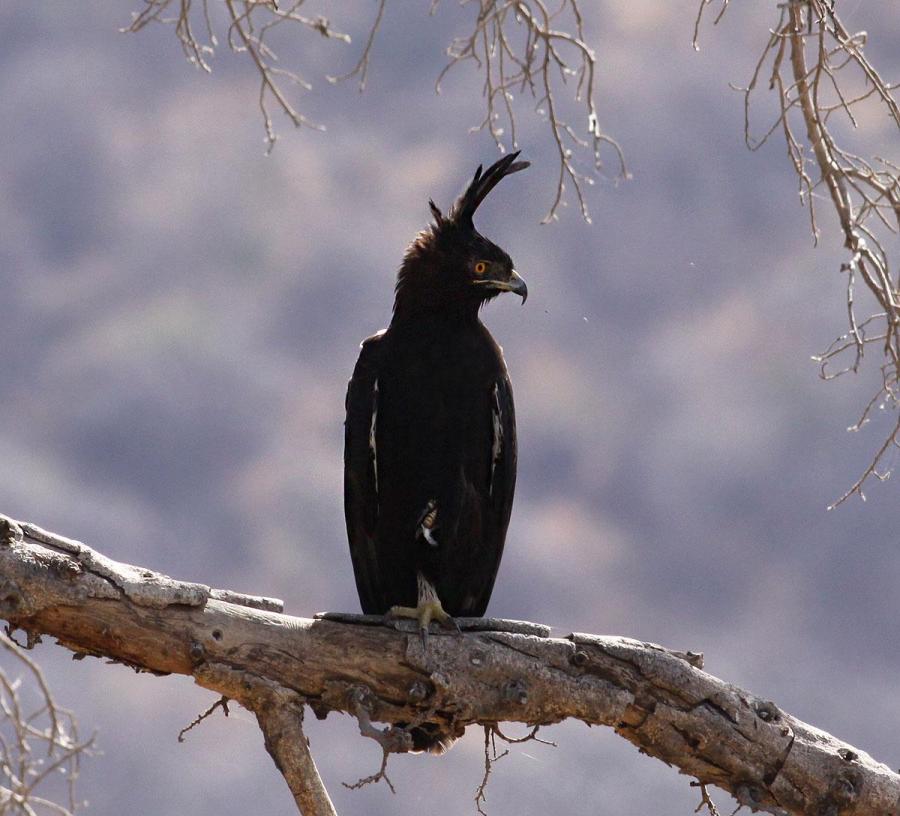
Long-crested Eagle (Lophaetus occipitalis)

Long-crested Eagle (Lophaetus occipitalis)

Photo@Raymond Galea

The adult Long-crested Eagle is overall very dark brown or black, except for white patches at the joint of the wing both above and below, white under-wing coverts spotted with black, a white base to the tail and greyish brown tarsi. The eyes golden to reddish brown, the cere and feet yellow.
Immatures can be distinguished from the adult by the whiter tips of the neck feathers, the less prominent crest, and a generally more mottled appearance. The eyes are dark olive-brown, the feet and cere pale ochre-yellow.

Long-crested Eagle can easily be seen in Kenya thought out Nairobi, Maasai Mara, Lake Nakuru National Park,Amboseli, Tsavo East and West National Park.

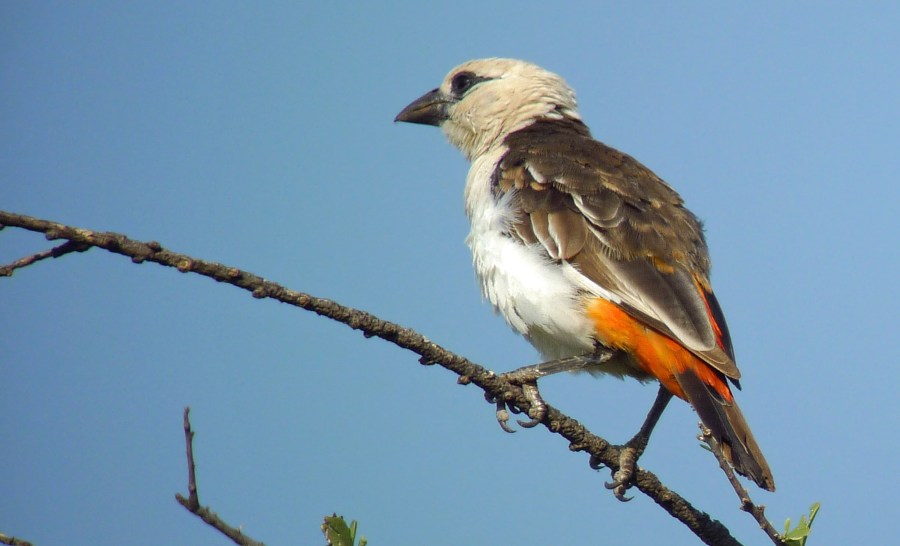
White-headed Buffalo Weaver (Dinemellia dinemelli)

White-headed Buffalo Weaver (Dinemellia dinemelli)

Photo@Jurg Hosang

Hello birders!!Sorry, I was a way for some time birding with two birders from Indiana and New York state.For that reason, I did not post any bird of the week for the last two weeks!. I am back now with great pictures that I hope you will enjoy!!!for how beautiful are just birds!!.

The white-headed Buffalo Weaver is confine to Eastern Africa, and it is brown and white with red rump and vent. Both are stout-bodied, heavy-billed bird. In breeding season the male’s bill become whitish and swollen at the base. Buffalo weavers live in dry regions, where they forage omnivorously on the ground in small noisy flocks, often in the wake of buffalo heards.The nest, a heap of thorny twigs, contains components for two or more pairs;several nest may occupy the same tree.

It is common and widespread in dry part of the arid and semi-arid areas of Kenya.

Green-backed Heron (Butorides striatus atricapillus)

Green-backed Heron (Butorides striatus atricapillus)

Photo@Jurg Hosang

Green-backed or Striated Heron as it is sometimes known is a small,short-legged heron with characteristic of a hunched posture.Adult bird appear dark greyish above with greenish-black erectile crown feathers;grey below with white throat and with a broad chestnut-buff line down foreneck.Legs and feet yellow(orange or red-orange when breeding;bill rather short,blackish with greenish-yellow base and yellow eyes.

Generally Striated heron is a shy and solitary bird, and likes creeping low a long waterside three or roots, and it is mainly diurnal.Well distributed and common in wetlands.