
Goliath Heron(Ardea goliath)

Goliath Heron

Photo@Yan Van Dainne

Goliath Heron

The Goliath heron is Africa largest heron, standing 53-to-55 inches tall, with a wingspan of six-to-seven feet. Male and female look similar, with an overall covering of slate gray and chestnut feathers. The head and its bushy crest, face, back and sides of the neck are chestnut. The chin, throat, foreneck and upper breast are white, with black streaks across the foreneck and upper breast. The lower breast and belly are buff with black streaks. The upper mandible is black and the lores and orbital areas are yellow with a greenish tinge. The eyes are yellow and legs and feet are black. Juveniles look similar to the adults, but are paler.

The Goliath heron is territorial, usually living alone near water. A diurnal and often rather inactive feeder, the heron hunts by standing in the shallows, or on floating vegetation, intently watching the water at its feet. As prey appears, the heron rapidly spears it with open mandibles.

Goliath heron nests are found in trees overhanging water, on the ground and in low bushes. Both sexes build the stick and reed platform nest, which measures three-to-four feet across. Both parents incubate two-to-four pale blue eggs for 29 days. The chicks are covered with long white down.
Martial Eagle (Polemaetus bellicosus)

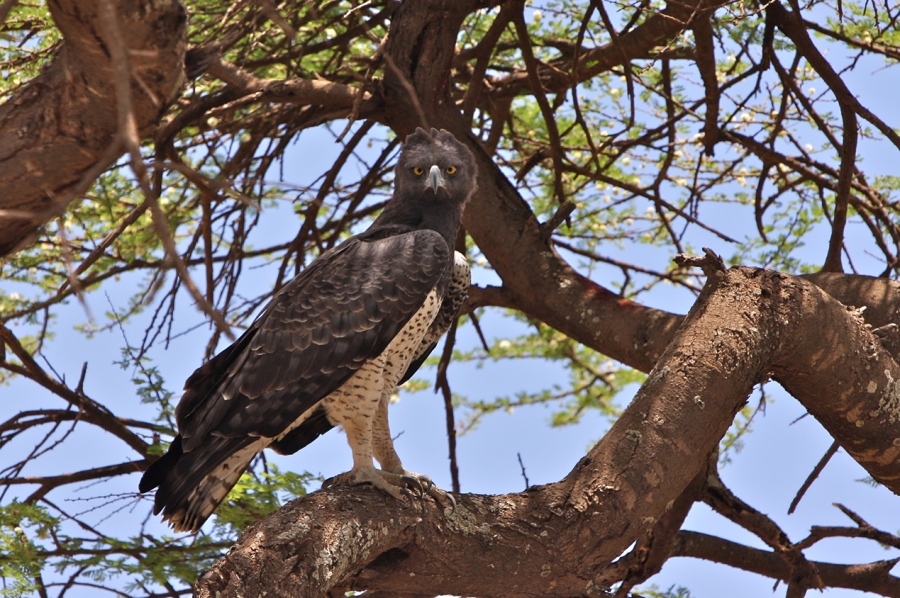
Martial Eagle (Polemaetus bellicosus)

Photo@Yan Van Dainne

Martial Eagle is the one of the huge eagle we have in Kenya.It is a large eagle, growing to a length of 76-83 cm with a wingspan of 190-260 cm. The adult’s plumage has dark brown upperparts, head and upper chest. The body underparts are white streaked with black. The underwing coverts are brown, with pale flight feathers, also streaked with black. The female is usually larger and more streaked than the male. The immature is paler above and has white underparts. It reaches adult plumage in its seventh year.

The Martial Eagle can be found throughout Kenya, wherever food is abundant and the environment favourable. It is never common, but greater population densities exist in Nairobi, Samburu and Maasai Mara National Parks, these birds are more abundant in protected areas than unprotected. It avoids dense forests but needs trees to nest in. The territory can vary greatly in size from more than 1000 Km² to areas where nests are less than 10 km distant. This disparity is due to differences in food supply.

White-headed Buffalo Weaver (Dinemellia dinemelli)

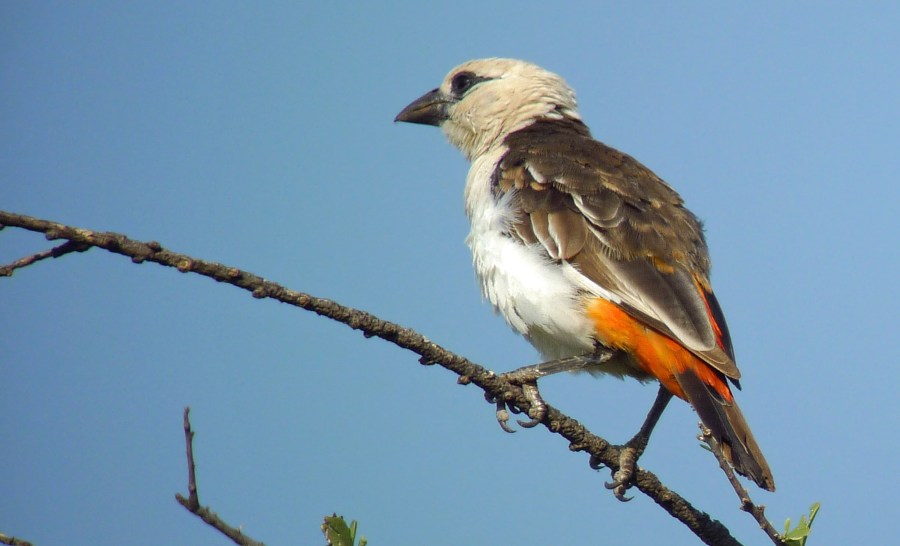
White-headed Buffalo Weaver (Dinemellia dinemelli)

Photo@Jurg Hosang

Hello birders!!Sorry, I was a way for some time birding with two birders from Indiana and New York state.For that reason, I did not post any bird of the week for the last two weeks!. I am back now with great pictures that I hope you will enjoy!!!for how beautiful are just birds!!.

The white-headed Buffalo Weaver is confine to Eastern Africa, and it is brown and white with red rump and vent. Both are stout-bodied, heavy-billed bird. In breeding season the male’s bill become whitish and swollen at the base. Buffalo weavers live in dry regions, where they forage omnivorously on the ground in small noisy flocks, often in the wake of buffalo heards.The nest, a heap of thorny twigs, contains components for two or more pairs;several nest may occupy the same tree.

It is common and widespread in dry part of the arid and semi-arid areas of Kenya.

March 11, 2012: Red-Necked Falcon (Falco chicquera)

March 11, 2012: Red-Necked Falcon (Falco chicquera)

Photo@Yan Von Danne

This rare  norrow-winged, Kestrel-sized falcon typically associated with Palm tree.It can easily be identified from its Red-rufous crown that extend all the way to the scapular. This beautiful raptor has a white face, chin and the upper breast, with broad pale rufoous band across upper breast.Pale blue-grey above with fine black barring;primaries and primary covert darker. The wings are pretty short compared to typical falcons like Peregrine.

Uncommon in low open country, especially with palms and acacia of Galana river, Meru and Samburu national park, Lake Turkana and the coastal part of Kenya.This photo was taken by a friend of mine in Samburu National Reserve.