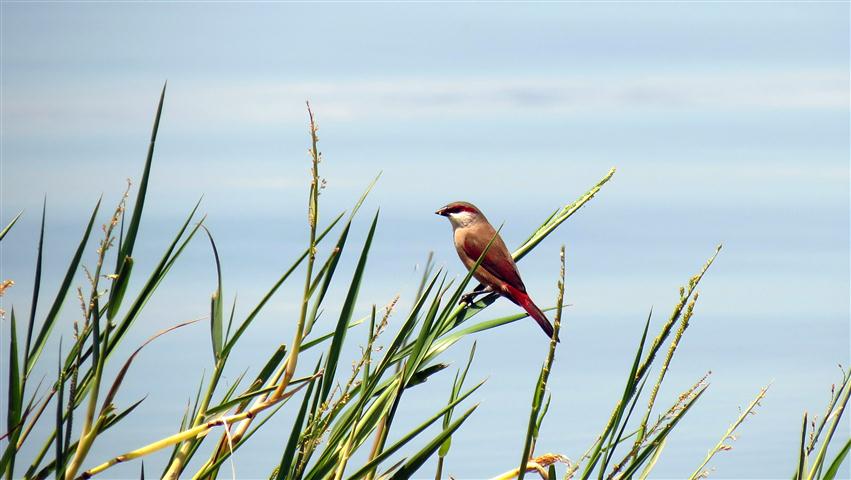
crimson-rumped-waxbill (Estrilda rhodopyga centralis)

Crimson-rumped Waxbill is a typical firefinch type of a bird who most of the time prefer spending its time within the grass top close to wetland habitat.The photo above was taken in Teddy bear Island at Lake Baringo. A Red-rumped waxbill has a slate-grey or black bill. This species is monomophic. Adult bird is warm brown above, with indistinct narrow barring;rumped and upper taile-tailed coverts red;tiled dusky brown, with central feathers tinged crimson, as are the wing-coverts. Broad red streak from bill through the eye. Juvenile bird is similar to an adult bird but lacks red streak through the eye.

Black-necked Weaver (Ploceus nigricollis)

@Michael Sammut

Black-necked Weaver appear in two races, P.n. nigricollis and P.n.melanoxanthus. Both species are widespread in moist secondary growth of western Kenya in area around Kakamega, Bunguma,  Lake Victoria and Masai Mara Game reserve.While spp menaloxanthus is uncommon in dry bush and woodland of Tsavo west and east, Amboseli,Lake Magadi, and Samburu. Male has deep golden-yellow head with black eyes;throat patch and nape also black with red-brown eyes with a back bill.Female has a prominent yellow supercilliary  stripes and not throat patch . Black-necked weaver is very similar to Dark-backed weaver (forest weaver) and Baglafecht Weaver.

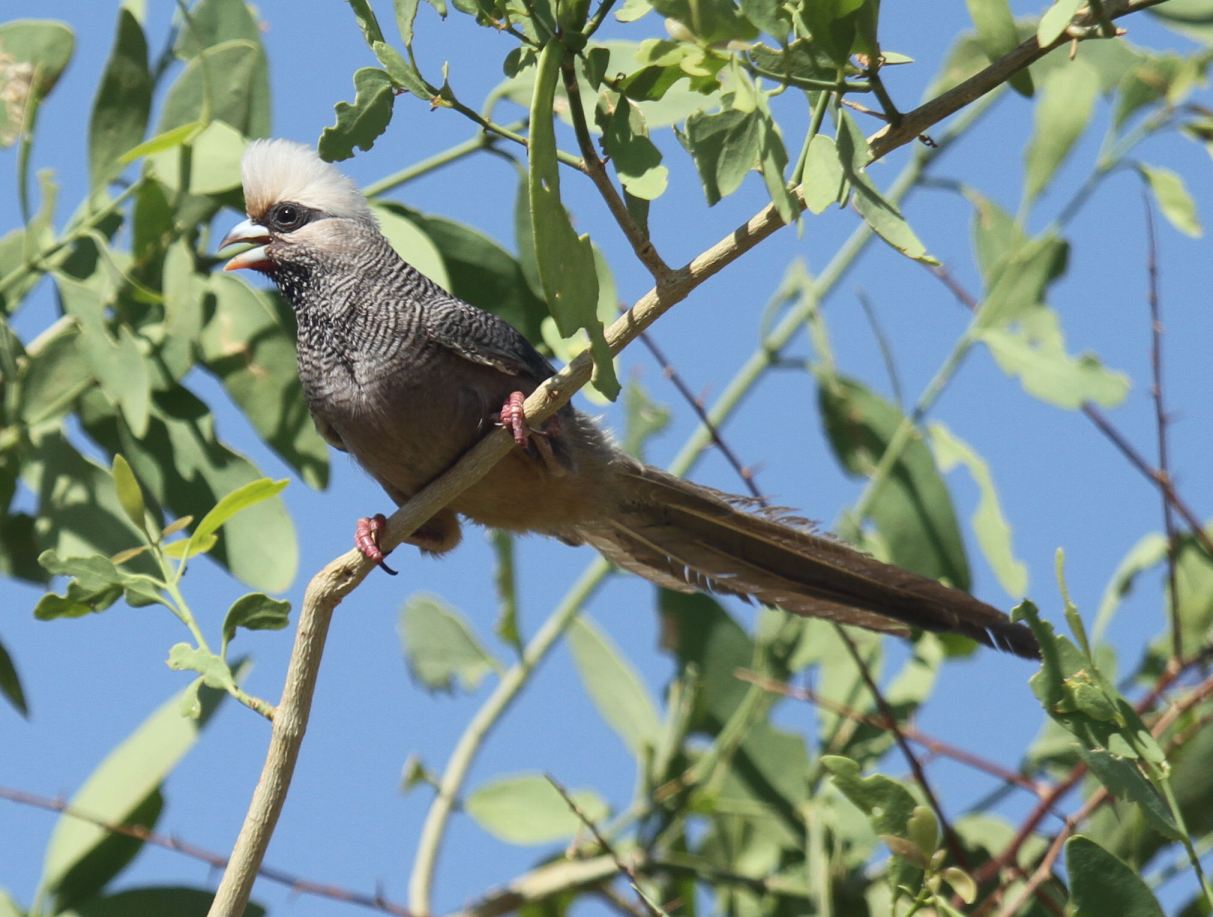
white-headed Mousebird (Colius leucocephalus)

Photo@Jacqui Harrington

Mousebirds, sometimes called colies, are an ancient group of small arboreal birds in Africa. They are so unique in morphological peculiarities that they were proposed as a separate Order of birds as long ago as 1872, and this placement has been confirmed by molecular evidence (Sibley & Ahlquist 1990, Hackett et al. 2008). They are the only Order restricted to sub-Saharan Africa.

In Kenya three species occurs,  White-headed, Blue-naped and Speckled Mousebird.There are only two genera among the mousebirds, and four of the six species are placed in Colius, including White-headed Mouse Bird  of east Africa (left). White-headed Mousebird, like most of this genus, is a bird of arid thornscrub. Its range is limited to a band of such thornscrub from s. Somalia to n.e. Tanzania. The most widespread species, Speckled Mousebird C. striatus, occurs more broadly in a variety of woodlands.

The three  species of Colius mousebirds are essentially allopatric in distribution, without any significant overlap, and where there is a little range overlap, they separate out by habitat.In Kenya it is found  in Samburu, Meru, Tsavo west and Tsavo East National Park.

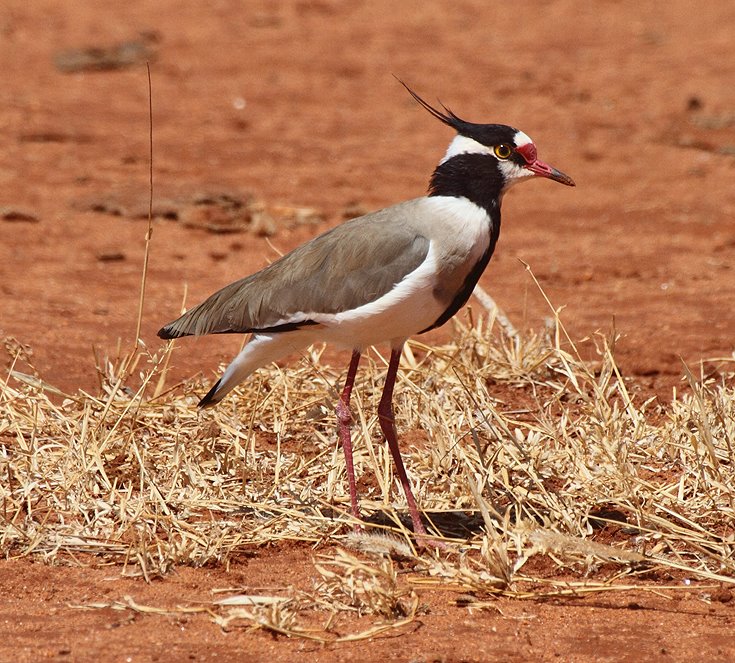
Black-headed Lapwing (Vanellus tectus)

Photo@Michael Sammut

The Black-headed Plover or Black-headed Lapwing (Vanellus tectus) is a species of wading bird of the family Charadriidae. It is found across sub-Saharan Africa.In Kenya specifically, it is found in areas like Tsavo West and East,Lake Baringo, Lake Bogoria,Samburu and Meru National Park. Although not migratory, there is some seasonal movement. Its habitat is wet lowlands close to water. It often feeds in drier habitats, such grassy scrubland.

This bird is readily noticeable and unmistakable. It is medium-large with a mainly black head and white forehead. The lower face and bands across the rear head and nape are also white. The crest is a weak black. The bill and legs are red. The tail is white and tipped black. In flight, the upperwings have black flight feathers and brown coverts separated by a white bar. The underwings are white with black flight feathers.

The diet of the Black-headed Plover consists of insects and other invertebrates that is picked from the ground. The call is a metallic tink-tink.


Hottentot Teal (Anas hottentota)

c@kelemen marton

The Hottentot Teal is a species of dabbling duck of the genus Anas. It is migratory resident in eastern Africa.The Hottentot teal is known for its black-capped head and distinctive blue bill. The duck’s body is speckled brown and black, with black wings.

Monogamous, territorial solitary nester. Interestingly, the pair bond barely lasts beyond incubation, with the male having almost no role in incubation and care of chicks.The female builds the nest, which is a deep bowl in the ground, filled with grass and leaves, often lined with down. It is usually placed in emergent vegetation near water.Laying dates vary with different regions, but usually in February-May.It lays 5-12 eggs, in successive days.Incubation is done solely by the female, for 25-27 days. She will sometimes leave the nest, to join the male in feeding and preening.The chicks are kept hidden in thick reedbeds, which makes them difficult to see. They fledge when they are about 60-65 days old.

Widespread all over Kenya in Swamps like Manguo, Lake Nakuru, Lake Baringo,Lake Bogoria and Lake Naivasha.

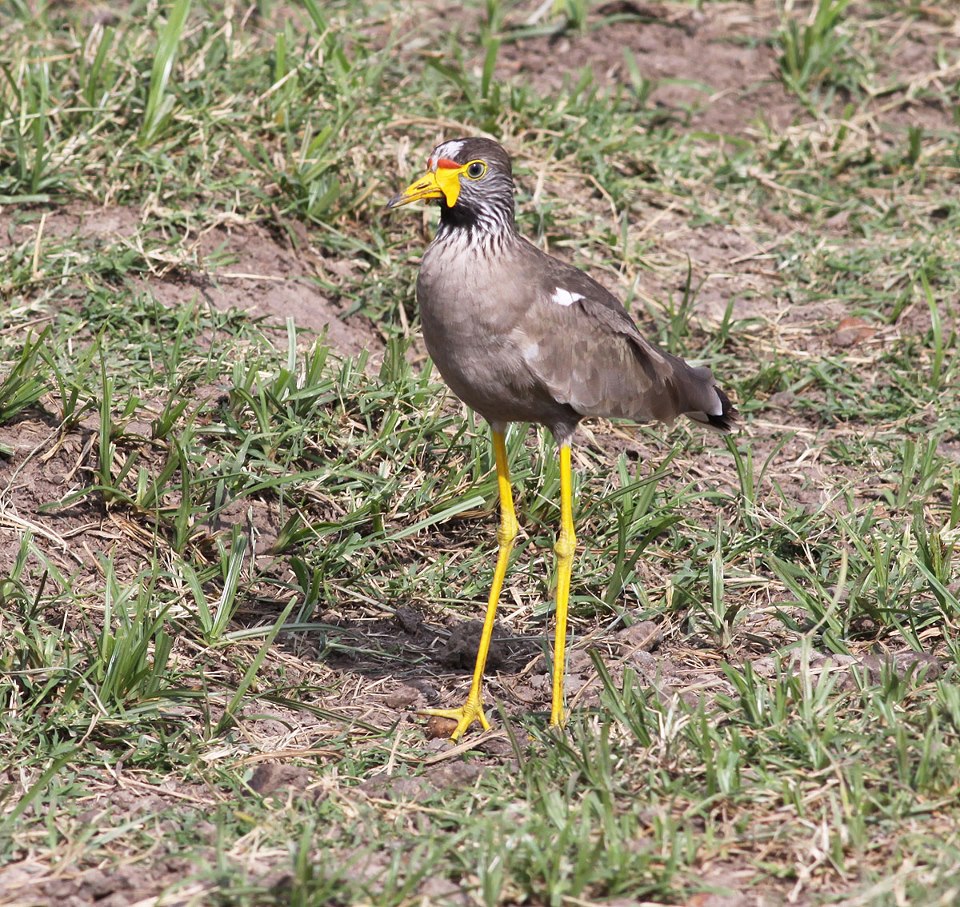
Wattled Plover (Vanellus senegallus)

Wattled Plover (Vanellus senegallus)
Photo@Raymond Galea

Wattled Plover (Vanellus senegallus)

A large and very distinctive Plover. Both the male and female have long yellow facial wattles as well as smaller red ones on the forehead. As with all the lapwings of the genus Vanellus, the Wattled Plover has a white wing stripe (visible in flight) and a white base to its tail. These birds are fairly common in the Maasai Mara and can also be found around Lake Victoria. Although they are residents of swamps, streams and lakes they are only occasionally seen near the Rift Valley Lakes

Green-backed Heron (Butorides striatus atricapillus)

Green-backed Heron (Butorides striatus atricapillus)

Photo@Jurg Hosang

Green-backed or Striated Heron as it is sometimes known is a small,short-legged heron with characteristic of a hunched posture.Adult bird appear dark greyish above with greenish-black erectile crown feathers;grey below with white throat and with a broad chestnut-buff line down foreneck.Legs and feet yellow(orange or red-orange when breeding;bill rather short,blackish with greenish-yellow base and yellow eyes.

Generally Striated heron is a shy and solitary bird, and likes creeping low a long waterside three or roots, and it is mainly diurnal.Well distributed and common in wetlands.