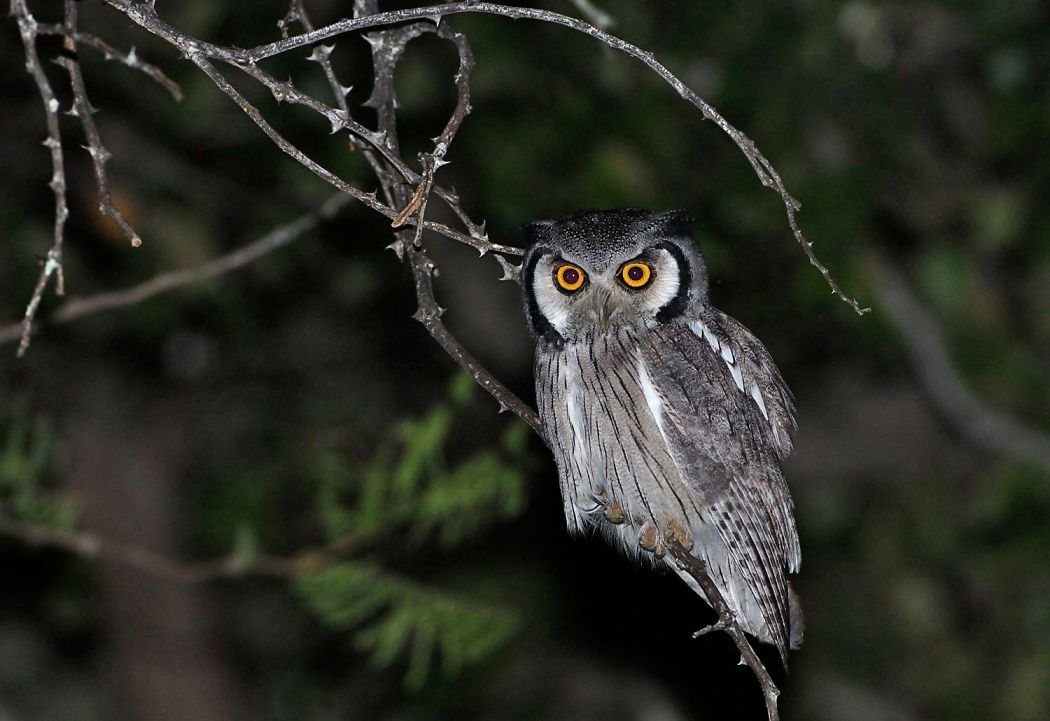
Northen white-faced scops Owl

Photo@Yan Van Duinne

The Northern White-Faced Scops Owl is a smallish owl easily recognizable by its very striking white facial disc, with a border of black plumage. It has large, bright orange eyes, which are also surrounded with black. (Juveniles have greyish plumage on their faces, and their eyes are yellow). These owls have prominent ear-tufts. Bigger than the Scops Owl, they are on average 25cms in height, weighing around 200gms. The feathers of their upper parts are mostly pale grey: their under parts are lighter and more streaked. The female of the species is larger than the male.Like so many other species of owl, northern white faced scops owl is a nocturnal. In Kenya they are found in Samburu and Baffalo springs  National reserve , Meru National Park, Kerio Valley, Lake Baringo and Bogoria .

This species is found singly or in pairs. The female will lay a clutch of 2 or 3 eggs in the old stick-nests of many other bird species, including small raptors such as goshawks and kites – or even herons, dove or crow’s nests. If these are not available, they will nest in natural tree holes. The 30 day incubation is mainly by the female, although the male may assist. Young chicks will start to fly at roughly 33 days, leaving the nest area two weeks thereafter.

Crested Guinea Fowl (Guttera pucherani)

Photo@Raymond Galea

Crested Guinea fowl has a wide range in Kenya and northern Tanzania. In Kenya it is found mostly in western tropical rain forest remnant of Kakamega forest and Lake Manyara national park in Northern Tanzania, Body plumage is much like a typhical Guinea Fowl, with whitish spot; most recognizable features is the short, curly “mop” of black feathers on the head, the rest of the head and neck are bare with blue skin, red skin arond the eyes and on the neck;eyes are red;legs dark brown to black.The species is mono morphic.

Golden-winged Sunbird (Nectarinia reichenowi)

Photo@Jacqui Harrington

Golden-winged Sunbird has a bright yellow tail and wings, the shoulders are dark gray, the dark gray extending to the nape and throat, while the head and downturned beak are lighter gray. The tail is long and ends in two long, very narrow parallel feathers.These birds are found in East Africa; Kenya, Tanzania, and Uganda.Golden-winged sunbirds live in grassland, bamboo thickets, and tropical mountain forest.

In Kenya this species if found in Lake Nakuru and Naivasha,Nyahururu,Mt.Kenya and Aberdare National Park.

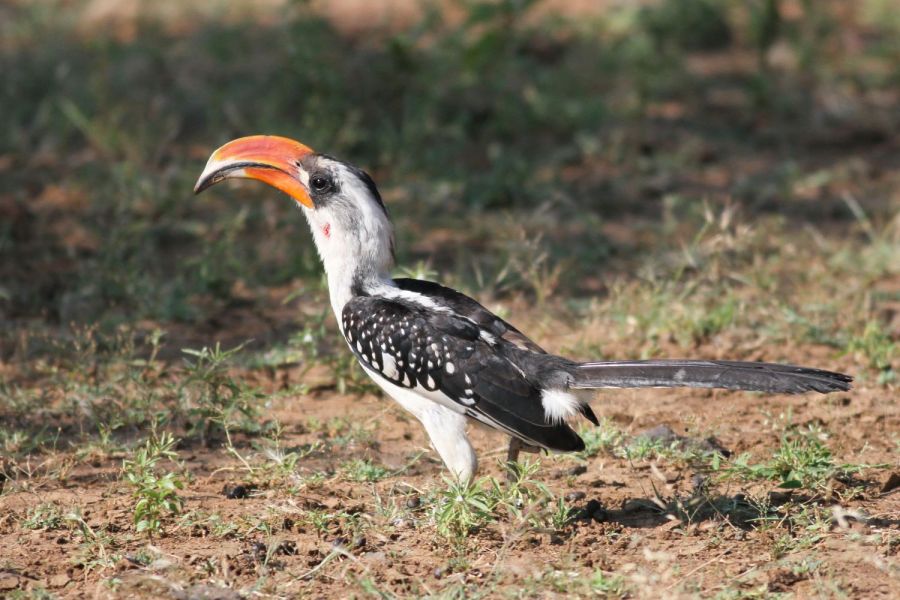
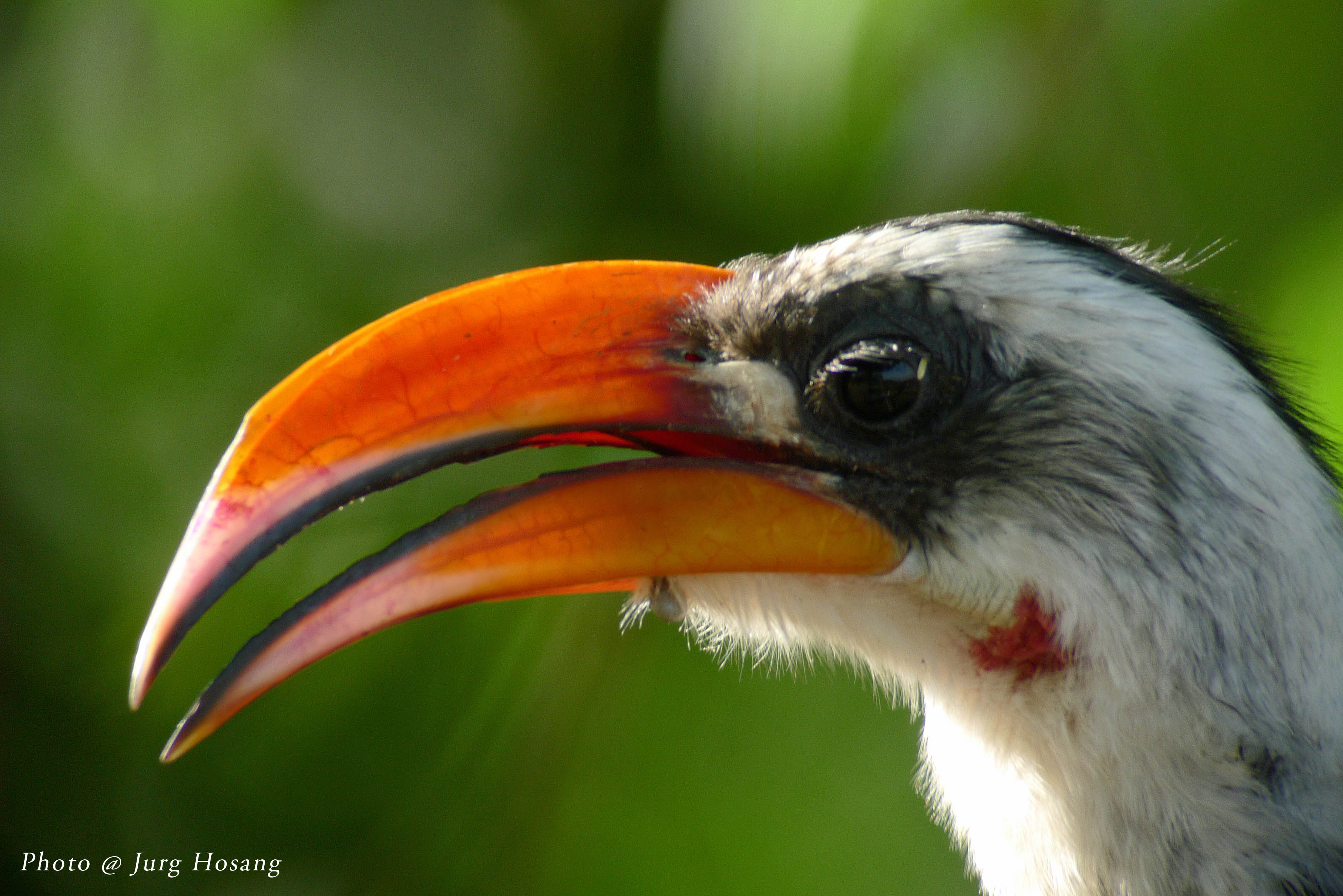
Jacson’s Hornbill (Tockus jacksoni)

Image

Similar to other hornbills, Jackson’s hornbills have a unique and nearly predator proof way of raising their offspring. Before she lays her eggs, the female is sealed in a tree cavity by her mate. During this time, he passes her food through a narrow slit.The species is an example of sexual dimorphism, meaning there is a difference in form between males and females of the same species. The male Jackson’s hornbill has a red billed with a yellow tip (see above) and the female has a black bill.

In Kenya they are found in Lake Baringo, Lake Bogoria, Kapedo and the the  upper part of the Rift Vally mostly in Turkana area.

Black-faced Sandgrouse (Pterocles decoratus)

Image

The sandgrouse are distributed across northern, southern and eastern Kenya, Specifically in desert and semi-arid areas of Samburu, Meru, Marsabit, Turkana,Lake Baringo,Tsavo west and east, and Amboseli

Sandgrouse have compact bodies, but small, pigeon-like heads and necks. The different species range in length from 24 – 40 cm and weigh from 150 – 500 g.

Males and females look alike, Some species are also polymorphic .

They have long pointed wings and short legs that are feathered down to the toes, and members of the genus Syrrhaptes also have feathered toes.

Sandgrouse mostly feed on seed and are often seen in large feeding flocks with up to 100 birds.

Sandgrouse are monogamous (form life-long pair bonds). They make their nest on a slight depression in the ground. The average clutch consists of 2 eggs, occasionally up to 4. The male and female share the incubation duties; with the male incubating during the night and early mornings, and the female taking over during the day.

The young hatch after about 20 – 25 days; and are able soon able to leave the nest.

They are able to feed themselves from the day they hatch, but have to learn foraging skills from their parents for several months.

Protect the Lesser Flamingo – save Lake Natron!

With this week’s bird of the week being the Flamingo, it reminded me of an important environmental and conservation concern regarding this spectacular pink bird: SODA ASH (sodium carbonate). The Eastern Rift Valley is home to Lake Nakuru, Lake Bogoria, Lake Elementaita, Lake Magadi, and Lake Natron – all soda lakes, famous for providing the habitat of the near-threatened Lesser Flamingo.

Sodium carbonate is used in many household and industrial products and is being harvested in Lake Magadi, Kenya by TATA Chemicals, who are also proposing to set up a new environmentally devastating plant at Lake Natron, Tanzania.

The introduction of a soda ash plant into Lake Natron would have catastrophic effects on the already near-threatened Lesser Flamingo. Not only would the plant lead to habitat degradation and species loss, but its development would also be detrimental to East African tourism, and the livelihood of the Maasai community living in the surrounding area.

Bird Life International highlighted these concerns in April 2011 with their article “Fresh concerns as President orders Lake Natron soda ash mining fast tracked

“Lake Natron is the only regular breeding site for Lesser Flamingos in Eastern Africa. The 1.5-2.5 million Lesser Flamingos – which represents three quarters of the world population – breed only at Lake Natron. ………Noise from the heavy equipment, the presence of people and a network of pipes will chase away the birds which are highly sensitive to disturbance while breeding”

Lessons learned in Lake Magadi highlight that little to no economic or development benefits have come from harvesting soda ash in the magical waters home to the flamingo.

“Soda ash mining at Lake Magadi has left local communities disillusioned with little to show for the 100 years of mining. The environment has been damaged and fresh water nearly depleted”

With the re-emergence of the issue recently, the Star published an environmental commentary, ‘Don’t Fund Lake Natron Mining’ advocating halting the development of a soda ash factory on Lake Natron.

Let this be a call to bird enthusiasts, ornithologists, conservationists, environmentalists, and tourism professionals to come together and advocate for the protection of Lake Natron, the rehabilitation of Lake Magadi and the security of our precious Lesser Flamingo.

Watch the amazing documentary The Crimson Wing and find inspiration to see these Flamingos continue their flight between the Rift Valley soda lakes.

The stunning movie trailer: The Crimson Wing

Other important articles and resources:

Bird Life International – Think Pink

RSPB: Lake Natron

Bird Life International – Serengeti Highway and Lake Natron

Stop the Serengeti Highway

Joe

Flamingos in Lake BogoriaFlamingos in Flight Lake Bogoria