Yellow-throated Sandgrouse (Pterocles gutturalis)

Yellow-throated Sandgrouse (Pterocles gutturalis)

Photo@Raymond Galea

Yellow-throated Sandgrouse is a sexual diamorphic species The female and male both have a buff-yellow chin and throat. The male is olive-brown and unspotted with a black collar on its foreneck. Upper wing-coverts are tipped with a light cinnamon and flight feathers are blackish brown. highs and belly are a dark chestnut. Females are mottled with fine black bars on their chestnut belly.These monogamous birds are also solitary nesters. They lay two to three eggs during the winter. The female incubates the eggs during the day and the male incubates them at night, for a total of 26 days. The female and male both care for the chicks when they hatch.They are seed and grains eaters.The bird appearing above was photographed inside Ngorongoro Crater.The yellow-throated sandgrouse is the largest of the five Kenyan Sandgrouses.In Kenya it is best seen in areas found in Southern part of the Country around Amboseli, Masai Mara and Tsavo west national park.
Greater Painted-snipe (Rostratula benghalensis)

Greater Painted-snipe (Rostratula benghalensis)

Photo@Morton Kelemen

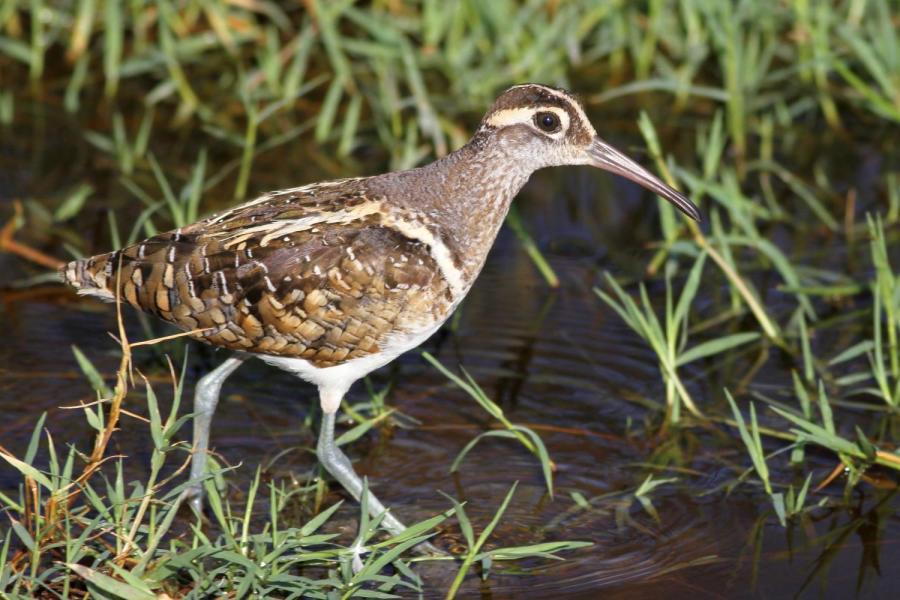
A medium-sized, attractive water bird, the greater painted-snipe (Rostratula benghalensis) is unusual amongst birds because the female is larger and more brightly coloured than the male. The female greater painted-snipe has distinct white patches around the eyes, which contrasts the dark red-brown head and neck. The upperparts are dark bronze-green with fine black barring and the wings are dark grey, white and gold. The male greater painted-snipe has a conspicuous golden eye patch that sits in stark contrast with the grey-brown head, ash-grey neck, and white streaked throat.
In Kenya it is widespread from sea level to over 2000m, but uncommon, highly erratic and seasonal. Frequent marshy and lakes like Lake Baringo, Lake Nakuru and central Kenya swamps.

Blue-cheeked Bee-Eater (Merops p. persicus)

Blue-cheeked Bee-Eater (Merops p. persicus)

photo@Yan Van Duinne

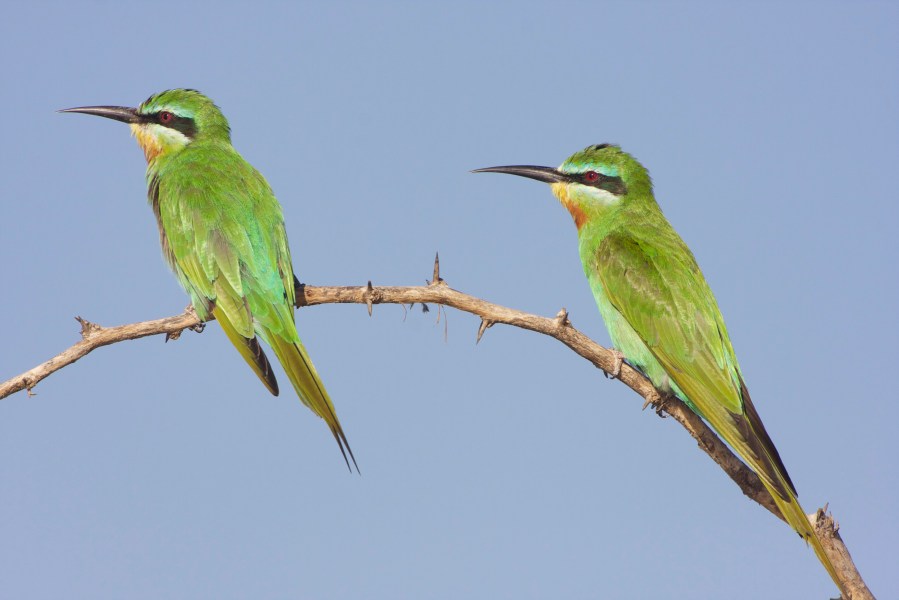
Blue-cheeked Bee-eater is a long tailed, bright green bee-eater with black mask, mostly white forehead,green crown and pale blue or whitish superciliary and cheek stripes conspicuously brighter than surrounding green plumage; yellow chin merges with russet throat. Underside of the wings coppery rufous. First winter birds are duller, more olive than adult, and sometimes retaining pale-edged juvenile feathers ;forehead green, narrowly yellowish bill; chin pale yellowish buff grading into rufous-buff throat patch.
Regular palearctic migrant of late October-early April at lake Victoria and Baringo which is the best place to see them in huge number

Fan-tailed Widowbird (Euplectes axillaris)

Fan-tailed Widowbird (Euplectes axillaris)

Photo@Tony Crocetta

This is an adult male fan-tailed widowbird, Euplectes axillaris, a member of the avian family Ploceidae, the weaver birds. One of its cousins is the red-billed quelea, Quelea quelea, the most abundant bird in the world.This species has an extremely large range, so incidence of you spotting it while birding in Kenya is very high. They exhibit sexual dimorphism and female appears brown, with the distinctive red-shoulders which clear when the bird air-bone.
In Kenya this species is mostly seen in Masai Mara, mostly a long the northern part of the reserve around the Musiara Swamp.

Spotted Eagle-Owl (Bubo africanus)

Spotted Eagle-Owl (Bubo africanus)

Photo@Michael Sammut

Spotted Eagle-Owl is medium to large owl with prominent ear tufts. Upper-parts dusky brown with pale spots, under-parts whitish and finely barred. Facial disk whitish to pale ochre. A more rufous morph exists in more arid areas.It very similar to Greyish Eagle-Owl, only that has bright-yellow eyes, and in Kenya is mostly found in the southern part of the equator. It prefers Savannah, rocky outcrops, scrub, open and semi-open woodland, semi-deserts.

Birding hotspot where this species can be recorded include;Amboseli, Tsavo West and East National Park, Meru, Kitui, Maasai Mara and the greater area of Lake Victoria.

Purple Grenadier (Uraeginthus ianthinogaster)

Purple Grenadier (Uraeginthus ianthinogaster)

Photo@Tony Crocetta

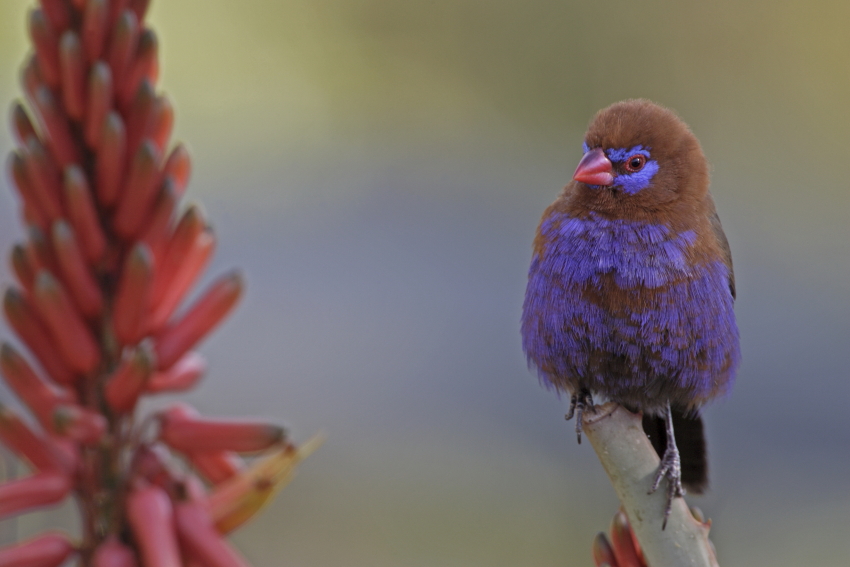
Dark chestnut brown bird with red beak, black tail, and deep purplish blue rump. Male has purplish-blue feathers around the eyes, and purplish-blue breast, belly, and flanks. Female has less extensive (sometimes absent) blue feathering on the face, and often has white feathers around the eyes; female’s breast and belly is spotted or barred white. Juveniles appear similar to the female but paler, duller, and without white markings. The juvenile tends to be paler. Juveniles have blackish bills and their legs are paler than the adults’. Juveniles go through an early partial molt of the face feathers where males obtain their blue feathering and females their pale mauve feathering around the eyes.
This is a dimorphic species; the male sports blue on his face, breast, and belly. The female has less extensive blue on the face and sports white around the eyes as well as on the breast and belly. Usually form pairs and small parties. Courtship usually takes place on the ground with the male holding a stem or feather in his bill, singing and bowing his head as he bobs up and down, hoping to attract a female. An interested female may fly to the male, twist her head and tail toward him and possibly also show a display. Both male and female share nest construction, often building their round nest low in a bush or shrub. The male may continually line the nest with feathers during incubation, which both parents take turns doing through the day, with the hen incubating at night.
This species is widely distributed in Kenya and it should not be difficult to spot and identify this bird.

Grey Crowned Crane (Balearica regulorum)

Grey Crowned Crane (Balearica regulorum)Photo@Tony Crocetta

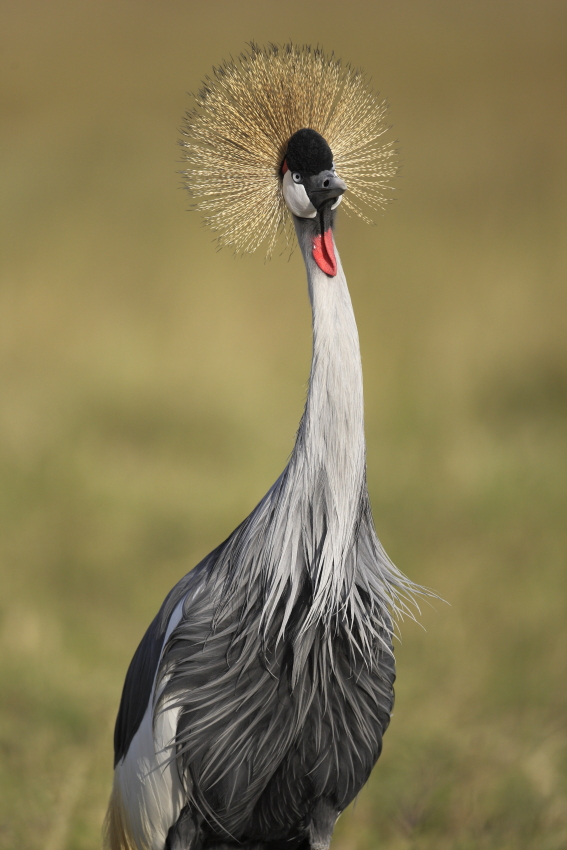
Grey Crowned Crane has a breeding display involving dancing, bowing, and jumping. It has a booming call which involves inflation of the red gular sac. It also makes a honking sound quite different from the trumpeting of other crane species. Both sexes dance, and immature birds join the adults. Dancing is an integral part of courtship, but also may be done at any time of the year.Its body plumage is mainly grey. The wings are also predominantly white, but contain feathers with a range of colours. The head has a crown of stiff golden feathers. The sides of the face are white, and there is a bright red inflatable throat pouch. The bill is relatively short and grey, and the legs are black. The have long legs for wading through the grasses. The feet are large, yet slender, adapted for balance rather than defense or grasping. The sexes are similar, although males tend to be slightly larger. Young birds are greyer than adults, with a feathered buff face.

In Kenya they are widespread in all wetlands and grassland field. They however, prefer breeding in Saiwa sawmp National Park in western Kenya and other high altitude wetland in Kenya.

Greater Crested Tern (Thalasseus bergii)

Greater Crested Tern (Thalasseus bergii)
Michael Sammut

Greater Crested Tern is a prominently crested coastal bird, which appears slightly smaller than Caspian Tern.At rest it appears elongated, with long wings  and large pale yellow billed which drops at the tip.On flight the tail appear very forked. A breeding adult has a black cap separated from the bill by a narrow white band. In Kenya it commonly seen a long the coast especially in areas around Sabaki delta,  Mida-Creek and Diani Beach.

Bar-Tialed Trogon (Apaloderma vittatum)

Bar-Tialed Trogon (Apaloderma vittatum)
Stratton Hatfield


The Bar-Tailed Trogon is a stunning secretive long tailed forest bird that sits motionless for long periods often high in the canopy.It is similar to the more widespread Narina Trogon  found both in Forest and bushlands, but with blue breast band and barred tail.

The Bar-Tailed Trogon has the following features that aid identification.The adult bird has dark green and red plumage with a blue band across the breast.From behind the Bar-Tailed Trogon has a narrow tail with black and white edges while underneath the tail is entirely barred.That’s where it gets its name from.The adult female has dull brown head and breast while the immature ones have pale-tipped wing coverts. Due to its secretive nature, the bird is rarely seen in location like Kakamega forest, Kieni Forest, Mt.Kenya and Aberadare National Park.


Friedmann’s Lark (Mirafra pulpa)

Friedmann's Lark (Mirafra pulpa)

Photo@Joseph Aengwo

Friedmann’s Lark is a rare bird resembling Singing Bush Lark but more richly coloured and more heavily streaked above, especially on nape and upper back, streaking enhanced in fresh plumage by broad pale feather edges; superciliary stripes somewhat  less prominent . Singing birds readily distinguished vocally and y prominent white throat. Gregarious territorial birds share habitat with Singing Bush Lark, Red-winged and Flappet Lark.It has a tendency of elevating crown feathers when singing, leaning forwards and fluffing out  the white throat. Tsavo West and East National Park are the only places you have an high chance of seeing them.