March 11, 2012: Red-Necked Falcon (Falco chicquera)

March 11, 2012: Red-Necked Falcon (Falco chicquera)

Photo@Yan Von Danne

This rare  norrow-winged, Kestrel-sized falcon typically associated with Palm tree.It can easily be identified from its Red-rufous crown that extend all the way to the scapular. This beautiful raptor has a white face, chin and the upper breast, with broad pale rufoous band across upper breast.Pale blue-grey above with fine black barring;primaries and primary covert darker. The wings are pretty short compared to typical falcons like Peregrine.

Uncommon in low open country, especially with palms and acacia of Galana river, Meru and Samburu national park, Lake Turkana and the coastal part of Kenya.This photo was taken by a friend of mine in Samburu National Reserve.
3 March, 2012:Rosy-Patched Bush Shrike (Rhodophoneus cruentus)

188

Photo@Joseph Aengwo

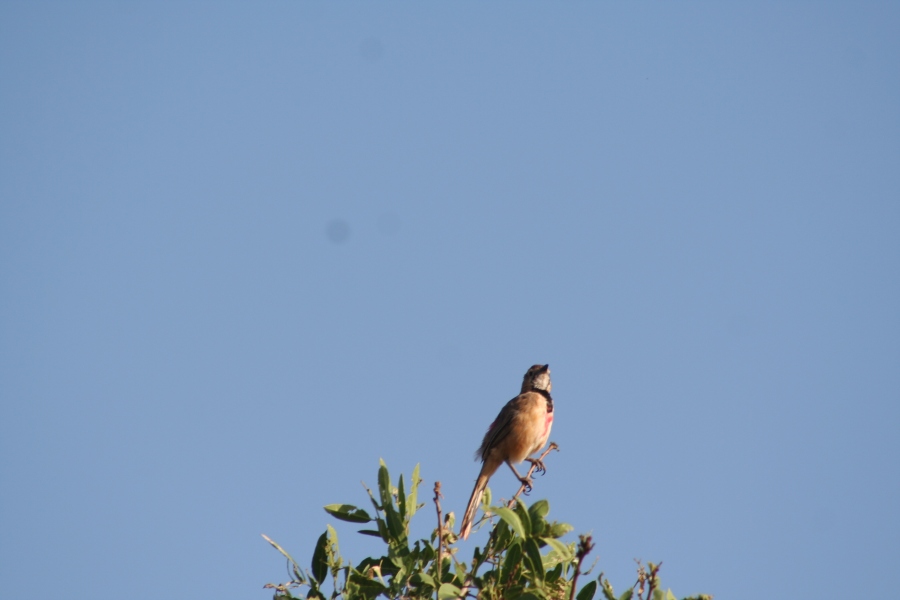
Rosy-patched Bush Shrike is a beautiful bird!it is locally  common in bushed grassland, bushland and scrub in arid and semi-arid plateau country up to altitude of about 1600 meter.Two races occur, apparently without intergrades: hilgerti in northern and eastern Kenya from Turkana, Ileret, Marsabit and Moyale to Baragoi, Isiolo and Athi .While the race Cathemagmena is in south Kenya in areas around Tsavo west and East National park.

While birding in those areas mentioned, this bird should be hard to see as they always like singing on top scrub bushes.They are never shy as such.

January 15,2012:Common Ostrich (Struthio camelus massaicus)

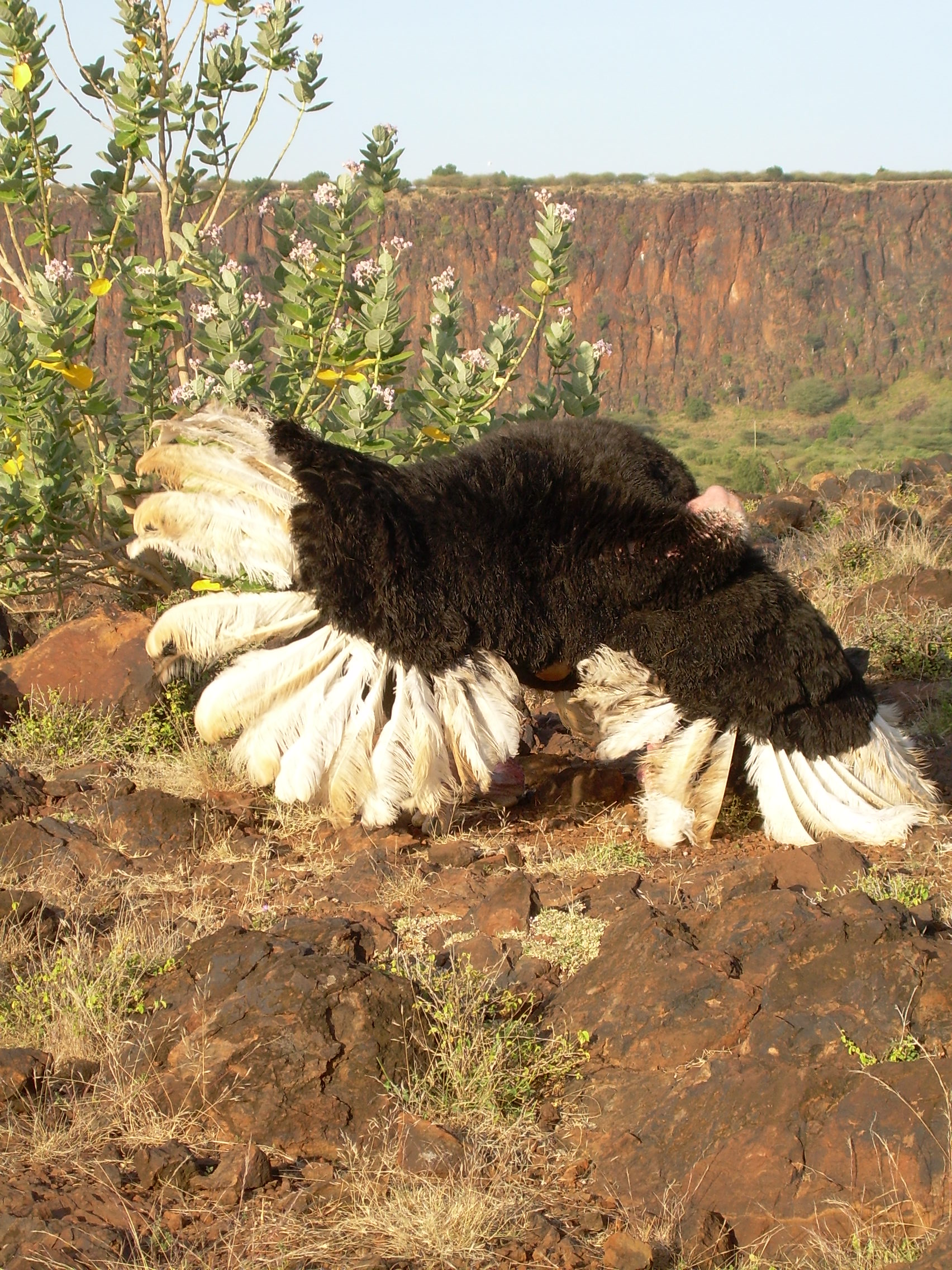
Common Ostrich is one of the two species in Kenya, the other is Somali Ostrich found in the northern eastern part of the country. Their distribution in Kenya is widespread. They are the tallest and heaviest birds in the world and belong to a primitive group called rarities. Because of their poorly developed sternum, they do not have the place where the muscle required to aid flight can be attached. They are adopted to terrestrial lifestyle. They can run incredibly fast.

Common Ostrich Dance

Ostriches have sexual dimorphism where the male is brownish black with white wings, tail and neck ring. The female appears in a generally grey-brown with pale feather edge with neck and legs being pale-pinkish.

The photos taken show the male performing their normal interesting courtship display mostly referred to as kantling, whereby they squat down and then sway from side to side while fanning and quivering their outstretched wings. This is thought to induce the female into wanting to mate.

I managed to capture these outside my home in Lake Baringo. This guy is a bit confused as he performed the dance for me! Perhaps I look like a female Ostrich. Enjoy this rare glimpse at the Common Ostrich’s courtship display.


January 8, 2012: Lilac-Breasted Roller (Coracias caudata)

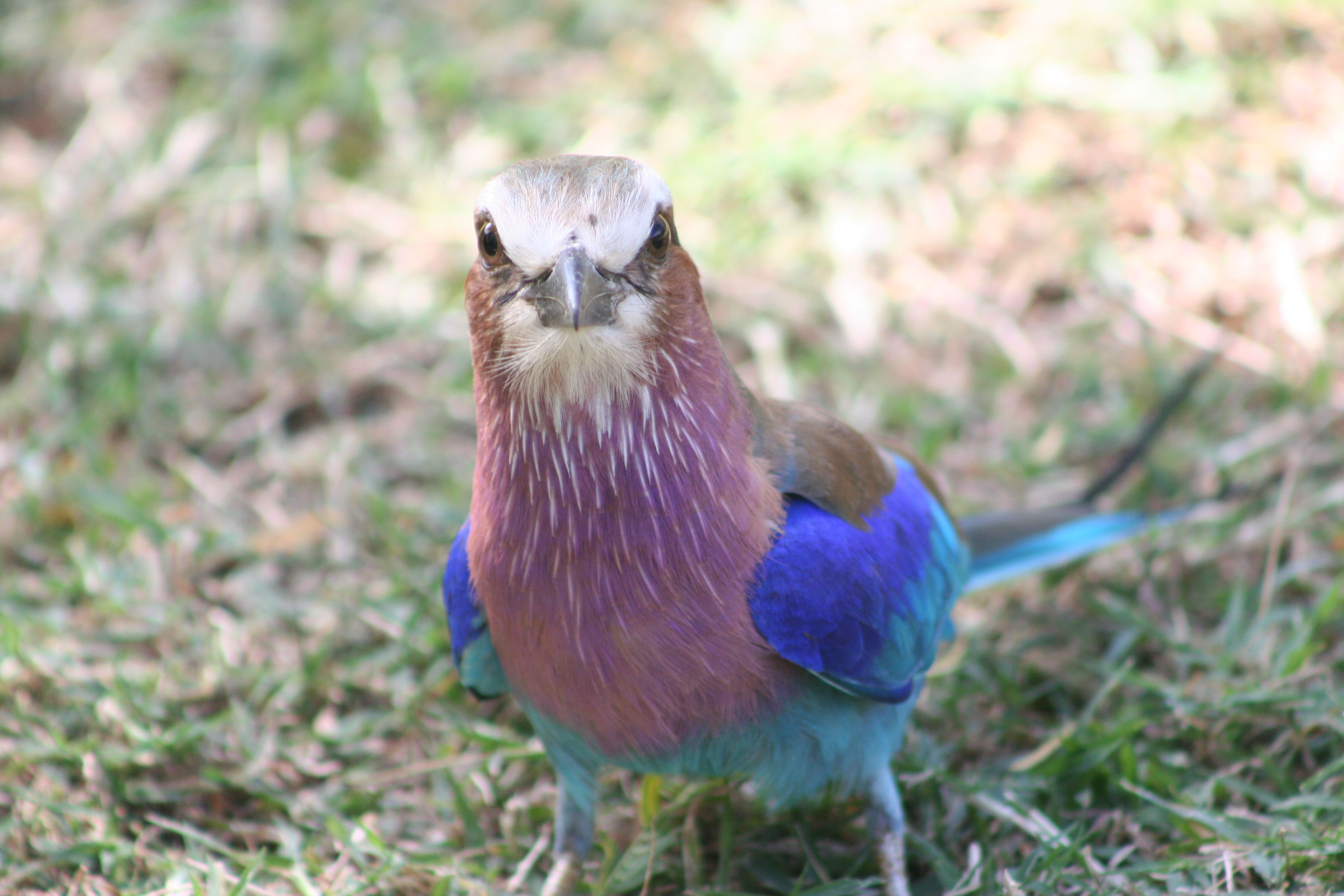
The average size of the Lilac Breasted Roller is 14.5 inches, including the tail streamers. The washed green head is large, the neck is short, the greenish yellow legs are rather short and the feet are small. The beak is strong, arched and hooked-tipped. The tail is narrow and of medium length. The back and scapulars are brown. The shoulder of the wing, outer webs of the flight feathers and the rump are all violet. The bases of the primaries and their coverts are pale greenish blue and the outer tail feathers are elongated and blackish. The chin is whitish, shading to rich lilac of the breast. The underparts are greenish blue. The bill is black and the eyes are brown. It has large wings and strong flight.

Lilac-breasted roller is most cases seen hunting for its food which may range from grasshoppers, beetles and small amphibians. Great photographic chances are found when the bird is foraging in the ground.

It is the most commonly seen roller. It well distributed in Samburu, Lake Baringo and Bogoria, Nakuru, Masai Mara, Amboseli, Nairobi and Tsavo National Park.

Lilac-breasted Roller photoshoot

This Lilac-breasted Roller was caught posing at the Lake Baringo Club over Christmas. It just couldn’t get enough of having its photo taken. Enjoy this set of photos of this beautiful bird!

Coming up, a report on birds spotted on a recent tour I guided, as well as the bird of the week, and much more!

Joe

December 30, 2011: Rufous-naped Lark (Mirafra africana)

 Rufous-naped Lark  (Mirafra Africana)

The Rufous-naped Lark’s head is coloured brown as well as the bill. The Mirafra Africana has a white coloured throat, pink legs and a brown coloured back. The eyes are brown.

The male Mirafra africana has physical features that are slightly different from the female bird. When the bird is excited it has a richly striped rufous crown. In most observatory incidence the bird tends to call from a raised platform or rather on top of a medium sized tree.

In Kenya, the bird is widely distributed in areas around central Kenya, Lake Naivasha, Maasai Mara and Amboseli National park.

Rufous-naped lark Rufous-naped lark song

I recently spotted this Rufous-naped lark in the Maasai Mara National Reserve and recorded it’s song.

– Joe

December 15, 2011: Hunter’s Sunbird (Nectarinia hunteri)

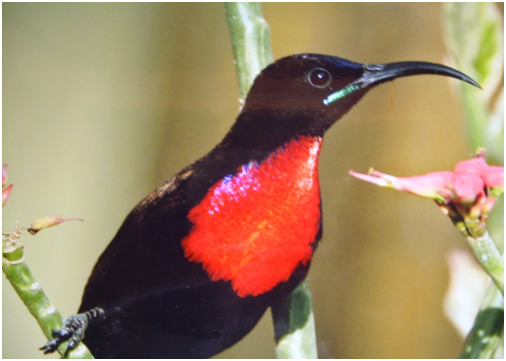
Hunter’s Sunbird is widespread and found in most dry areas of Kenya; especially in wooded and bushed grassland, it will however avoid very dry desert-like environments. It can easily be mistaken for the Scarlet-chested and Amethyst Sunbird.

The adult male is a non-reflective velvety black, with more brownish on the back, and a glittering green crown which appears turquoise; the throat as well as the patch on the bend of the wing is metallic ruby or rose-purple.

Hunter's Sunbird

The female is grey-brown above with white edged coverts. The under part is dull white, strongly mottled with sepia-brown on the throat and breast, more faintly on the belly and flanks washed brown, with chin and throat appearing darker .

It has a habit of being shy and solitary. It is widely distributed in dry areas like Samburu and Shaba National Reserve, Lake Baringo, Lake Bogoria and Kerio Valley.

Urban Birding in Kenya

I bird everywhere! Even in the urban landscapes of Kenya, in locations where one wouldn’t expect to be birding, it is possible to spot species with a keen eye. I spotted this Winding Cisticola on the outskirts of a residential area of Eldoret on an evening walk.

Winding CisticolaWinding Cisticola 2Coming soon your ‘Bird of the Week‘.

Joe