Gabar Goshawk (Micronisus gabar)

Gabar Goshawk (Micronisus gabar)

Photo@Michael Sammut

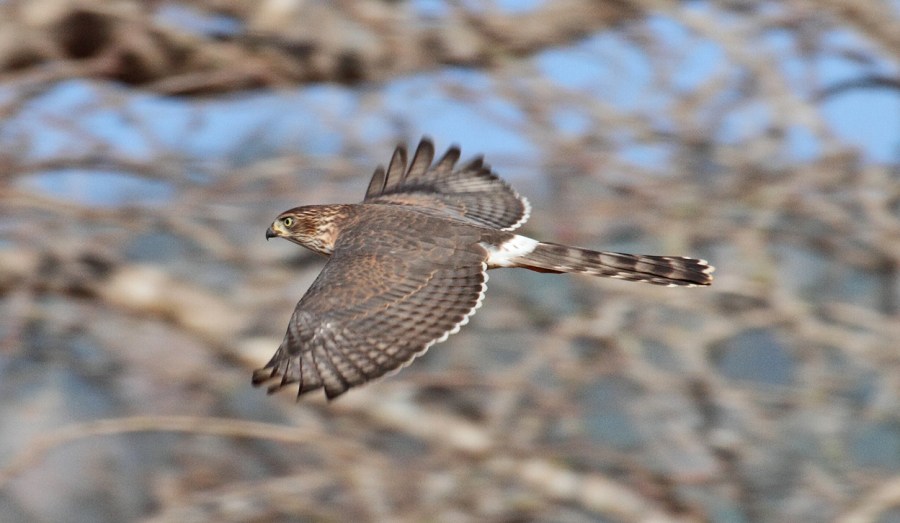
Gabar Goshawk is smaller than other Goshawks. We can observe two morphs, one grey and one almost black. This melanistic form represents about 6 to 25 % of population. The photo shown above is of a juvenile bird.

In typical grey morph, adult has plain grey upperparts and white rump. Tail is grey, barred with black.Underparts are plain grey on chest. Belly is white, barred with grey. Vent is white. Flight feathers are sooty-grey with very pale grey bars. Tail is white with broad dark grey bars.
Head is grey. Bill is black, with red cere and gape. Eyes are deep dark red. Long bare legs and stocky toes are bright red.

Gabar Goshawk lives in savannahs and semi-arid scrub with scattered trees. It avoids too dense forests and driest deserts. It is rather found in drier thorn savannah, and also along watercourses.In Kenya it is commonly seen in Lake Baringo and Bogoria, Tsavo West and East National and Samburu National Reserve.
Martial Eagle (Polemaetus bellicosus)

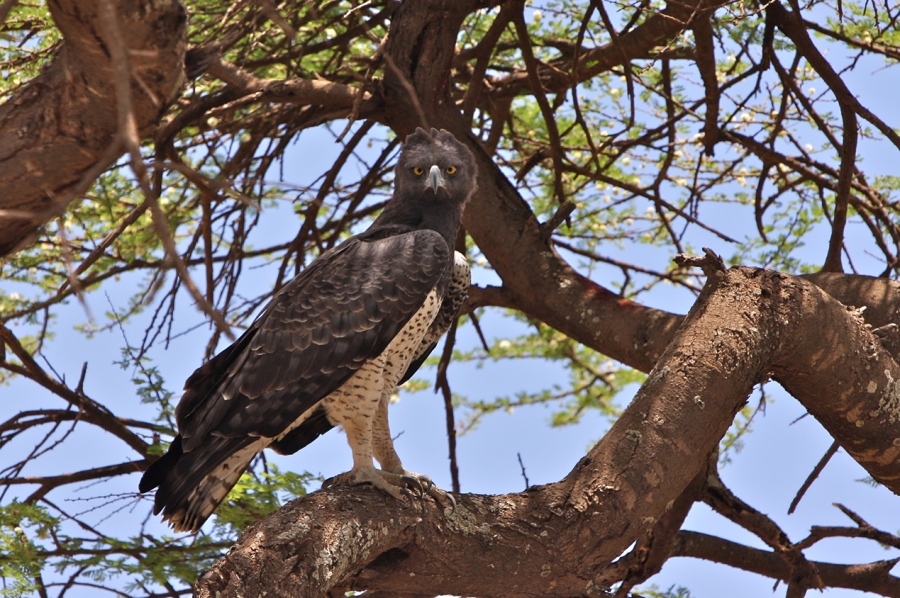
Martial Eagle (Polemaetus bellicosus)

Photo@Yan Van Dainne

Martial Eagle is the one of the huge eagle we have in Kenya.It is a large eagle, growing to a length of 76-83 cm with a wingspan of 190-260 cm. The adult’s plumage has dark brown upperparts, head and upper chest. The body underparts are white streaked with black. The underwing coverts are brown, with pale flight feathers, also streaked with black. The female is usually larger and more streaked than the male. The immature is paler above and has white underparts. It reaches adult plumage in its seventh year.

The Martial Eagle can be found throughout Kenya, wherever food is abundant and the environment favourable. It is never common, but greater population densities exist in Nairobi, Samburu and Maasai Mara National Parks, these birds are more abundant in protected areas than unprotected. It avoids dense forests but needs trees to nest in. The territory can vary greatly in size from more than 1000 Km² to areas where nests are less than 10 km distant. This disparity is due to differences in food supply.

White-headed Buffalo Weaver (Dinemellia dinemelli)

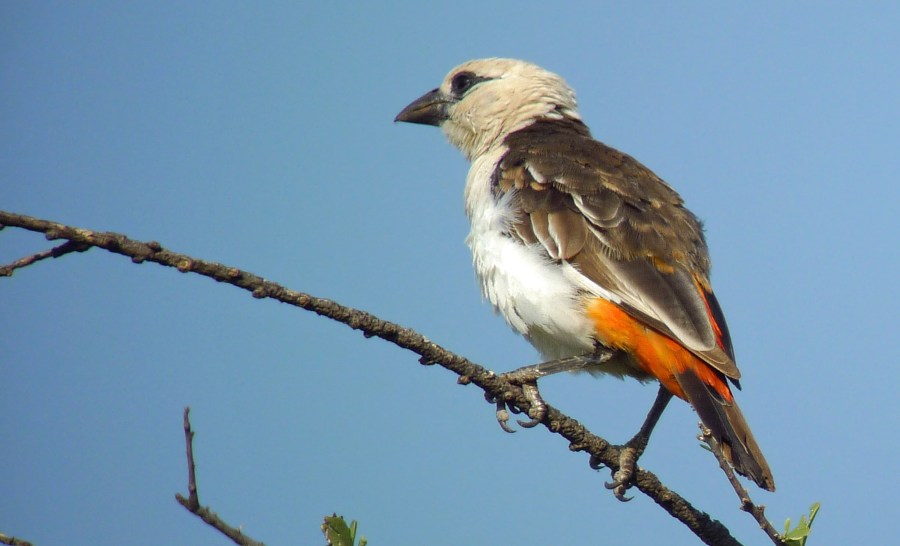
White-headed Buffalo Weaver (Dinemellia dinemelli)

Photo@Jurg Hosang

Hello birders!!Sorry, I was a way for some time birding with two birders from Indiana and New York state.For that reason, I did not post any bird of the week for the last two weeks!. I am back now with great pictures that I hope you will enjoy!!!for how beautiful are just birds!!.

The white-headed Buffalo Weaver is confine to Eastern Africa, and it is brown and white with red rump and vent. Both are stout-bodied, heavy-billed bird. In breeding season the male’s bill become whitish and swollen at the base. Buffalo weavers live in dry regions, where they forage omnivorously on the ground in small noisy flocks, often in the wake of buffalo heards.The nest, a heap of thorny twigs, contains components for two or more pairs;several nest may occupy the same tree.

It is common and widespread in dry part of the arid and semi-arid areas of Kenya.

Green-backed Heron (Butorides striatus atricapillus)

Green-backed Heron (Butorides striatus atricapillus)

Photo@Jurg Hosang

Green-backed or Striated Heron as it is sometimes known is a small,short-legged heron with characteristic of a hunched posture.Adult bird appear dark greyish above with greenish-black erectile crown feathers;grey below with white throat and with a broad chestnut-buff line down foreneck.Legs and feet yellow(orange or red-orange when breeding;bill rather short,blackish with greenish-yellow base and yellow eyes.

Generally Striated heron is a shy and solitary bird, and likes creeping low a long waterside three or roots, and it is mainly diurnal.Well distributed and common in wetlands.

Rufous-crowned Roller (Coracias naevius)

Rofouse-crowned Roller

Photo@Yan Van Danne

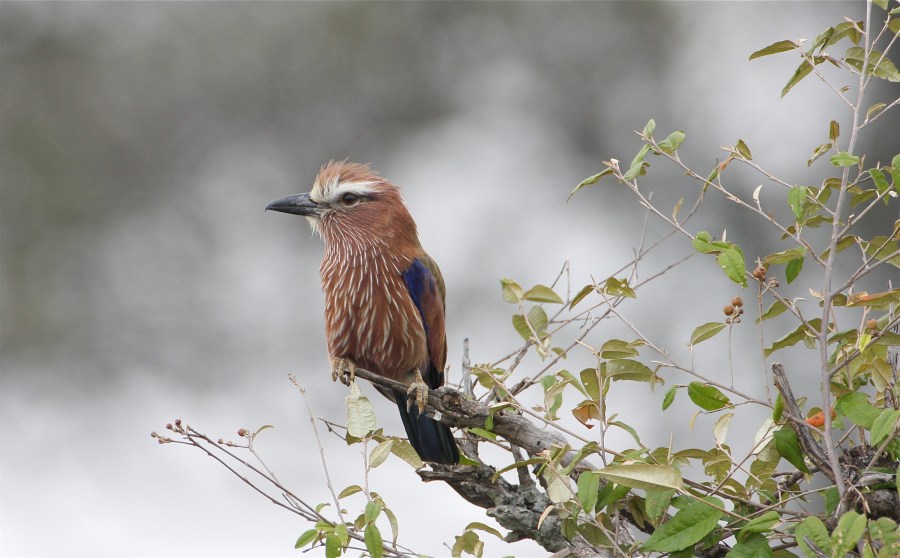
Rufous-crowned or Purple Roller has it is sometimes referred to is a very uncommon compared to other species of Rollers, with exception of Abyssinian Roller.It feed on big insect and it can be observed from one spot for some time as it scanned and goes for his prey and returning to the same location .

The bird is generally purple as the name suggest with violet tailed and a little spot on the wing shoulder.It is the biggest roller we have in East Africa, therefore identifying this bird should never be a problem at all.

It is very common in areas around Lake Baringo, Lake Bogoria, Kerio Valley, Kapedo, Samburu National reserve and Meru National Park.


Northern Red Bishop (Euplectes franciscanus)

Northern Red Bishop (Euplectes franciscanus)

Photo@Yan Van Danne

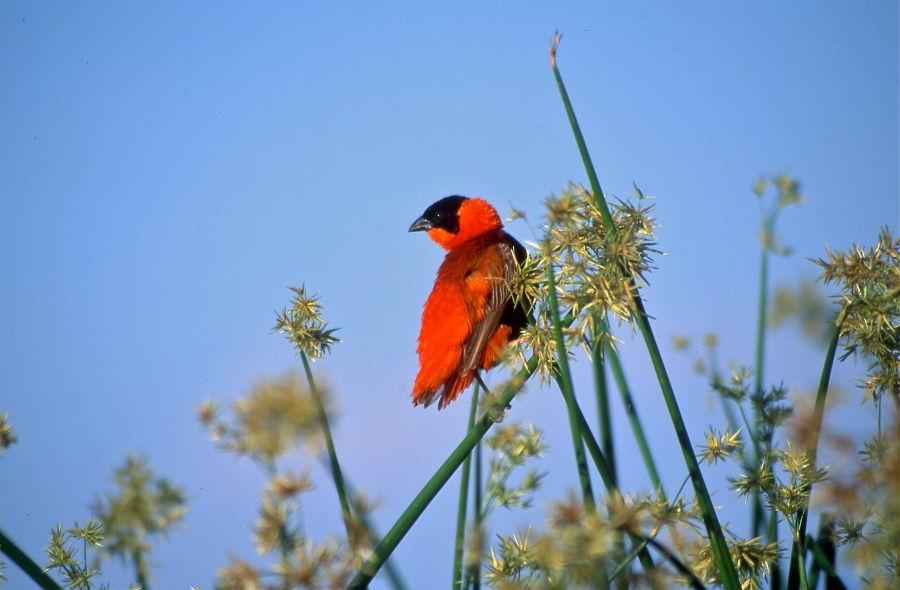
Northern Red-Bishop is have sexual dimorphism. Breeding Males has bright red back all the down to the tail, with wing panels being dark brown. The the front head to the face is black with a all black belly.

The male have eclipse plumage when not breeding in order to remain inconspicuous-at this time they resemble the drab female.This dimorphism is indicative of polygymous, colonial breeding species with intense reproductive competition-male taking a number of mates (up to eight) simultaneously or consecutively without offereing assistance in incubation or check-rearing.

He does however protect the territory vigorously from conspecific males. Males display to female with what  is called the “bumble flight” where the back and head feathers are fluffed-giving them the appearance of a bumb-bee. Female feed the chicks by regurgitation.

Locally common in grassland, savanna and wetland in the Rift Valley around the Lakes of Baringo and Bogoria

25 March, 2012:Red-and-Yellow Barbet (Trachyphonus erythrocephalus)

25 March, 2012:Red-and-Yellow Barbet (Trachyphonus erythrocephalus)

Photo@Jurg Hosang

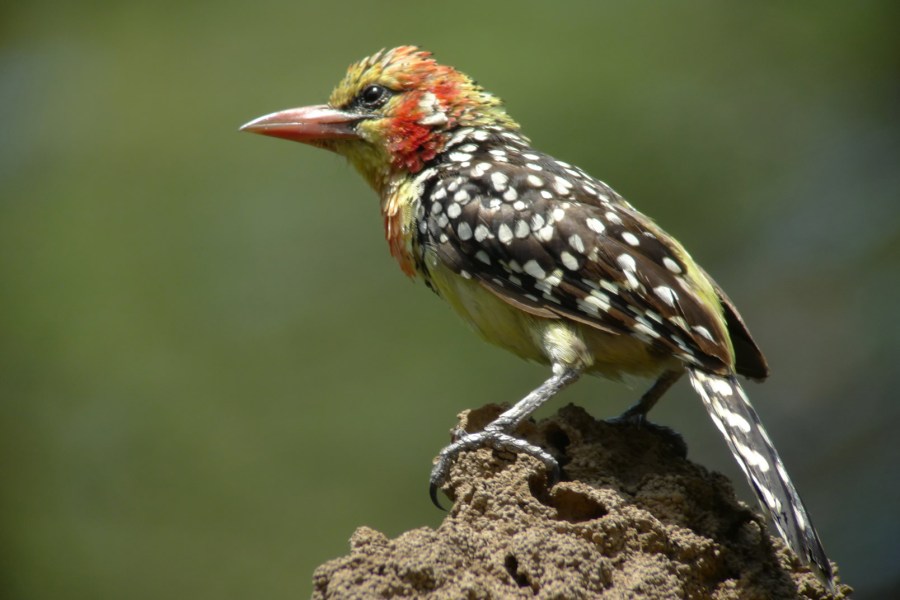
Red-and-Yellow Barbet like so all the other species of Barbet that I have come across are creatures of distinctive beauty. Barbet are closely related to tinkerbirds, woodpecckers,   honeyguides  and wrynecks. They are usually found alone or pairs.

This Barbet has a strong red billed, which is hooked and the face is generally red with bright white eared patches. The nominate race which is generally common is boldly white spotted above, with a black and white  speckled band across the yellow breast, yellow-white tail spots, and boldly barred outer tail feathers; rump yellow, upper tail coverts red and yellow; and under tail coverts red and yellow tips.

Very social species and always prefer hanging around termite mounds where they both derive their food stuff and build their nest is circular holes.

Locally common and widespread in dry bush,  savanna  and woodland scrub of Kerio Valley, Lake Baringo, Lake Bogoria , Meru national park, Olorgesaillie and Magadi road.

March 19, 2012: Giant Kingfisher (Megaceryle maxima)

March 19, 2012: Giant Kingfisher (Megaceryle maxima)

Photo@Joseph Aengwo

Giant Kingfisher is a crow-sized kingfisher, dark-crested,with white throat and a large black bill.Upper part of this beautiful bird is dark slate, finely spotted and barred with white.This species also exhibit sexual dimorphism with male having chestnut breast, white belly and black-and-white-barred flanks.Female is chestnut bellied, with densely black-and-white-speckled breast .

This bird is widely distributed in Kenya and can easily be seen in rivers, swamps and lakes.Areas where it is commonly seen include Subukia, Nyahururu, Lake Naivasha, Baringo and Kitobo forest which close to the Kenya-Tanzania border.