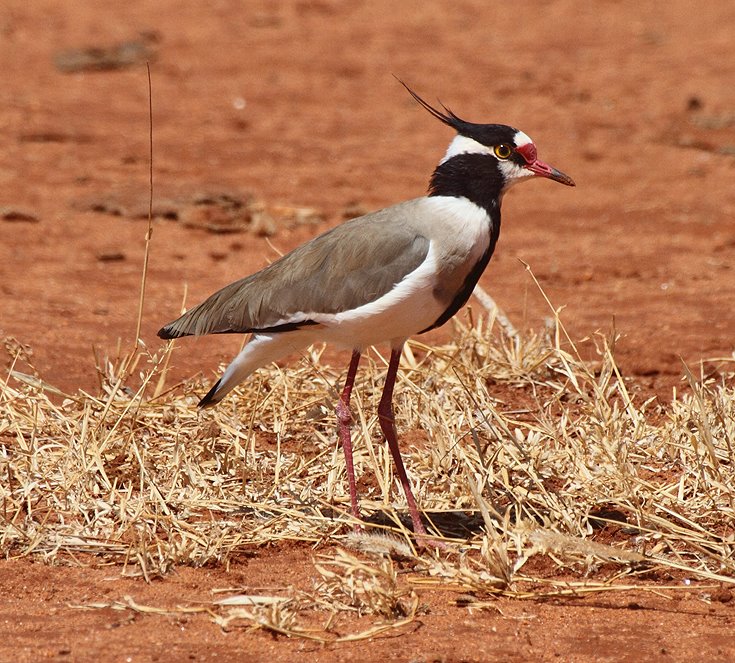
Black-headed Lapwing (Vanellus tectus)

Photo@Michael Sammut

The Black-headed Plover or Black-headed Lapwing (Vanellus tectus) is a species of wading bird of the family Charadriidae. It is found across sub-Saharan Africa.In Kenya specifically, it is found in areas like Tsavo West and East,Lake Baringo, Lake Bogoria,Samburu and Meru National Park. Although not migratory, there is some seasonal movement. Its habitat is wet lowlands close to water. It often feeds in drier habitats, such grassy scrubland.

This bird is readily noticeable and unmistakable. It is medium-large with a mainly black head and white forehead. The lower face and bands across the rear head and nape are also white. The crest is a weak black. The bill and legs are red. The tail is white and tipped black. In flight, the upperwings have black flight feathers and brown coverts separated by a white bar. The underwings are white with black flight feathers.

The diet of the Black-headed Plover consists of insects and other invertebrates that is picked from the ground. The call is a metallic tink-tink.


Hottentot Teal (Anas hottentota)

c@kelemen marton

The Hottentot Teal is a species of dabbling duck of the genus Anas. It is migratory resident in eastern Africa.The Hottentot teal is known for its black-capped head and distinctive blue bill. The duck’s body is speckled brown and black, with black wings.

Monogamous, territorial solitary nester. Interestingly, the pair bond barely lasts beyond incubation, with the male having almost no role in incubation and care of chicks.The female builds the nest, which is a deep bowl in the ground, filled with grass and leaves, often lined with down. It is usually placed in emergent vegetation near water.Laying dates vary with different regions, but usually in February-May.It lays 5-12 eggs, in successive days.Incubation is done solely by the female, for 25-27 days. She will sometimes leave the nest, to join the male in feeding and preening.The chicks are kept hidden in thick reedbeds, which makes them difficult to see. They fledge when they are about 60-65 days old.

Widespread all over Kenya in Swamps like Manguo, Lake Nakuru, Lake Baringo,Lake Bogoria and Lake Naivasha.

Black-faced Sandgrouse (Pterocles decoratus)

Image

The sandgrouse are distributed across northern, southern and eastern Kenya, Specifically in desert and semi-arid areas of Samburu, Meru, Marsabit, Turkana,Lake Baringo,Tsavo west and east, and Amboseli

Sandgrouse have compact bodies, but small, pigeon-like heads and necks. The different species range in length from 24 – 40 cm and weigh from 150 – 500 g.

Males and females look alike, Some species are also polymorphic .

They have long pointed wings and short legs that are feathered down to the toes, and members of the genus Syrrhaptes also have feathered toes.

Sandgrouse mostly feed on seed and are often seen in large feeding flocks with up to 100 birds.

Sandgrouse are monogamous (form life-long pair bonds). They make their nest on a slight depression in the ground. The average clutch consists of 2 eggs, occasionally up to 4. The male and female share the incubation duties; with the male incubating during the night and early mornings, and the female taking over during the day.

The young hatch after about 20 – 25 days; and are able soon able to leave the nest.

They are able to feed themselves from the day they hatch, but have to learn foraging skills from their parents for several months.

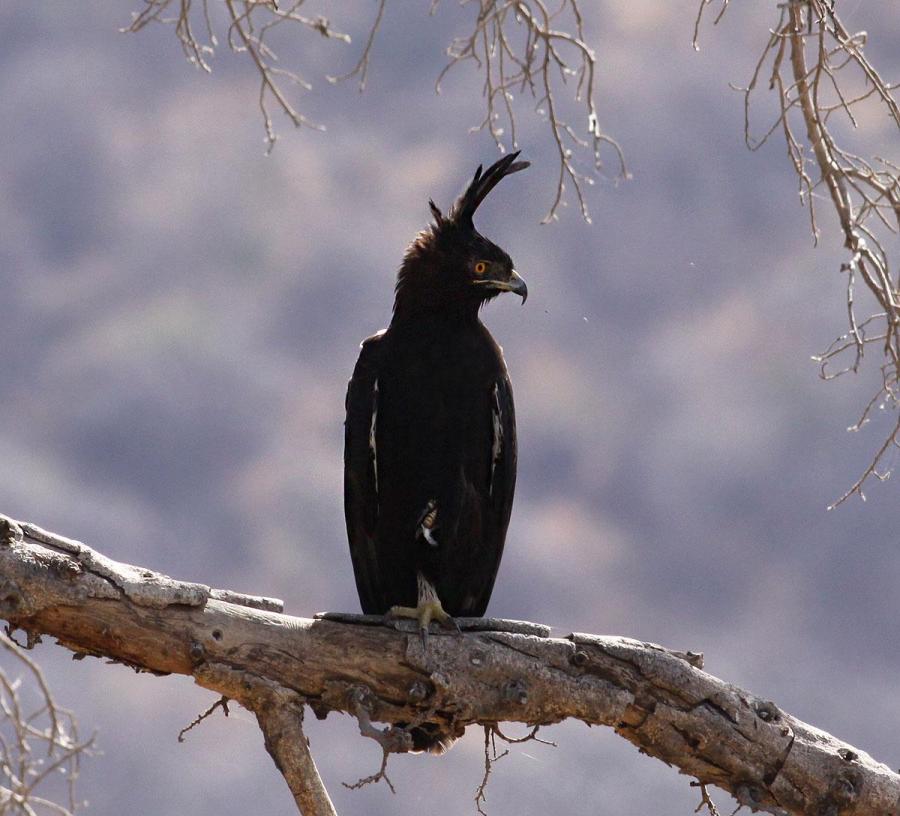
Long-crested Eagle (Lophaetus occipitalis)

Long-crested Eagle (Lophaetus occipitalis)

Photo@Raymond Galea

The adult Long-crested Eagle is overall very dark brown or black, except for white patches at the joint of the wing both above and below, white under-wing coverts spotted with black, a white base to the tail and greyish brown tarsi. The eyes golden to reddish brown, the cere and feet yellow.
Immatures can be distinguished from the adult by the whiter tips of the neck feathers, the less prominent crest, and a generally more mottled appearance. The eyes are dark olive-brown, the feet and cere pale ochre-yellow.

Long-crested Eagle can easily be seen in Kenya thought out Nairobi, Maasai Mara, Lake Nakuru National Park,Amboseli, Tsavo East and West National Park.

Southern Ground Hornbill (Bucorvus leadbeateri)

Southern Ground Hornbill (Bucorvus leadbeateri)

Photo@Joseph Aengwo

Southern Ground Hornbill is a large, turkey sized terrestrial bird, black-plumaged except for white primaries, conspicuous in flight. Adult bird has a bright red bare skin around eyes and on the neck, where usually somewhat inflated;eyes pale yellow; bill back, with small casque at the base above.

Pairs or small groups walk about in search for insects and small vertebrates.It will tend to take flight only when disturbed or alarmed.Widespread but partially distributed in open grassland and savanna around Nairobi  National Park, Maasai Mara, Central Rift Valley a round Lake Nakuru and Naivasha and Kakamega forest, Mt.Elgon and Kapenguria.

January 23, 2012: Saddle-billed Stork (Ephippiorhynchus senegalensis)

Hello fellow birders!

I am off on a birding adventure for the next few weeks with some guests! I am armed with binoculars, a scope, a Canon Rebel XT, and a panasonic mp3 recorder, with which I hope to capture some special birding moments to share with you.

In the meantime, enjoy the Bird of the Week; this unique and beautiful stork.

One of the tallest species of storks is the Saddle-billed Stork, Ephippiorhynchus senegalensis, which stands up to 58 in. high. It has a large crimson bill with a black band and a triangular yellow frontal shield (or saddle), and has black legs with reddish joints. The overall coloring is black and white–the head, neck, tail and wing-coverts black, the remaining plumage and the flight feathers white. It breeds in sub-Saharan Africa, generally by rivers. The large nest is built of sticks in the tops of tall trees. It lays one egg. It feeds on grasshoppers, fish, frogs and lizards.

Photo © Tony Crocetta

They can either be found in solitary or pairs, they prefer moist habitat of lake shores, swamps and rivers. In Kenya they are widespread and be spotted in areas like Maasai Mara game reserve, Lake Baringo, Nakuru, Naivasha and Lake Victoria, Meru National Park and the coastal strip.

December 30, 2011: Rufous-naped Lark (Mirafra africana)

 Rufous-naped Lark  (Mirafra Africana)

The Rufous-naped Lark’s head is coloured brown as well as the bill. The Mirafra Africana has a white coloured throat, pink legs and a brown coloured back. The eyes are brown.

The male Mirafra africana has physical features that are slightly different from the female bird. When the bird is excited it has a richly striped rufous crown. In most observatory incidence the bird tends to call from a raised platform or rather on top of a medium sized tree.

In Kenya, the bird is widely distributed in areas around central Kenya, Lake Naivasha, Maasai Mara and Amboseli National park.

Rufous-naped lark Rufous-naped lark song

I recently spotted this Rufous-naped lark in the Maasai Mara National Reserve and recorded it’s song.

– Joe