Joe guided Nigel Marven of Animal Planet on a Kenya Birding Trip

photo@Joe Aengwo

Nigel Marven went Birding in Kenya

When Moses, a colleague of mine informed me that I was to guide a client from England for 8 days birding safaris, I had no idea that my client will torn out to be Nigel Marven, the famous Animal Planet natural history presenter.  We had good time birding together in Kakamega forest, Tugen hills,Lake Baringo, Bogoria, and Nakuru and finally Nairobi National Park. We managed to spot over 300 species of birds and lucky enough, we managed to see most of our sort after species with exception of four or five species.

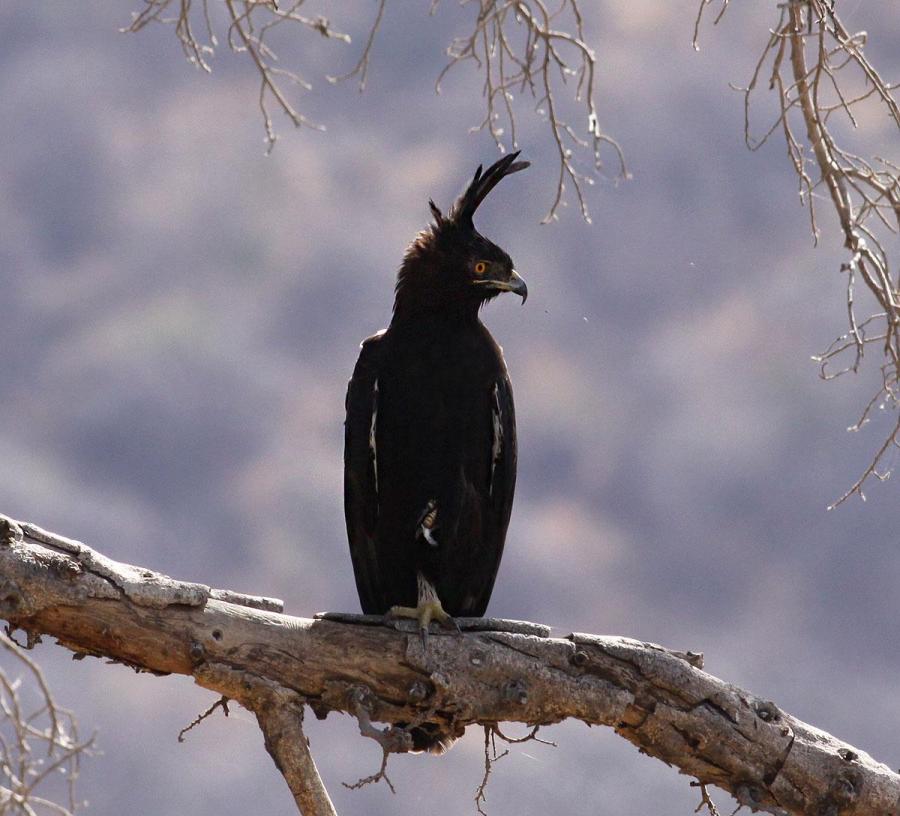
Long-crested Eagle (Lophaetus occipitalis)

Long-crested Eagle (Lophaetus occipitalis)

Photo@Raymond Galea

The adult Long-crested Eagle is overall very dark brown or black, except for white patches at the joint of the wing both above and below, white under-wing coverts spotted with black, a white base to the tail and greyish brown tarsi. The eyes golden to reddish brown, the cere and feet yellow.
Immatures can be distinguished from the adult by the whiter tips of the neck feathers, the less prominent crest, and a generally more mottled appearance. The eyes are dark olive-brown, the feet and cere pale ochre-yellow.

Long-crested Eagle can easily be seen in Kenya thought out Nairobi, Maasai Mara, Lake Nakuru National Park,Amboseli, Tsavo East and West National Park.

Pel’s Fishing-Owl (Scotopelia peli)

Pel's Fishing-Owl (Scotopelia peli)

Photo@Yan Van Dainne

Fish owls differ from other owls in that they have no feathers on their feet. Additionally, they lack the noiseless flight typical of owls, perhaps because their submerged prey is less able to hear their approach.  Three species of fish owl occurs in Africa . Pel’s Fishing Owl snatch their prey while skimming the water surface. In Kenya it is found in Maasai Mara and Samburu national reserve along the the Mara rive and Ewaso Ngiro rivers.

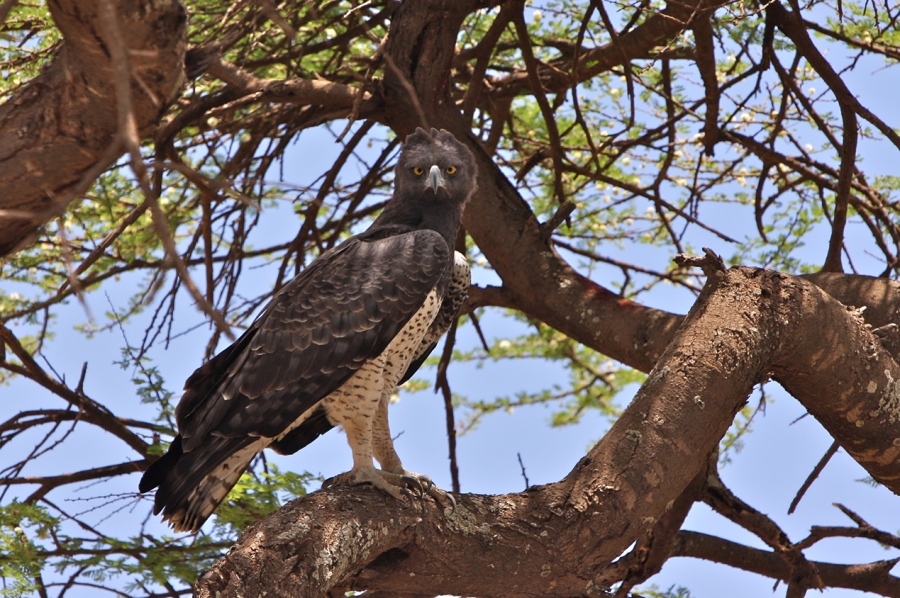
Martial Eagle (Polemaetus bellicosus)

Martial Eagle (Polemaetus bellicosus)

Photo@Yan Van Dainne

Martial Eagle is the one of the huge eagle we have in Kenya.It is a large eagle, growing to a length of 76-83 cm with a wingspan of 190-260 cm. The adult’s plumage has dark brown upperparts, head and upper chest. The body underparts are white streaked with black. The underwing coverts are brown, with pale flight feathers, also streaked with black. The female is usually larger and more streaked than the male. The immature is paler above and has white underparts. It reaches adult plumage in its seventh year.

The Martial Eagle can be found throughout Kenya, wherever food is abundant and the environment favourable. It is never common, but greater population densities exist in Nairobi, Samburu and Maasai Mara National Parks, these birds are more abundant in protected areas than unprotected. It avoids dense forests but needs trees to nest in. The territory can vary greatly in size from more than 1000 Km² to areas where nests are less than 10 km distant. This disparity is due to differences in food supply.

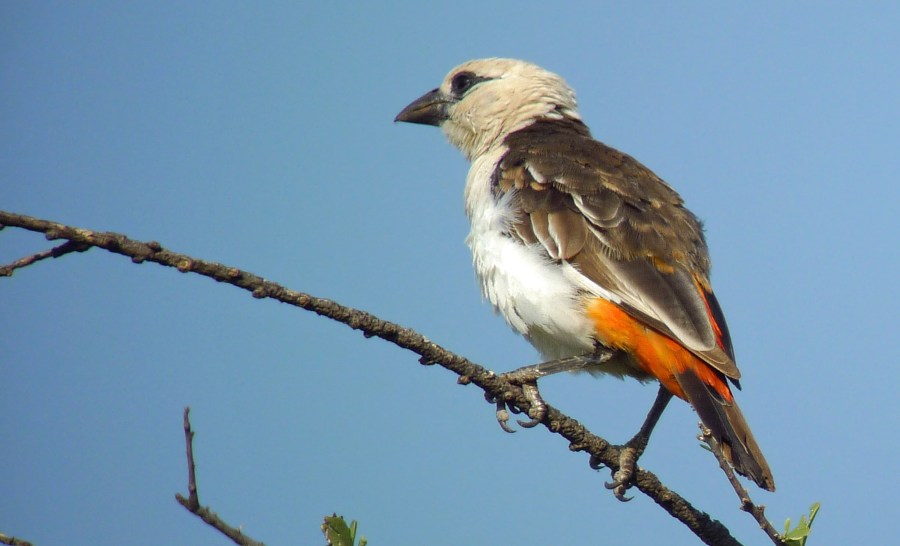
White-headed Buffalo Weaver (Dinemellia dinemelli)

White-headed Buffalo Weaver (Dinemellia dinemelli)

Photo@Jurg Hosang

Hello birders!!Sorry, I was a way for some time birding with two birders from Indiana and New York state.For that reason, I did not post any bird of the week for the last two weeks!. I am back now with great pictures that I hope you will enjoy!!!for how beautiful are just birds!!.

The white-headed Buffalo Weaver is confine to Eastern Africa, and it is brown and white with red rump and vent. Both are stout-bodied, heavy-billed bird. In breeding season the male’s bill become whitish and swollen at the base. Buffalo weavers live in dry regions, where they forage omnivorously on the ground in small noisy flocks, often in the wake of buffalo heards.The nest, a heap of thorny twigs, contains components for two or more pairs;several nest may occupy the same tree.

It is common and widespread in dry part of the arid and semi-arid areas of Kenya.

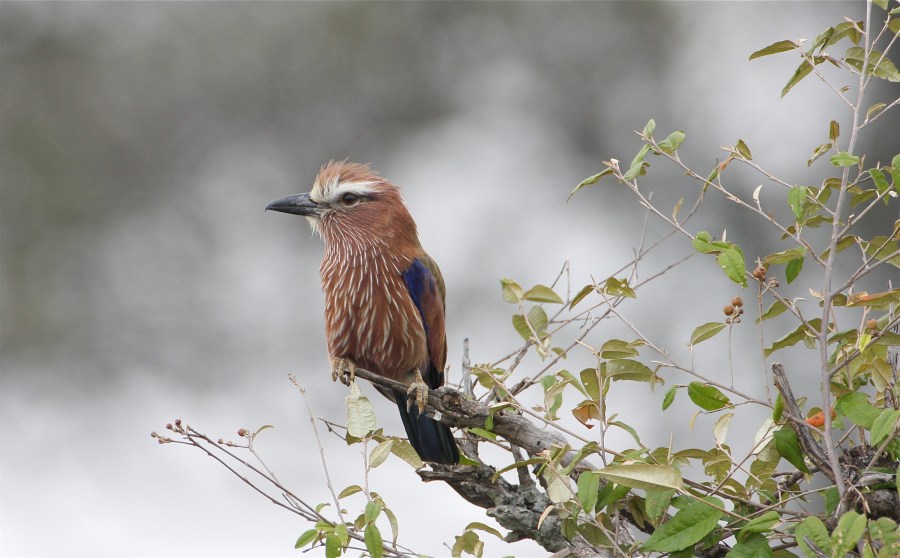
Rufous-crowned Roller (Coracias naevius)

Rofouse-crowned Roller

Photo@Yan Van Danne

Rufous-crowned or Purple Roller has it is sometimes referred to is a very uncommon compared to other species of Rollers, with exception of Abyssinian Roller.It feed on big insect and it can be observed from one spot for some time as it scanned and goes for his prey and returning to the same location .

The bird is generally purple as the name suggest with violet tailed and a little spot on the wing shoulder.It is the biggest roller we have in East Africa, therefore identifying this bird should never be a problem at all.

It is very common in areas around Lake Baringo, Lake Bogoria, Kerio Valley, Kapedo, Samburu National reserve and Meru National Park.


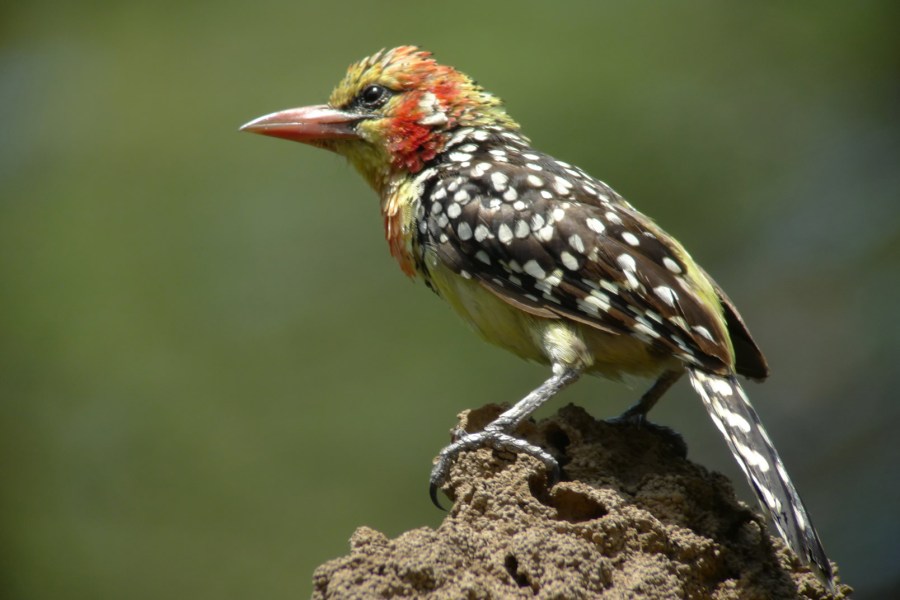
25 March, 2012:Red-and-Yellow Barbet (Trachyphonus erythrocephalus)

25 March, 2012:Red-and-Yellow Barbet (Trachyphonus erythrocephalus)

Photo@Jurg Hosang

Red-and-Yellow Barbet like so all the other species of Barbet that I have come across are creatures of distinctive beauty. Barbet are closely related to tinkerbirds, woodpecckers,   honeyguides  and wrynecks. They are usually found alone or pairs.

This Barbet has a strong red billed, which is hooked and the face is generally red with bright white eared patches. The nominate race which is generally common is boldly white spotted above, with a black and white  speckled band across the yellow breast, yellow-white tail spots, and boldly barred outer tail feathers; rump yellow, upper tail coverts red and yellow; and under tail coverts red and yellow tips.

Very social species and always prefer hanging around termite mounds where they both derive their food stuff and build their nest is circular holes.

Locally common and widespread in dry bush,  savanna  and woodland scrub of Kerio Valley, Lake Baringo, Lake Bogoria , Meru national park, Olorgesaillie and Magadi road.

January 23, 2012: Saddle-billed Stork (Ephippiorhynchus senegalensis)

Hello fellow birders!

I am off on a birding adventure for the next few weeks with some guests! I am armed with binoculars, a scope, a Canon Rebel XT, and a panasonic mp3 recorder, with which I hope to capture some special birding moments to share with you.

In the meantime, enjoy the Bird of the Week; this unique and beautiful stork.

One of the tallest species of storks is the Saddle-billed Stork, Ephippiorhynchus senegalensis, which stands up to 58 in. high. It has a large crimson bill with a black band and a triangular yellow frontal shield (or saddle), and has black legs with reddish joints. The overall coloring is black and white–the head, neck, tail and wing-coverts black, the remaining plumage and the flight feathers white. It breeds in sub-Saharan Africa, generally by rivers. The large nest is built of sticks in the tops of tall trees. It lays one egg. It feeds on grasshoppers, fish, frogs and lizards.

Photo © Tony Crocetta

They can either be found in solitary or pairs, they prefer moist habitat of lake shores, swamps and rivers. In Kenya they are widespread and be spotted in areas like Maasai Mara game reserve, Lake Baringo, Nakuru, Naivasha and Lake Victoria, Meru National Park and the coastal strip.

Protect the Lesser Flamingo – save Lake Natron!

With this week’s bird of the week being the Flamingo, it reminded me of an important environmental and conservation concern regarding this spectacular pink bird: SODA ASH (sodium carbonate). The Eastern Rift Valley is home to Lake Nakuru, Lake Bogoria, Lake Elementaita, Lake Magadi, and Lake Natron – all soda lakes, famous for providing the habitat of the near-threatened Lesser Flamingo.

Sodium carbonate is used in many household and industrial products and is being harvested in Lake Magadi, Kenya by TATA Chemicals, who are also proposing to set up a new environmentally devastating plant at Lake Natron, Tanzania.

The introduction of a soda ash plant into Lake Natron would have catastrophic effects on the already near-threatened Lesser Flamingo. Not only would the plant lead to habitat degradation and species loss, but its development would also be detrimental to East African tourism, and the livelihood of the Maasai community living in the surrounding area.

Bird Life International highlighted these concerns in April 2011 with their article “Fresh concerns as President orders Lake Natron soda ash mining fast tracked

“Lake Natron is the only regular breeding site for Lesser Flamingos in Eastern Africa. The 1.5-2.5 million Lesser Flamingos – which represents three quarters of the world population – breed only at Lake Natron. ………Noise from the heavy equipment, the presence of people and a network of pipes will chase away the birds which are highly sensitive to disturbance while breeding”

Lessons learned in Lake Magadi highlight that little to no economic or development benefits have come from harvesting soda ash in the magical waters home to the flamingo.

“Soda ash mining at Lake Magadi has left local communities disillusioned with little to show for the 100 years of mining. The environment has been damaged and fresh water nearly depleted”

With the re-emergence of the issue recently, the Star published an environmental commentary, ‘Don’t Fund Lake Natron Mining’ advocating halting the development of a soda ash factory on Lake Natron.

Let this be a call to bird enthusiasts, ornithologists, conservationists, environmentalists, and tourism professionals to come together and advocate for the protection of Lake Natron, the rehabilitation of Lake Magadi and the security of our precious Lesser Flamingo.

Watch the amazing documentary The Crimson Wing and find inspiration to see these Flamingos continue their flight between the Rift Valley soda lakes.

The stunning movie trailer: The Crimson Wing

Other important articles and resources:

Bird Life International – Think Pink

RSPB: Lake Natron

Bird Life International – Serengeti Highway and Lake Natron

Stop the Serengeti Highway

Joe

Flamingos in Lake BogoriaFlamingos in Flight Lake Bogoria