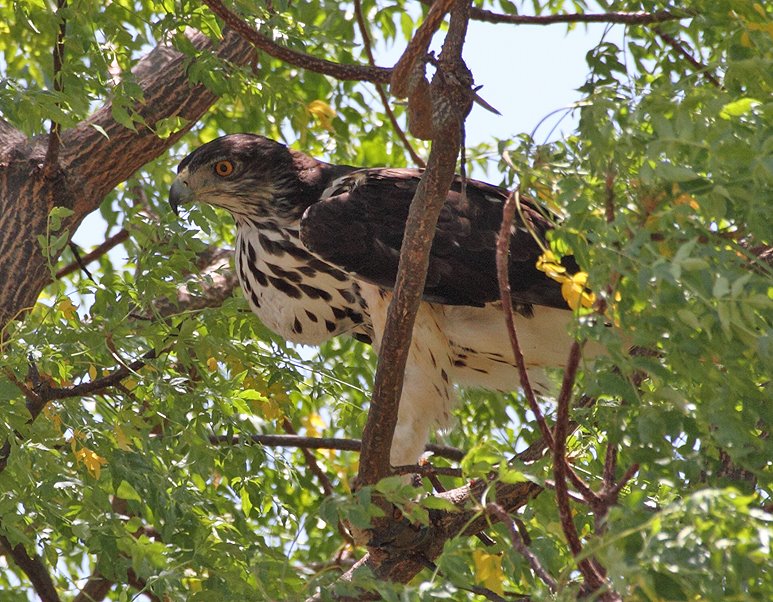
African Hawk Eagle (Aquila spilogaster)

Photo@Michael Sammut

African Hawk Eagle (Aquila spilogaster) are large birds of Prey  that occur naturally in Kenya, where they inhabit wooded hills.In Kenya they mostly seen in birding hot spot like Masai Mara,Tsavo West and East,Nairobi National Park,Hell’s Gate, and Lake Nakuru National Park.

African Hawk Eagles are large eagles that measure about 55 – 65cm in length.The plumage above is blackish. Below they are mostly white, heavily streaked with black. Theunderwing feathers are white with a black trailing edge. The wings below are blackish with white spots.Males and females look alike, but young birds are brown above and rufous colored below.

Their large platform nests are built out of sticks and are about 3 meters in diameter.They are typically placed in the forks of large trees.The average clutch consists of one or two eggs.
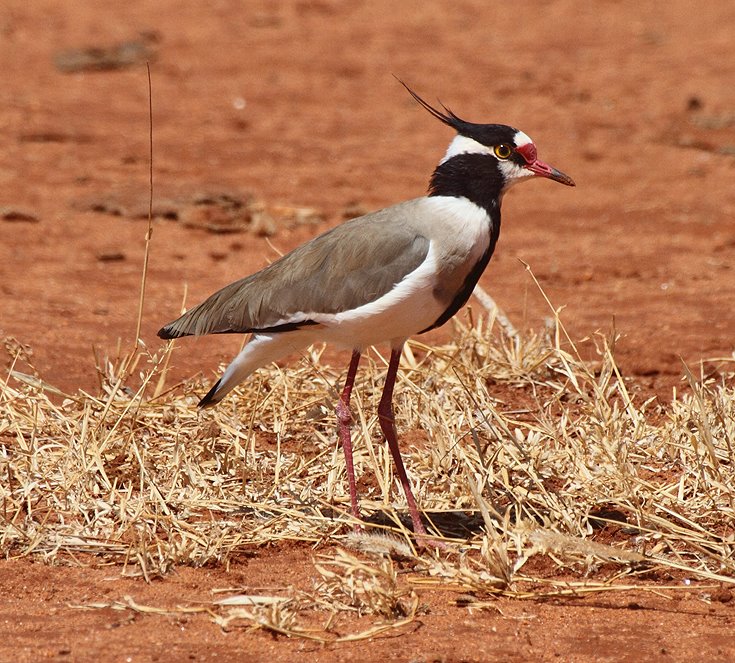
Black-headed Lapwing (Vanellus tectus)

Photo@Michael Sammut

The Black-headed Plover or Black-headed Lapwing (Vanellus tectus) is a species of wading bird of the family Charadriidae. It is found across sub-Saharan Africa.In Kenya specifically, it is found in areas like Tsavo West and East,Lake Baringo, Lake Bogoria,Samburu and Meru National Park. Although not migratory, there is some seasonal movement. Its habitat is wet lowlands close to water. It often feeds in drier habitats, such grassy scrubland.

This bird is readily noticeable and unmistakable. It is medium-large with a mainly black head and white forehead. The lower face and bands across the rear head and nape are also white. The crest is a weak black. The bill and legs are red. The tail is white and tipped black. In flight, the upperwings have black flight feathers and brown coverts separated by a white bar. The underwings are white with black flight feathers.

The diet of the Black-headed Plover consists of insects and other invertebrates that is picked from the ground. The call is a metallic tink-tink.


Hottentot Teal (Anas hottentota)

c@kelemen marton

The Hottentot Teal is a species of dabbling duck of the genus Anas. It is migratory resident in eastern Africa.The Hottentot teal is known for its black-capped head and distinctive blue bill. The duck’s body is speckled brown and black, with black wings.

Monogamous, territorial solitary nester. Interestingly, the pair bond barely lasts beyond incubation, with the male having almost no role in incubation and care of chicks.The female builds the nest, which is a deep bowl in the ground, filled with grass and leaves, often lined with down. It is usually placed in emergent vegetation near water.Laying dates vary with different regions, but usually in February-May.It lays 5-12 eggs, in successive days.Incubation is done solely by the female, for 25-27 days. She will sometimes leave the nest, to join the male in feeding and preening.The chicks are kept hidden in thick reedbeds, which makes them difficult to see. They fledge when they are about 60-65 days old.

Widespread all over Kenya in Swamps like Manguo, Lake Nakuru, Lake Baringo,Lake Bogoria and Lake Naivasha.

Vulturine Guineafowl ((Acryllium vulturinum))

c@Joseph Aengwo

 Vulturine Guineafowl is Large, unmistakable guineafowl; the bare skin of the head and neck is bluish-gray with a band of short chestnut feathers that extends behind the eyes on the back of the head; long, white striped plumes extend from the breast and back; the upper back and breast is brilliant blue, with a black patch on the center of the chest; wings and rear half of body spotted with a long, drooping tail. Females are similar to the males, but slightly smaller and have smaller tarsal spurs. Chicks much like other guineafowl, but develop light blue underparts in a few weeks.Common in dry savanna and scrub land of northeastern Kenya.This photo was taken in Samburu National Reserve.

Joe guided Nigel Marven of Animal Planet on a Kenya Birding Trip

photo@Joe Aengwo

Nigel Marven went Birding in Kenya

When Moses, a colleague of mine informed me that I was to guide a client from England for 8 days birding safaris, I had no idea that my client will torn out to be Nigel Marven, the famous Animal Planet natural history presenter.  We had good time birding together in Kakamega forest, Tugen hills,Lake Baringo, Bogoria, and Nakuru and finally Nairobi National Park. We managed to spot over 300 species of birds and lucky enough, we managed to see most of our sort after species with exception of four or five species.

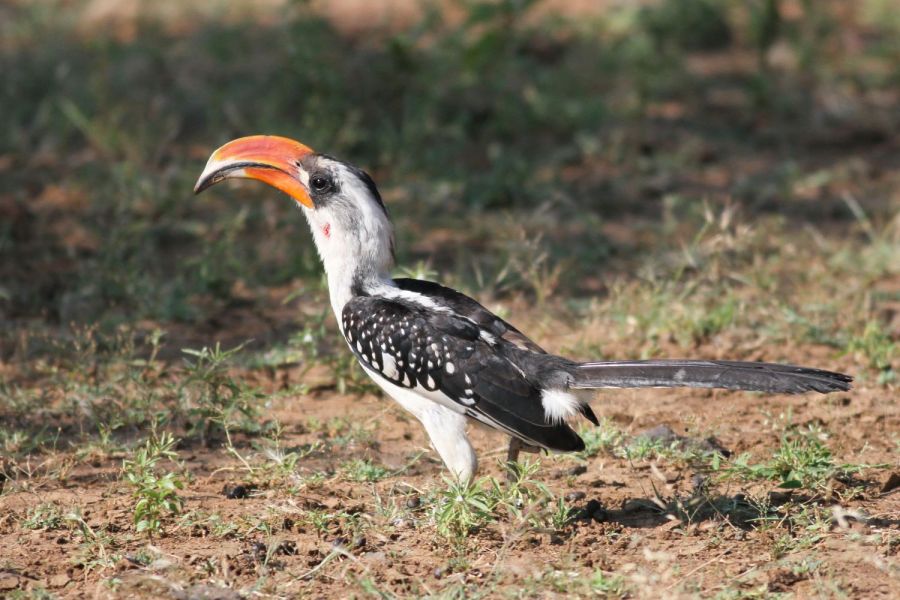
Jacson’s Hornbill (Tockus jacksoni)

Image

Similar to other hornbills, Jackson’s hornbills have a unique and nearly predator proof way of raising their offspring. Before she lays her eggs, the female is sealed in a tree cavity by her mate. During this time, he passes her food through a narrow slit.The species is an example of sexual dimorphism, meaning there is a difference in form between males and females of the same species. The male Jackson’s hornbill has a red billed with a yellow tip (see above) and the female has a black bill.

In Kenya they are found in Lake Baringo, Lake Bogoria, Kapedo and the the  upper part of the Rift Vally mostly in Turkana area.

Black-faced Sandgrouse (Pterocles decoratus)

Image

The sandgrouse are distributed across northern, southern and eastern Kenya, Specifically in desert and semi-arid areas of Samburu, Meru, Marsabit, Turkana,Lake Baringo,Tsavo west and east, and Amboseli

Sandgrouse have compact bodies, but small, pigeon-like heads and necks. The different species range in length from 24 – 40 cm and weigh from 150 – 500 g.

Males and females look alike, Some species are also polymorphic .

They have long pointed wings and short legs that are feathered down to the toes, and members of the genus Syrrhaptes also have feathered toes.

Sandgrouse mostly feed on seed and are often seen in large feeding flocks with up to 100 birds.

Sandgrouse are monogamous (form life-long pair bonds). They make their nest on a slight depression in the ground. The average clutch consists of 2 eggs, occasionally up to 4. The male and female share the incubation duties; with the male incubating during the night and early mornings, and the female taking over during the day.

The young hatch after about 20 – 25 days; and are able soon able to leave the nest.

They are able to feed themselves from the day they hatch, but have to learn foraging skills from their parents for several months.

Goliath Heron(Ardea goliath)

Goliath Heron

Photo@Yan Van Dainne

Goliath Heron

The Goliath heron is Africa largest heron, standing 53-to-55 inches tall, with a wingspan of six-to-seven feet. Male and female look similar, with an overall covering of slate gray and chestnut feathers. The head and its bushy crest, face, back and sides of the neck are chestnut. The chin, throat, foreneck and upper breast are white, with black streaks across the foreneck and upper breast. The lower breast and belly are buff with black streaks. The upper mandible is black and the lores and orbital areas are yellow with a greenish tinge. The eyes are yellow and legs and feet are black. Juveniles look similar to the adults, but are paler.

The Goliath heron is territorial, usually living alone near water. A diurnal and often rather inactive feeder, the heron hunts by standing in the shallows, or on floating vegetation, intently watching the water at its feet. As prey appears, the heron rapidly spears it with open mandibles.

Goliath heron nests are found in trees overhanging water, on the ground and in low bushes. Both sexes build the stick and reed platform nest, which measures three-to-four feet across. Both parents incubate two-to-four pale blue eggs for 29 days. The chicks are covered with long white down.

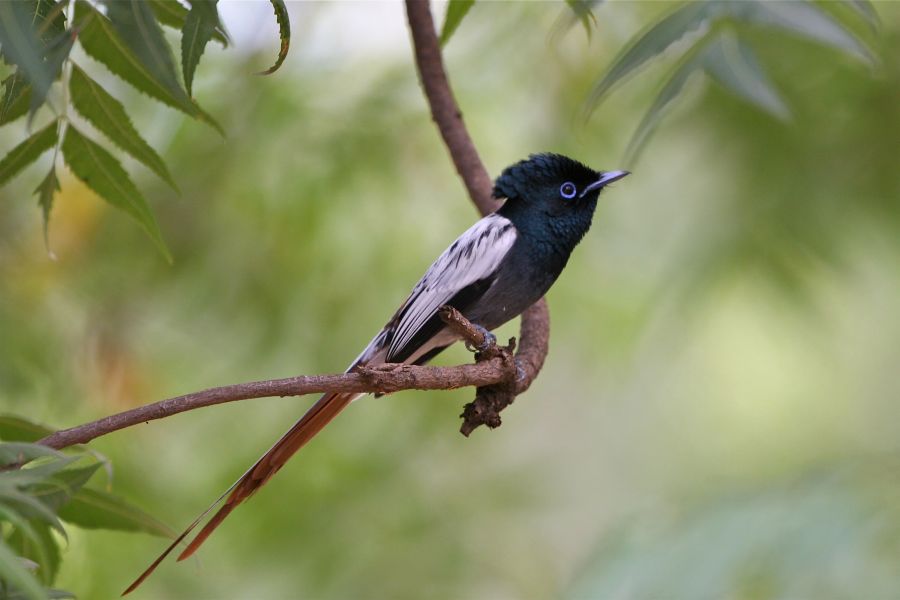
African Paradise-flycatcher (Terpsiphone virisidis)

 African Paradise-flycatcher (Terpsiphone virisidis)

Photo@Yan Van Dainne

African Paradise-Flycatcher is a beautiful bird with very long tail which allows sometimes detecting the bird among the foliage.
Plumage is very variable, from rufous to white, with five colours recognized.

Adult male (of all types) has rufous upperparts, upperwing and tail, with variable amount of black and white and greyish underparts.
Head is glossy blue-black with a crest. Central tail feathers are very elongated. In breeding plumage, the upper mandible and the eye-rings become electric-blue.

The male of nominate race has deep rufous upperparts. Wings show conspicuous white edgings.
Underparts are glossy blue-black on throat and breast. Belly is duller, mostly dark grey. Undertail coverts and tail are rufous.
Head is glossy blue-black with dark, thick crest on the crown.
Bill is cobalt-blue with black tip. Eyes are dark brown with thick bright cobalt-blue eye-ring. Legs and feet are bluish-black.

Pel’s Fishing-Owl (Scotopelia peli)

Pel's Fishing-Owl (Scotopelia peli)

Photo@Yan Van Dainne

Fish owls differ from other owls in that they have no feathers on their feet. Additionally, they lack the noiseless flight typical of owls, perhaps because their submerged prey is less able to hear their approach.  Three species of fish owl occurs in Africa . Pel’s Fishing Owl snatch their prey while skimming the water surface. In Kenya it is found in Maasai Mara and Samburu national reserve along the the Mara rive and Ewaso Ngiro rivers.