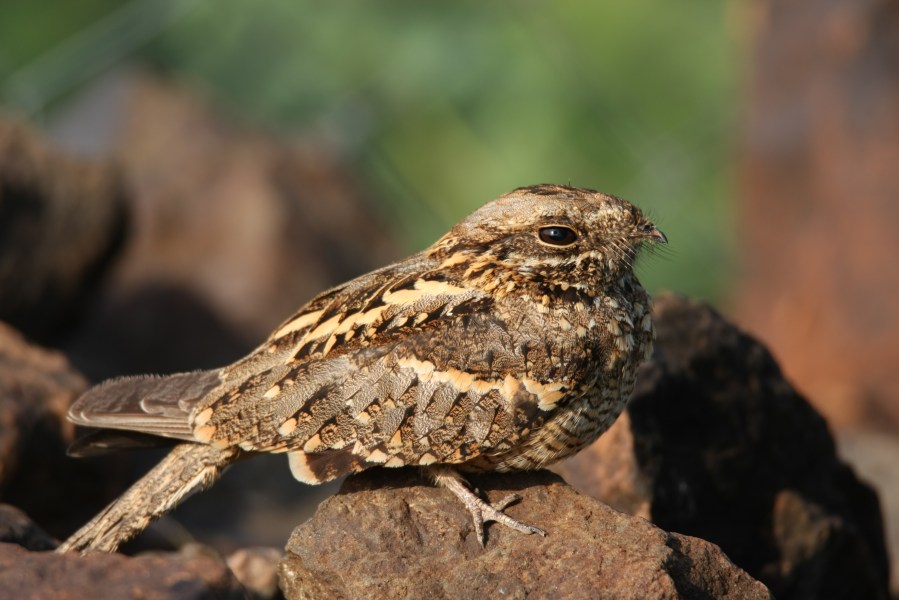
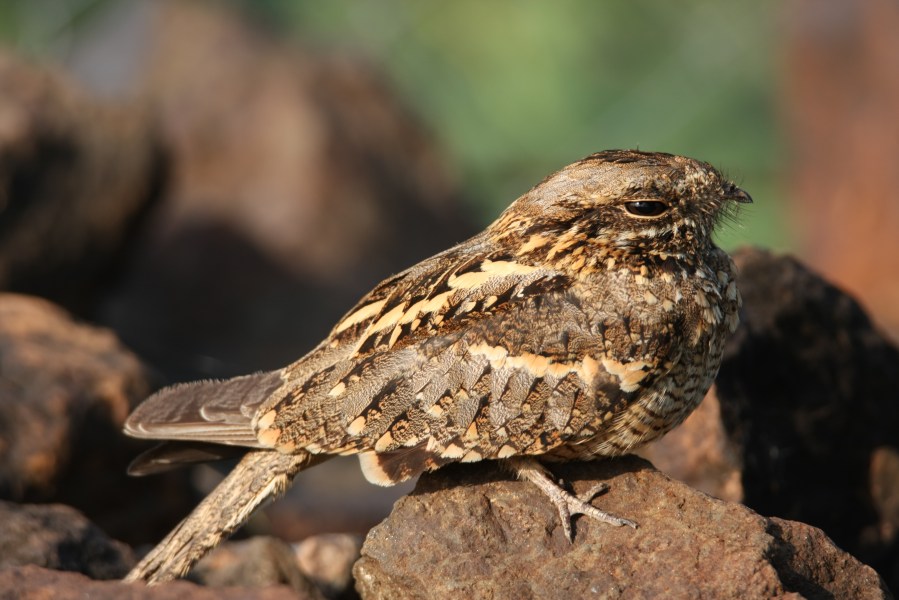
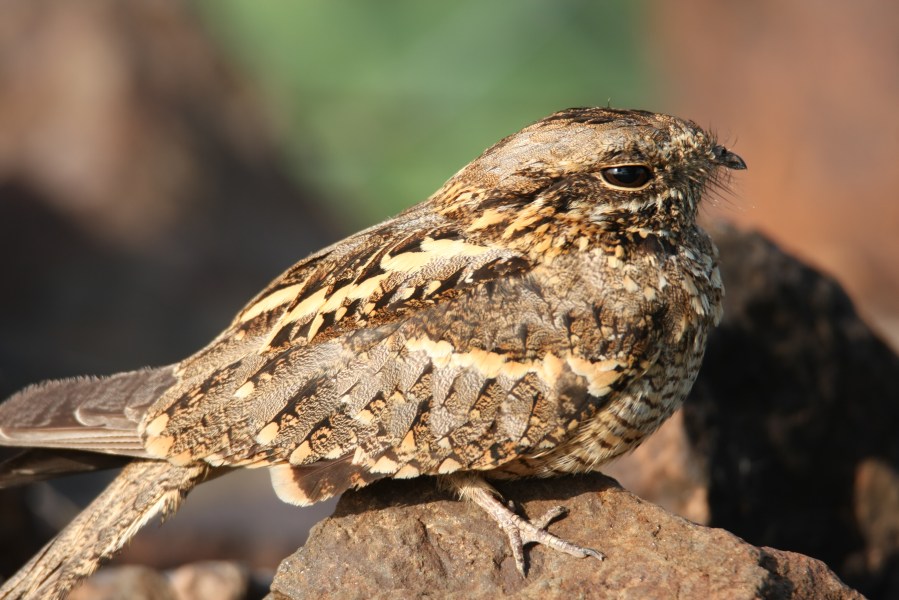
Nightjars are largely nocturnal family. They look like owls, with large heads and eyes and a cryptic plumage. The family name caprimulgidae was given to them after some superstitious belief that because of their wide mouths, the birds suckled goats.
Photo@Joe Aengwo
In Kenya we have 13 different species of Nightjars, wide spread in different habitats across the country. The photo appearing above was taken at a rocky countryside of Lake Baringo. Most species are nocturnal or active at dusk, and are solitary and retiring . They concentrate their foraging bouts during twilight hours.
Photo@ Joe Aengwo
By day, they roots on exposed grounds or rocks, in leaf litter, or on branches. When roosting , they adopt a horizontal posture, in contrast to owls.
Photo@Joe Aengwo
Nightjars have very large eyes, adopted to low light condition. They eye have a tapetum, a reflective membrane that increases the amount of light entering the eyeball. Its presence causes reflective “eye-shine” when the eye are illuminated by artificial light.
African Crowned-Eagle gliding the African Skies. Photo by Juhani Vilpo
Although not the biggest eagle in Africa, the Crowned Eagle is considered the most powerful and ferocious eagle based on the size of its prey. Weighing in at 2.5 – 4.5 kg, it regularly kills prey heavier than itself. Forest mammals like Vervet monkeys and duiker (25kg) are never safe when this eagle is near. Africa’s biggest eagle is the Martial Eagle which can weigh over 6kg but prefers to prey on animals like Guineafowl and reptiles.
Also known as the Leopard of the Sky for its hunting abilities, the Crowned Eagle is well camouflaged with bars and blotches on the chest and a slate grey upper side. This colouring makes it disappear in a forest environment, especially because it tends to sit inside the tree canopy instead of on top like most other eagles.
A breeding pair of African Crowned Eagle at Kakamega forest. Photo by Juhani Vilpo
To adapt to the forest environment, the Crowned Eagle has a long tail and
broad, rounded wings. The combination of these two makes it extremely agile and
fast which is one of the main reasons why it is the only eagle that preys on
monkeys actively. Monkeys are very alert and quick, making them difficult to
hunt, especially in a group. The male and female Crowned Eagle often hunt as a
pair, while one eagle distracts the monkeys, the other makes the kill. With
powerful feet and massive talons it can kill a monkey in one blow. This is
essential because monkeys have strong hands and can easily damage an eye or a
wing of the eagle.
During breeding time crowned eagles become much more visible and vocal as
they make undulating areal displays at heights of up to 1km. They can be noisy
during these times with a loud ‘kewee kewee kewee’ call from the male. This
ritual is normally associated with breeding, but could also be an act of
territorial domination.
The nest of a Crowned Eagle is a huge structure of sticks which is repaired
and enlarged every breeding season, making the nests grow bigger and bigger.
Some nests grow to be about 2.3 metres across making them the biggest nests of
all the eagle species.
You have a chance of seeing this species in Kenya if you are touring
Mt.Kenya Forest Reser, Nairobi National Park, Aberdare National Park, Kakamega
tropical rain forest and Mau Forest.
On the first week of December, 2018 we had planned a 8 days photographic trip to kakamega forest. My client opted to stay at Rondo Retreat Centre because of its location right inside the forest. Our target birds were many, but high on the list was the stunning White-spotted Flufftail.
After 3 days of continuous search of this elusive and secretive species, nature rewarded us with great views of both male and female. I guess they were on romantic walk enjoying each other company and failed to notice our presence.
Birding is first class at Kakamega forest, although the forest suffers from increasing fragmentation .
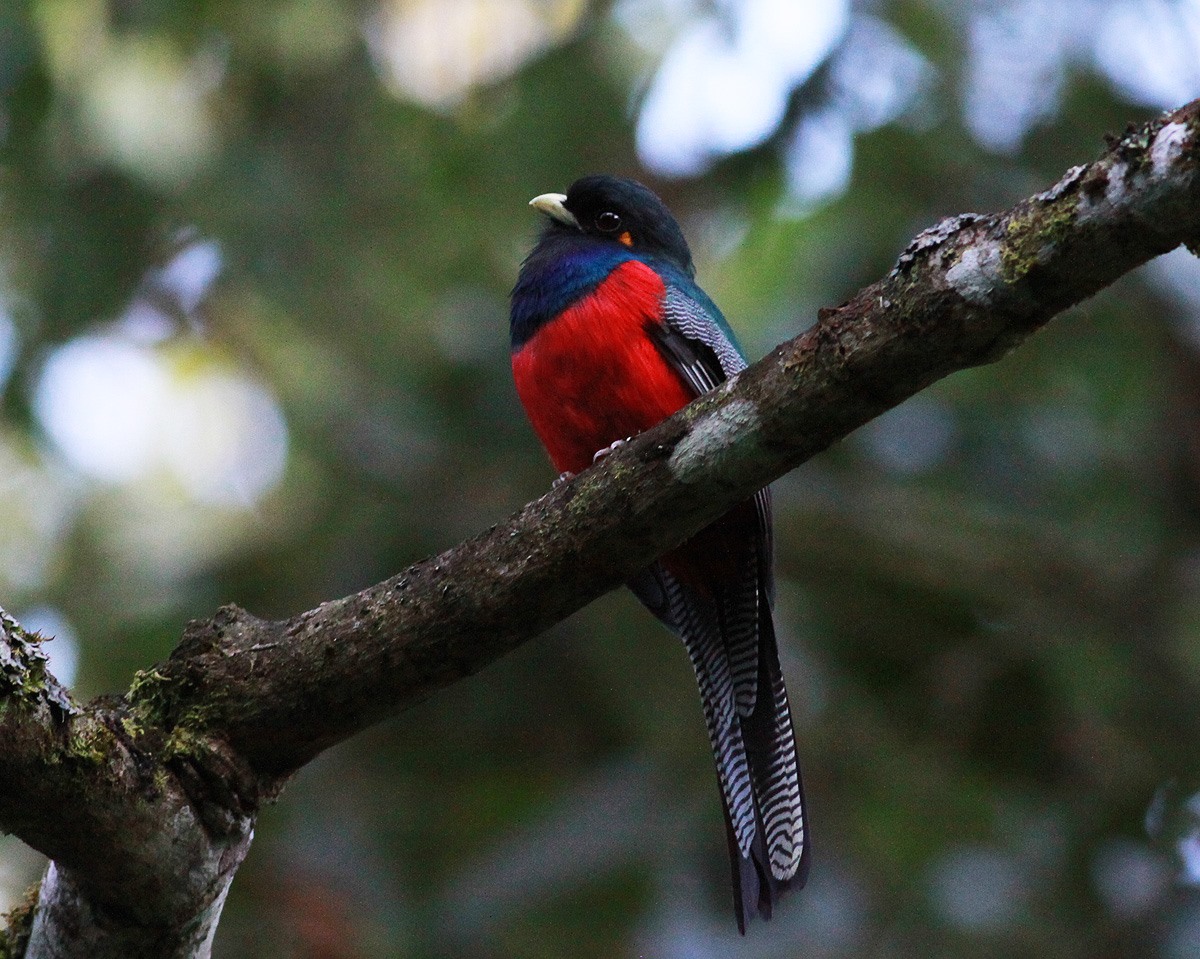
On any bird watching excursion disappointment and surprises happen all the time, so when my clients and I arrived at one of the forest block a long the lower slopes of Mt.Kenya, seeing a Bar-tailed Trogon was not really in our mind, I guess we had learned to manage our expectation.
On the main trail in the forest other things come by easily without much effort, Mountain Yellow and Brown Woodland Warbler, African Hill Babbler, Black-fronted Bush-Shrike, Yellow-crowned Canary, Abyssinian Crimsonwing, Hartlaub’s Turaco, African Crowned Eagle, Mountain Buzzard, Eastern Mountain and Slender-bill Greenbul, White-starred Robin, Ruppelle’s Robin-chat, Golden-winged and Tacazze Sunbird among others were some of our priced collection.
Then the big moment come and voila we had some fantastic views of Bar-tailed Trogon. It begun by it calling from a nearby forest thicket and its continuous calling betrayed its exact location and we had excellent photographic opportunities.
On such kind of trips, sometimes you lose and sometimes you win, but this time round we won in a big way.
Our bird of the week is the Grey Woodpecker, race rhodeogaster, which is sometimes considered conspecific with the Ethiopian spodocephalus and known as Grey-headed Woodpecker. This species species was photographed around central Kenya.
In Kenya we have 13 species of Woodpecker and they are amazingly beautiful to watch in the field. Most of the woodpeckers we have here are diamorphic, meaning male look different from the female.
Woodpeckers are known for tapping on tree trunks in order to find insects living in crevices in the bark and to excavate nest cavities. Woodpeckers also have, well, a head for pecking. For one, woodpeckers have tiny brains—just 0.07 ounce. The bigger the brain, the higher the mass and thus the higher the risk of brain injury according to biologist research work, hence the reason why woodpeckers don’t get a headache while pecking.
The woodpecker’s strong, pointed beak acts as both a chisel and a crowbar to remove bark and find hiding insects. It has a very long tongue, up to four inches in some species – with a glue-like substance on the tip for catching insects.
While most birds have one toe pointing back and three pointing forward on each foot, woodpeckers have two sharply clawed toes pointing in each direction to help them grasp the sides of trees and balance while they hammer – this formation is called zygodactal feet. Many woodpecker species also have stiffened tail feathers, which they press against a tree surface to help support their weight.
Woodpeckers live in wooded areas and forest where they tap on tree trunks in order to find insects living in crevices in the bark and to excavate nest cavities. Some species drum on trees to communicate to other woodpeckers and as a part of their courtship behavior. Woodpeckers tap an estimated 8,000-12,000 times per day.
During our brief two days stay at a pristine montane forest located in the southern part of Mt. Kenya, we came across this eye-catching forest robin. Observing it from the back might appear a little bit dull, but wait until it turns its back to you, and you will be amazed by its bright-yellow breast, its views will surely take your breath away .
On our way up there, we had early on passed through Wajee Nature Park located Mukurweini valley, which is arguably the best site in Kenya to see the endemic Hinde’s Babbler, we managed to steal few excellent views of this iconic species, but missed the African Wood Owl which our guide James as earlier on said it roots at the reserve.
Other than the White-starred Robin, we also managed to record species like; Rameron and Eastern Bronze-naped Pigeon, Red-fronted Parrot, Olive Ibis, Hartlaub’s Turaco, Ruppell’s Robin-chat, Hunter’s Cisticola, Black-throated, Chestnut-throated and Grey Apalis, Abbott’s and Waller’s Starling, Black-fronted Bush-shrike, Abyssinian Crimsonwing, Oriole Finch and several species of Sunbird.
Once again, birding Mt.Kenya forest reserve is always exciting and rewarding, I will never get enough of this forest .
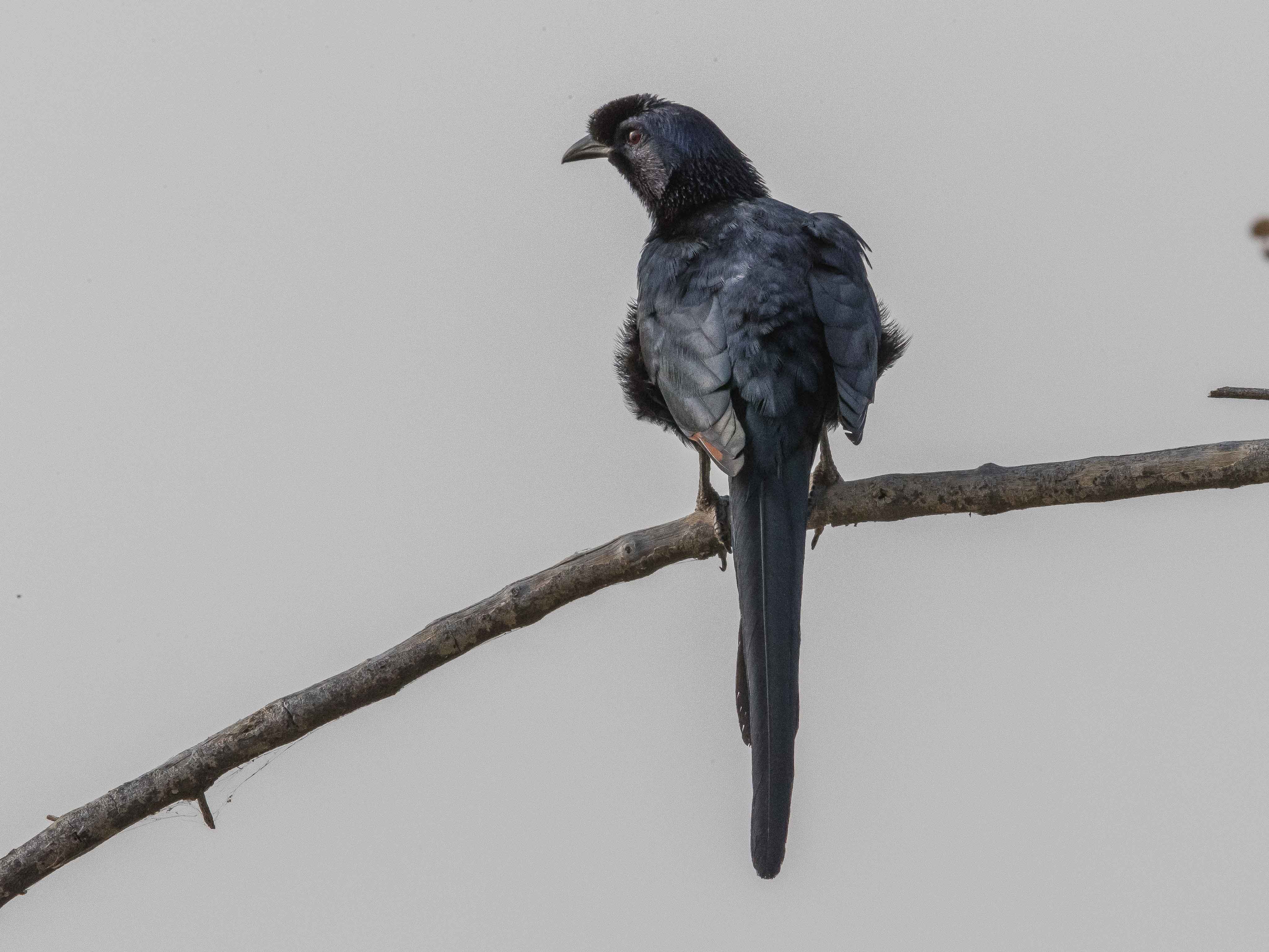
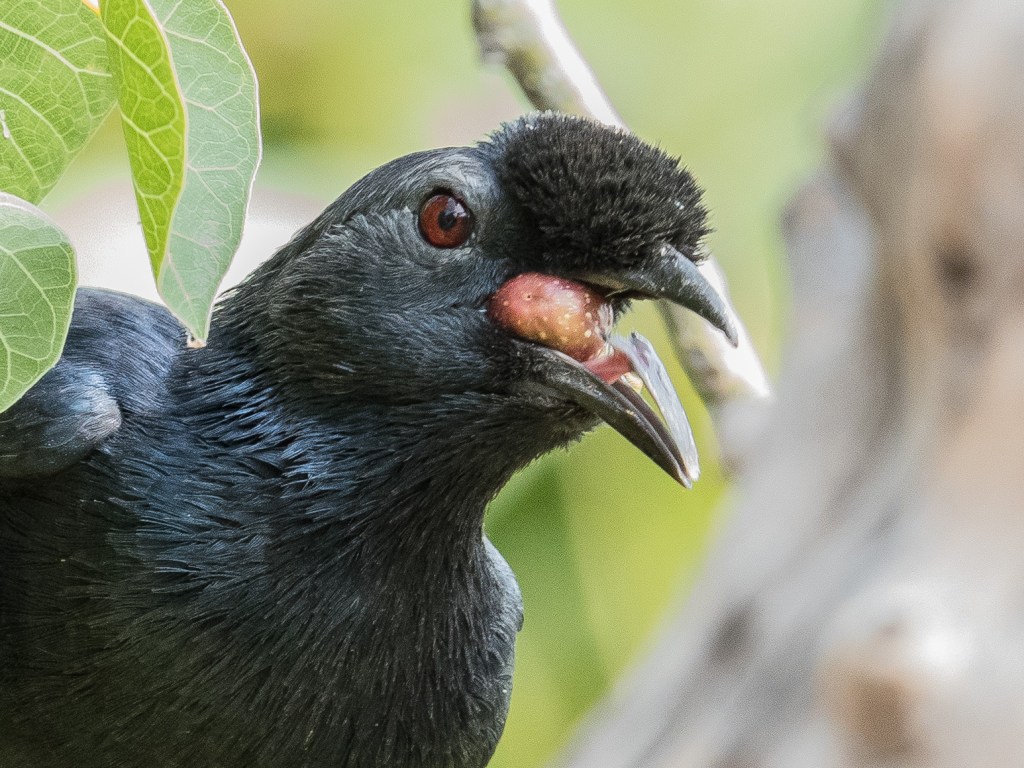
Bristle-crowned Starling is an elegant looking bird appearing mostly in dry bush land habitat of Samburu, Marsabit and Lake Baringo. It is mostly found in cliffs, gouges and near water.
It is a very large starling with a very long graduating tail and a black forehead with a small cushion bristle forehead feathers. Its overall appprearences is black with reddish-brown primaries. Females have a short-tail and some grayish feathers around the eye and on ear-coverts.Juveniles are duller with only a faint gloss.
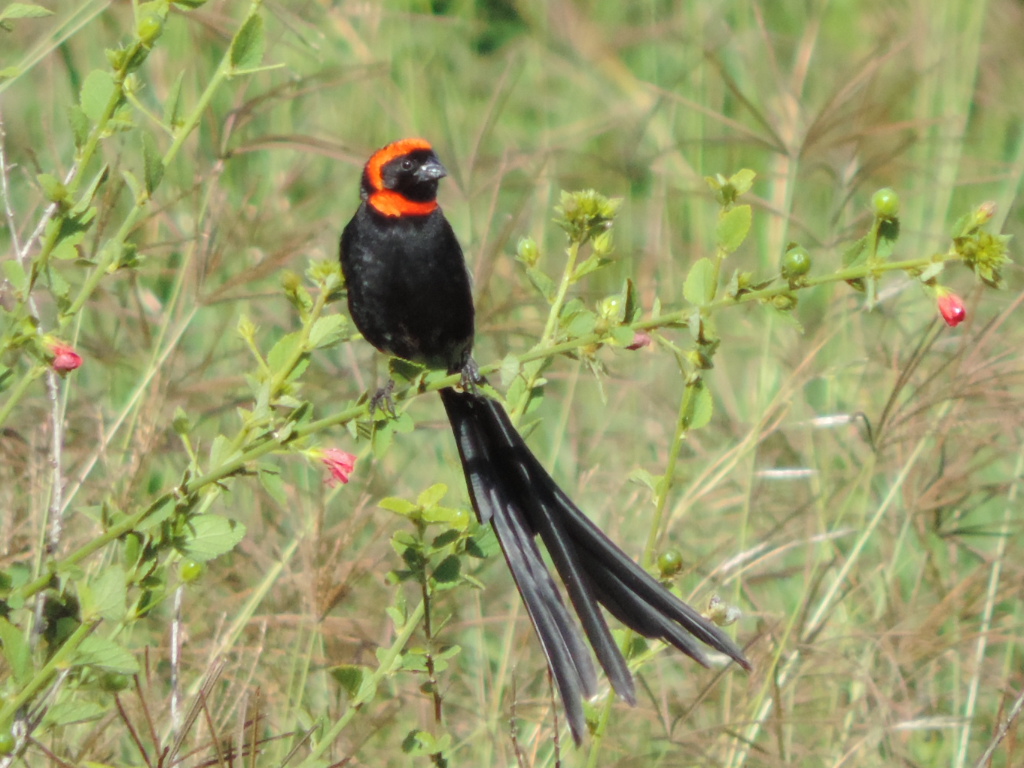
These inhabitant of Kenya high altitudes grassland are known for their long tails and brilliant red badges, both which acts as sexual ornaments. During their breeding season, males spend incredible amount of time doing flight display with single intention of attracting females.
The photo appearing above was taken in Naro Moru River Lodge, located at the base of Mt.Kenya. This species is found throughout Central Kenya, with special emphasis given to open grassland while driving through this region.
The race found in Kenya is Euplectes ardens suahelicus, which apparently also appears in the highlands of Tanzania.
The Broad-billed roller is a beautiful bird to watch during your nature travel in Kenya, and its strikingly yellow billed catches your attention instantly .It is found in areas around Lake Nakuru national park, Mt.Kenya, Kakamega extending south to Masai Mara game reserve.
Here it is fairly common in savanna, as well as clearings in woodlands. It is a specialist predator, mainly eating swarming termite and ants, as well as beetles and bugs. It mainly nests in unlined cavities in trees 5-15 m above ground. It also nests in holes of barns . It lays 2-4 eggs, timing laying to coincide with the emergence of insects after rain.
Intra-African breeding migrant, mainly breeding in southern Africa before moving north in the non-breeding season. Flocks start to arrive in southern Africa in September, leaving in the period from December to April.
It mainly nests in unlined cavities about 5-15 m above ground, usually in a tree but occasionally in a barn.
Hartlaub’s Turaco is a beautiful bird to watch!!! it will surely take your breath away if at all you are seeing it for first time. Hartlaub’s Turaco dominates the montane forest of Kenya with its range slightly extending to Northern Tanzania and Western Uganda in East Africa.
Hartlaub’s turaco is a spectacularly patterned, medium-sized bird with a strong, curved bill, short, rounded wings and a rather long tail. The vivid plumage of Hartlaub’s turaco, is a product of two unique copper pigments, unknown in any other bird family, or indeed in any other animal group. The adult has a bushy, blue-black crest and a conspicuous red eye-ring, with a distinctive white patch immediately in front of the eye and a white line beneath the eye. Much of the upper body, including the neck, mantle, throat and breast is silky green, while the lower back, folded wings, and tail are an iridescent violet-blue, Visible only in flight, the flight feathers are a striking crimson. Like all Turacos, the feet of Hartlaub’s turaco have a special joint that allows the outer toe to move either forward or backward, an attribute that enables these birds to move acutely through vegetation.
Best location to look for this species in Kenya includes, Mt. Kenya forest reserve, Aberdare National Park, Nairobi National Park, Taita and Tugen Hills. In Kenya , other than the Hartlaub’s Turaco, we have have Great Blue and Black-billed Turaco restricted to Kakamega tropical rain forest. Others are Ross’s, Purple-crested, Schalow’s, and Fisher’s Turaco.




 Our bird of the week is the Grey Woodpecker, race rhodeogaster, which is sometimes considered conspecific with the Ethiopian spodocephalus and known as Grey-headed Woodpecker. This species species was photographed around central Kenya.



 Kenya Birding