Hartlaub’s Turaco (Tauraco hartlaubi)

DSCN0894Hartlaub's TuracoHartlaub's Turaco photo

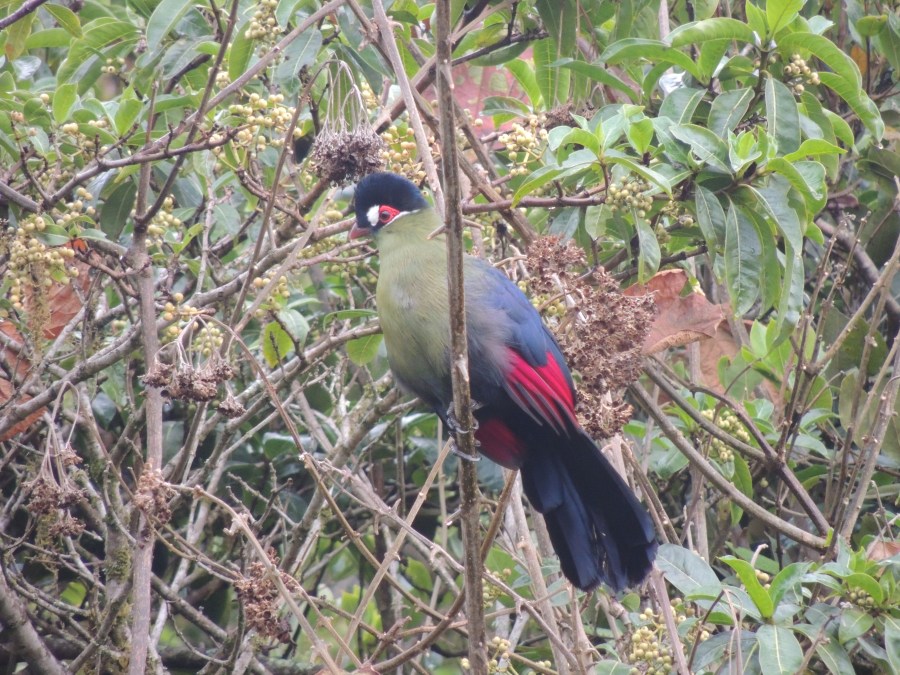
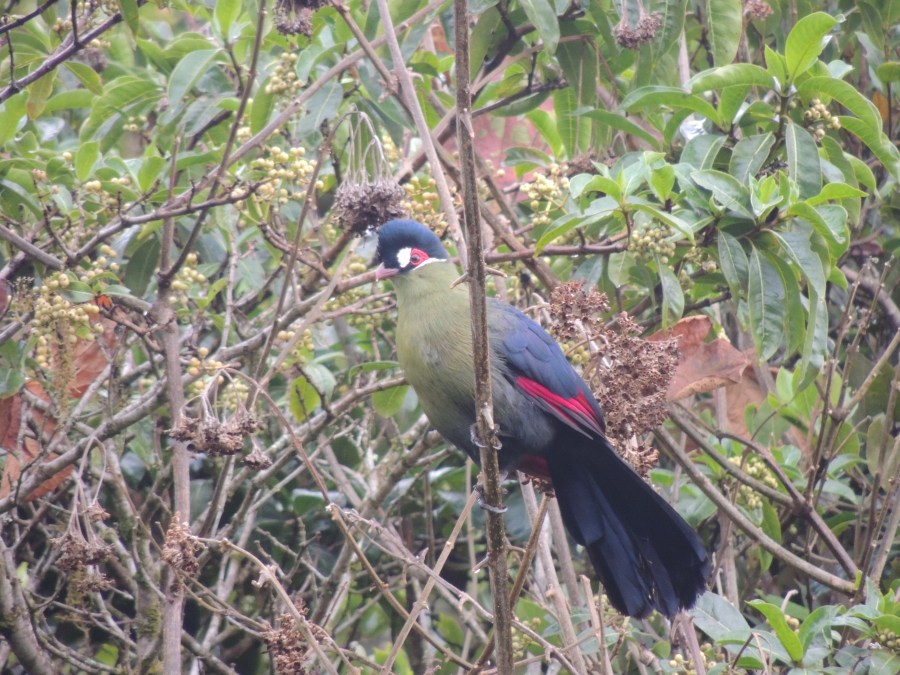
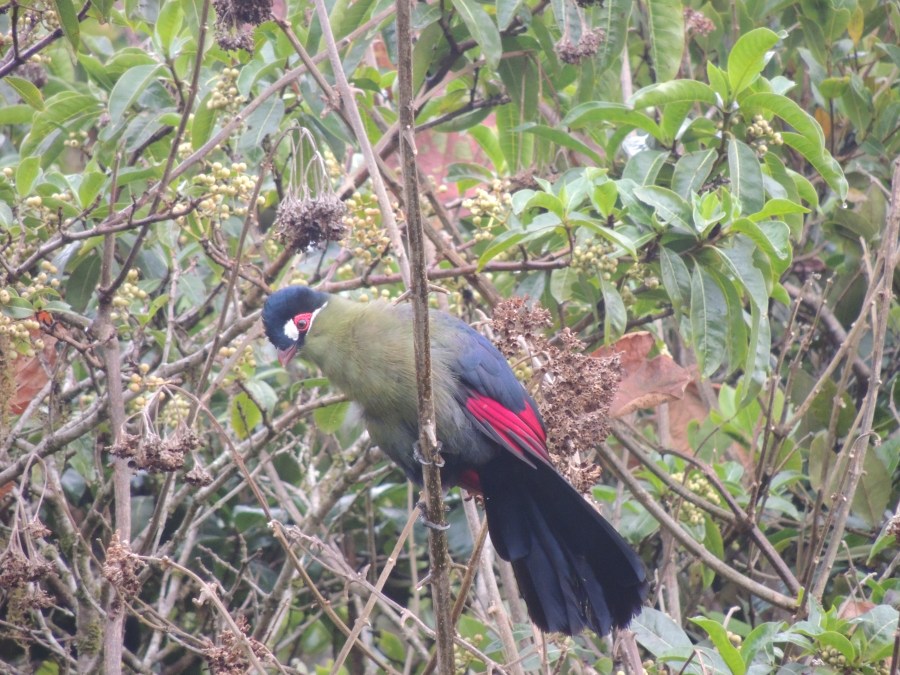
Hartlaub’s Turaco is a beautiful bird to watch!!! it will surely take your breath away if at all you are seeing it for first time. Hartlaub’s  Turaco dominates the montane forest of Kenya with its range slightly extending to Northern Tanzania and Western Uganda in East Africa.

Hartlaub’s turaco is a spectacularly patterned, medium-sized bird with a strong, curved bill, short, rounded wings and a rather long tail. The vivid plumage of Hartlaub’s turaco, is a product of two unique copper pigments, unknown in any other bird family, or indeed in any other animal group. The adult has a bushy, blue-black crest and a conspicuous red eye-ring, with a distinctive white patch immediately in front of the eye and a white line beneath the eye. Much of the upper body, including the neck, mantle, throat and breast is silky green, while the lower back, folded wings, and tail are an iridescent violet-blue, Visible only in flight, the flight feathers are a striking crimson. Like all Turacos, the feet of Hartlaub’s turaco have a special joint that allows the outer toe to move either forward or backward, an attribute that enables these birds to move acutely through vegetation.

Best location to look for this species in Kenya includes, Mt. Kenya forest reserve, Aberdare National Park, Nairobi National Park, Taita and Tugen Hills. In Kenya , other than the Hartlaub’s  Turaco, we have have Great Blue and Black-billed Turaco restricted to Kakamega tropical rain forest. Others are Ross’s, Purple-crested, Schalow’s, and Fisher’s Turaco.


Northern crombec (Sylvietta brachyura)

Northern Crombec (Sylvietta brachyura)_20180110_082131_75702
Photo by Juhani Vilpo

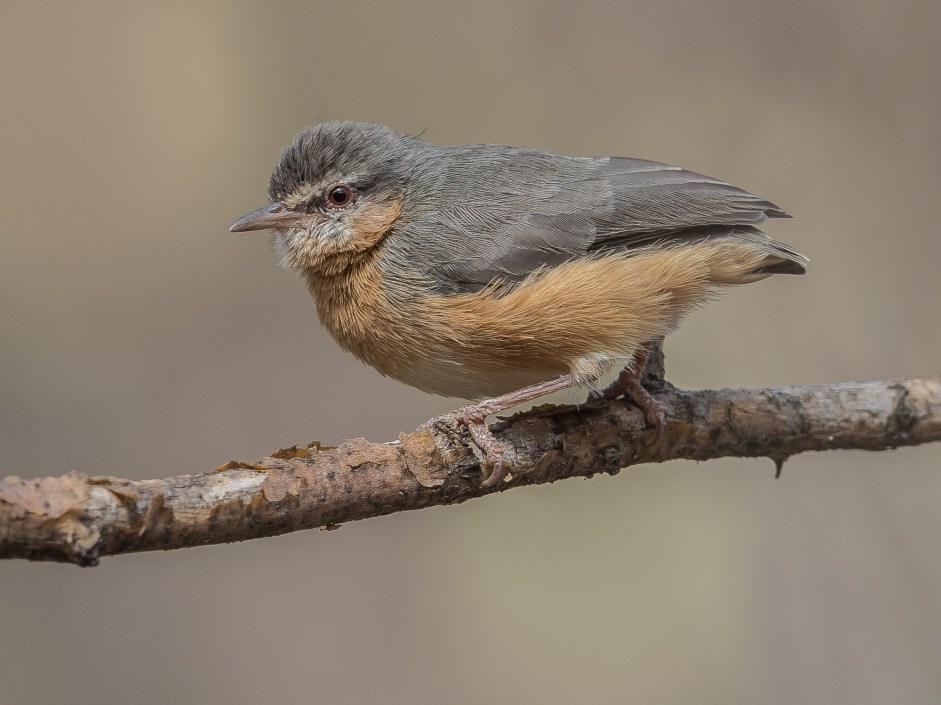
Northern Crombec is a species of African Warbler. This species is listed on IUCN red list as a near threatened species, but is evaluated as least concern. This species as an incredible short tailed, that sometimes you might tempted to assume that is has no tail. This crombec construct deep pocket shaped nests suspended from a branch and is mostly made of cob web materials .

This is commonly seen alone or in a small group of upto 5 species, but they also found feeding in a mixed flock of species. In Kenya it can easily be seen in arid and semi-arid areas of Samburu national reserve, Lake Baringo, Lake Bogoria, Tsavo East and West national park.

Orange-breasted Bushshrike (Telophorus sulfureopectus)

Sulphur-breasted Bush-shrike,Malaconotus
sulfomiopectus,Maanzoni.

Also know as Sulphur-breasted Bush shrike is an easy specie to pick in the field especially if you are birding the dry country side of Kenya, Uganda, Tanzania and Ethiopia. It prefers the canopy of acacia tortilis, but its presence is always betrayed by its unmistakable  call.   This Bush shrike main diet is invertebrates.

Another interesting natural history fact about this specie is that it is monogamous, it will only seek a new breeding mate  in the event that his partner dies. The bird lays eggs which are green in colour and number between 1-3. A real beauty in the field.

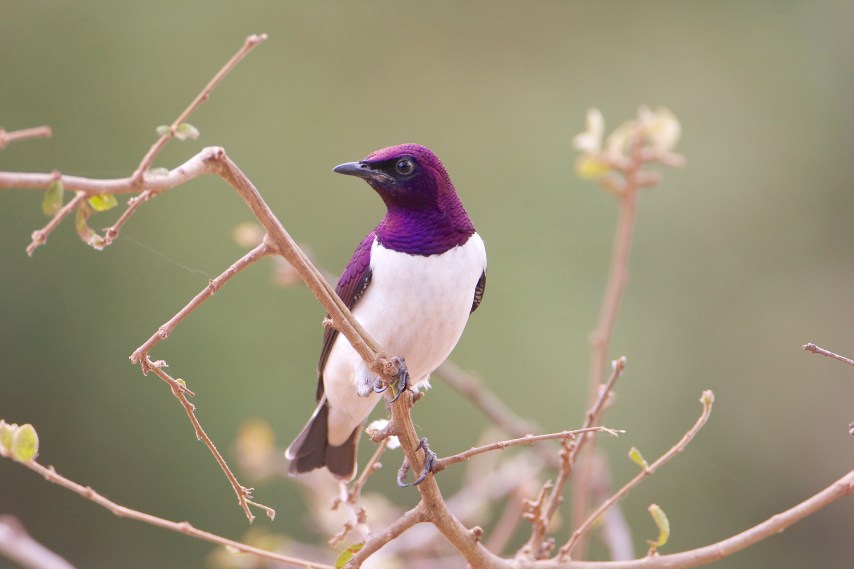
violet-backed starling (Cinnyricinclus leucogaster)

Violet-backed Starling.Maanzoni.
Photo@Jan F. Van Duinen

The Violet-backed Starling  belongs to the family of birds classified as Sturnidae. This species, also known as the Plum-coloured Starling or Amethyst Starling, is the smallest of Kenya starlings, reaching only about 18cm in length. It is a successful breeder, and is fortunately not listed as a threatened species.

The sexes are strongly sexually dimorphic, meaning that there is a distinct difference in the appearance of the male and female. The breeding male is brilliantly coloured, with feathers an iridescent shining plum violet colour along the length of is back, wings, face and throat, contrasting with bright white on the rest of the body. Females (and juveniles) are a streaky brown and buff colour, and can easily be mistaken for a thrush.

Less noisy than other starlings, this bird is a monogamous species, and will remain so unless its mate dies. Under those circumstances it will seek a new mate in replacement. These starlings are normally seen in small flocks in summer, just before the breeding season when they will break off into pairs to nest.

Violet-backed starlings will nest in cavities such as tree holes high off the ground, holes in river banks, even in old hollow fence posts, lining the nests with dung, leaves and other plant material. They have been known to reuse nests in successive breeding seasons

In Kenya, they are found a long riverine vegetation in big dead tree trunks in Machakos, the low areas of Tugen hills, Lake Nakuru and Nairobi national park.


Grey-Headed Bush-Shrike (Malaconotus blanchoti)

Grey-headed Bush-shrike is the biggest Bush-shrike in our region. It is a very colorful bird to watch and know to be flying low in the vegetation, when hunting. It generally occupies wooded areas, especially Miombo, Acacia and riverine woodland, but it occasionally moves into suburban gardens and alien tree plantations adjacent to indigenous forest. Is presence easily know by is loud call which which normally not mistaken when known.

Grey-headed Bush-shrike.
Photo by Jan Van Duinen

In Kenya, is a widely distributed bird and can be seen in Samburu, Buffalo and Shaba game reserve, Masai Mara, Nairobi national park, Lake Baringo, Nakuru, Bogoria and Magadi road.

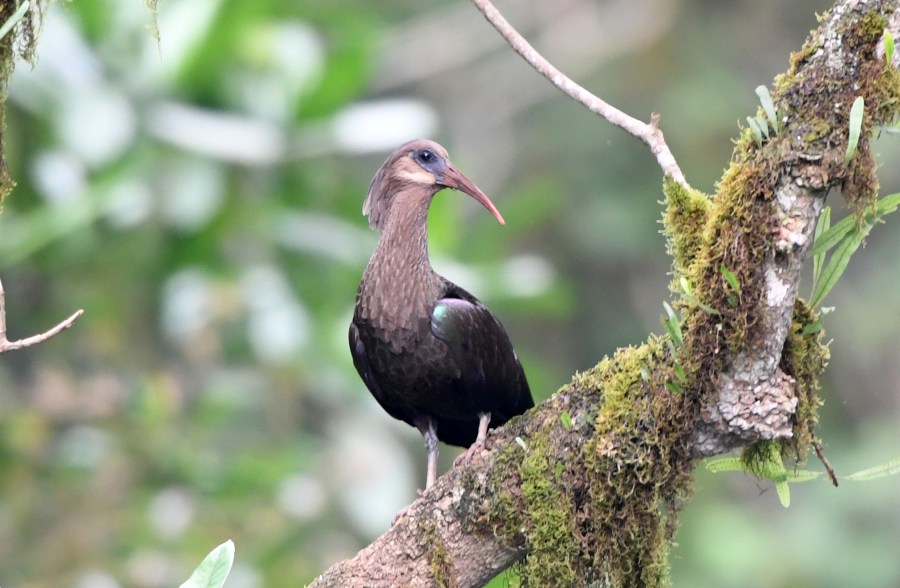
Olive Ibis (Bostrychia olivacea)

DSC_2253
Photo by Chin Tong Tan

African Green Ibis as it is mostly known is one of the most infrequent sighted among other species of Ibises we have in Kenya. Sacred, Hadada and Glossy Ibis are easy target to pocket. In Kenya, African Green Ibis is mostly restricted in Montane habitat of Mt.Kenya and Aberdare ranges. All my sighting of this species was in southern section of Mt.Kenya Forest Reserve mostly referred as Castle Forest, where Castle forest lodge is located.

They are mostly heard calling early in the morning and late in the afternoon where with luck you might be able to have some views of this incredible species. The bird photograph appearing above was taken at Castle Forest in June this year.

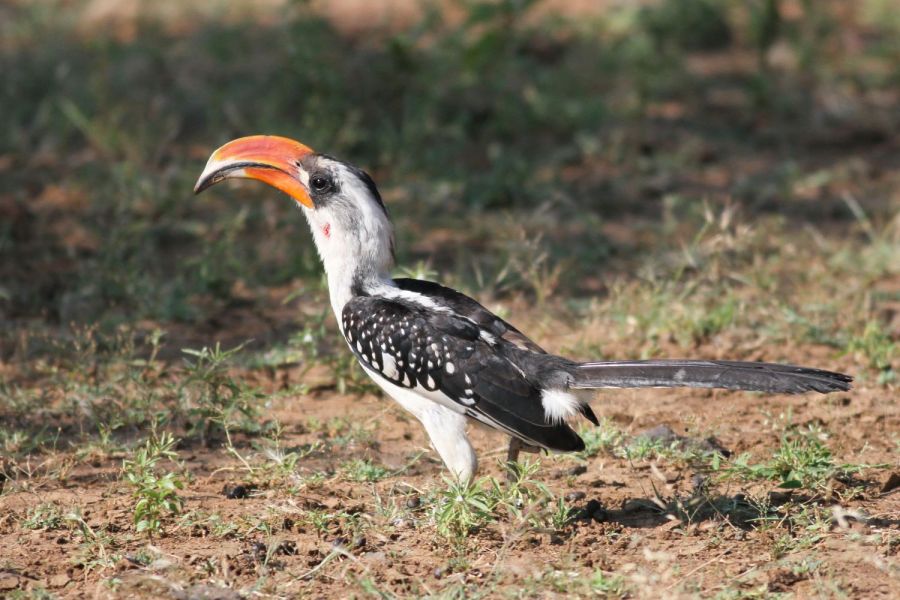
Jacson’s Hornbill (Tockus jacksoni)

Image

Similar to other hornbills, Jackson’s hornbills have a unique and nearly predator proof way of raising their offspring. Before she lays her eggs, the female is sealed in a tree cavity by her mate. During this time, he passes her food through a narrow slit.The species is an example of sexual dimorphism, meaning there is a difference in form between males and females of the same species. The male Jackson’s hornbill has a red billed with a yellow tip (see above) and the female has a black bill.

In Kenya they are found in Lake Baringo, Lake Bogoria, Kapedo and the the  upper part of the Rift Vally mostly in Turkana area.

January 15,2012:Common Ostrich (Struthio camelus massaicus)

Common Ostrich is one of the two species in Kenya, the other is Somali Ostrich found in the northern eastern part of the country. Their distribution in Kenya is widespread. They are the tallest and heaviest birds in the world and belong to a primitive group called rarities. Because of their poorly developed sternum, they do not have the place where the muscle required to aid flight can be attached. They are adopted to terrestrial lifestyle. They can run incredibly fast.

Common Ostrich Dance

Ostriches have sexual dimorphism where the male is brownish black with white wings, tail and neck ring. The female appears in a generally grey-brown with pale feather edge with neck and legs being pale-pinkish.

The photos taken show the male performing their normal interesting courtship display mostly referred to as kantling, whereby they squat down and then sway from side to side while fanning and quivering their outstretched wings. This is thought to induce the female into wanting to mate.

I managed to capture these outside my home in Lake Baringo. This guy is a bit confused as he performed the dance for me! Perhaps I look like a female Ostrich. Enjoy this rare glimpse at the Common Ostrich’s courtship display.