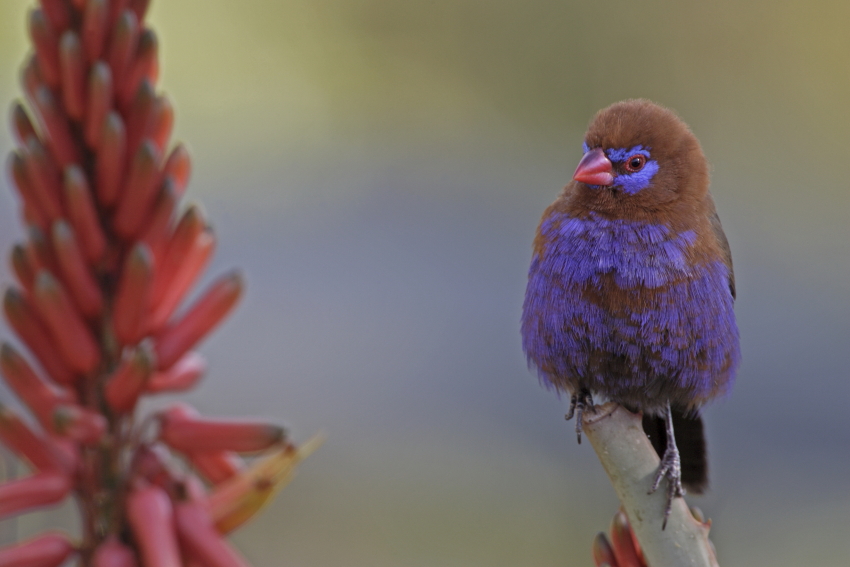
Purple Grenadier (Uraeginthus ianthinogaster)

Purple Grenadier (Uraeginthus ianthinogaster)

Photo@Tony Crocetta

Dark chestnut brown bird with red beak, black tail, and deep purplish blue rump. Male has purplish-blue feathers around the eyes, and purplish-blue breast, belly, and flanks. Female has less extensive (sometimes absent) blue feathering on the face, and often has white feathers around the eyes; female’s breast and belly is spotted or barred white. Juveniles appear similar to the female but paler, duller, and without white markings. The juvenile tends to be paler. Juveniles have blackish bills and their legs are paler than the adults’. Juveniles go through an early partial molt of the face feathers where males obtain their blue feathering and females their pale mauve feathering around the eyes.
This is a dimorphic species; the male sports blue on his face, breast, and belly. The female has less extensive blue on the face and sports white around the eyes as well as on the breast and belly. Usually form pairs and small parties. Courtship usually takes place on the ground with the male holding a stem or feather in his bill, singing and bowing his head as he bobs up and down, hoping to attract a female. An interested female may fly to the male, twist her head and tail toward him and possibly also show a display. Both male and female share nest construction, often building their round nest low in a bush or shrub. The male may continually line the nest with feathers during incubation, which both parents take turns doing through the day, with the hen incubating at night.
This species is widely distributed in Kenya and it should not be difficult to spot and identify this bird.

Grey Crowned Crane (Balearica regulorum)

Grey Crowned Crane (Balearica regulorum)Photo@Tony Crocetta

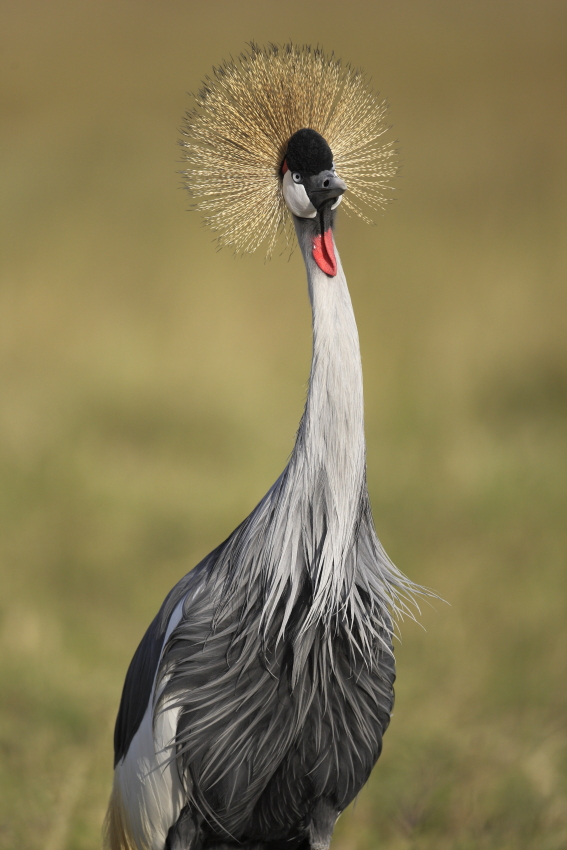
Grey Crowned Crane has a breeding display involving dancing, bowing, and jumping. It has a booming call which involves inflation of the red gular sac. It also makes a honking sound quite different from the trumpeting of other crane species. Both sexes dance, and immature birds join the adults. Dancing is an integral part of courtship, but also may be done at any time of the year.Its body plumage is mainly grey. The wings are also predominantly white, but contain feathers with a range of colours. The head has a crown of stiff golden feathers. The sides of the face are white, and there is a bright red inflatable throat pouch. The bill is relatively short and grey, and the legs are black. The have long legs for wading through the grasses. The feet are large, yet slender, adapted for balance rather than defense or grasping. The sexes are similar, although males tend to be slightly larger. Young birds are greyer than adults, with a feathered buff face.

In Kenya they are widespread in all wetlands and grassland field. They however, prefer breeding in Saiwa sawmp National Park in western Kenya and other high altitude wetland in Kenya.

Hammerkop (Scopus umbretta)

The Hammerkop (Scopus umbretta), about the size of a small egret, is entirely brown, with a robust crest which gives its head a hammer-like appearance. This pronounced head crest makes it unmistakable. The bill is long, laterally compressed, blade-like and tipped with a sharp hook. Its legs are strong and endowed with narrowly webbed toes.

This bird is related to the storks but is different enough to be placed in a separate family (Family Scopidae) of which it is the only member species.Perhaps what the hammerkop is knowned for is massive nest built mostly on a tall V-shaped branched acacia tree.Hammerkops feed mostly on frogs,fish and tadpoles, and they also take small crustaceans, grasshoppers, and aquatic insects. They often rest during the day and become active at twilight, when they are most often encountered, often alone. They range throughout Kenya.

November 2013 and January 2014 Scheduled Birding Trip to North and Western Kenya Birding Trip

This 17 days trip will take you to Nairobi, Mt. Kenya region,Samburu, Lake Nakuru, Lake Baringo, Kakamega, Lake Victoria, Masai Mara and Lake Naivasha. Some of the highlight species expected on the this include;Turner’s Eremomela, Abbot’s Starling, and Sharpes’s Longclaw, Rufous-bellied Heron,Allen’s Gallinule, Hartlaub’s Bustard, White-crested, Great Blue and Black-billed Turaco, White-faced Scops Owl, Gambaga Flycatcher and Boran Cisticola

Yellow-throated Longclaw (Macronyx croceus)

Yellow-throated Longclaw (Macronyx croceus)
Photo@Tony Crocetta

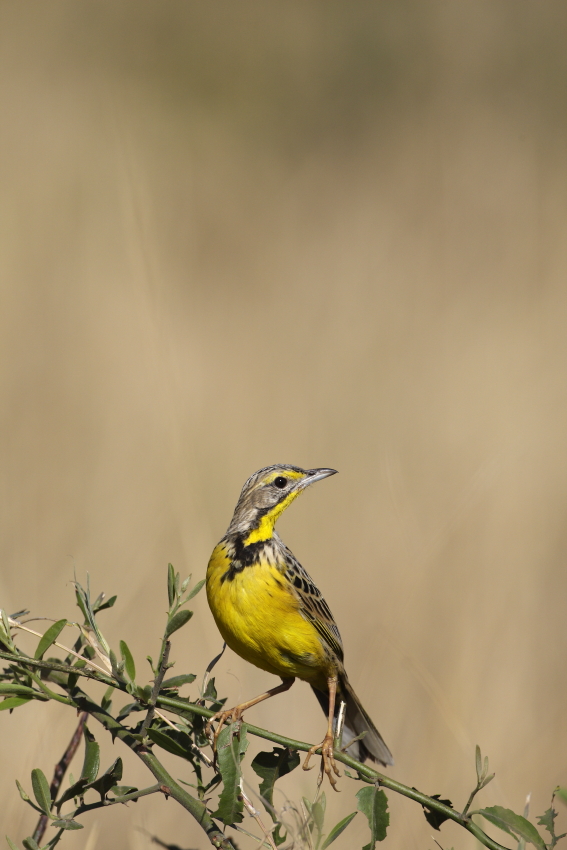
Yellow-throated Longclaw is a stocky grassland bird, that has a tendency of up and down when flushed out, exposing the conspicuous white edged tail.When perched the bird has a V-shaped black band white a bright yellow throat.The head and the upper part of the bird is all brown with little white on the upper neck.Young birds appear more buff yellow with band of indistict short streak on the breast.In Kenya it is widely distributed in areas like Aberdare park, Solio Ranch, Nairobi National park and Masai Mara national reserve.

African Orange-bellied Parrot (Poicephalus rufiventris )

African Orange-bellied Parrot (Poicephalus rufiventris )

photo@Piero

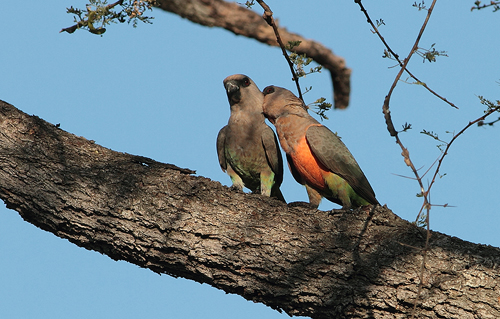
African Orange-bellied Parrot  male has a brown, with varying tinges of brown/orange on cheeks and breast; orange lower breast, abdomen and underwing coverts; pale green thighs and lower flanks to undertail coverts; yellow/green rump and upper tail coverts with blue suffusion. Bill grey/black. Cere and eye ring bare and brown/grey. Eye orange/red. Female-green lower breast to undertail coverts; green rump and upper tail coverts, blue suffusion absent. A juvenile bird is similar to adult female, but in general paler and duller; in male orange wash on underwing coverts and breast. Cere and eye ring bare and paler grey. Eye brown.

This is species is  is well distributed in  in eastern part of Kenya , commonly seen in places like Samburu and Meru National Park, Tsavo East and West , and if you are lucky enough to Tarangire National Park, then you are absolutely sure of spotting it in the big Baobab trees the park is known for.

Greater Crested Tern (Thalasseus bergii)

Greater Crested Tern (Thalasseus bergii)
Michael Sammut

Greater Crested Tern is a prominently crested coastal bird, which appears slightly smaller than Caspian Tern.At rest it appears elongated, with long wings  and large pale yellow billed which drops at the tip.On flight the tail appear very forked. A breeding adult has a black cap separated from the bill by a narrow white band. In Kenya it commonly seen a long the coast especially in areas around Sabaki delta,  Mida-Creek and Diani Beach.

Bar-Tialed Trogon (Apaloderma vittatum)

Bar-Tialed Trogon (Apaloderma vittatum)
Stratton Hatfield


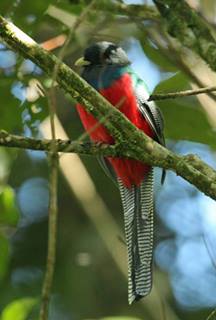
The Bar-Tailed Trogon is a stunning secretive long tailed forest bird that sits motionless for long periods often high in the canopy.It is similar to the more widespread Narina Trogon  found both in Forest and bushlands, but with blue breast band and barred tail.

The Bar-Tailed Trogon has the following features that aid identification.The adult bird has dark green and red plumage with a blue band across the breast.From behind the Bar-Tailed Trogon has a narrow tail with black and white edges while underneath the tail is entirely barred.That’s where it gets its name from.The adult female has dull brown head and breast while the immature ones have pale-tipped wing coverts. Due to its secretive nature, the bird is rarely seen in location like Kakamega forest, Kieni Forest, Mt.Kenya and Aberadare National Park.


Friedmann’s Lark (Mirafra pulpa)

Friedmann's Lark (Mirafra pulpa)

Photo@Joseph Aengwo

Friedmann’s Lark is a rare bird resembling Singing Bush Lark but more richly coloured and more heavily streaked above, especially on nape and upper back, streaking enhanced in fresh plumage by broad pale feather edges; superciliary stripes somewhat  less prominent . Singing birds readily distinguished vocally and y prominent white throat. Gregarious territorial birds share habitat with Singing Bush Lark, Red-winged and Flappet Lark.It has a tendency of elevating crown feathers when singing, leaning forwards and fluffing out  the white throat. Tsavo West and East National Park are the only places you have an high chance of seeing them.