Somali Bee-eater (Merops revoilii)

Somali Bee-eater
Photo@Raymond Galea

Somali Bee-eater is a small bee-eater, about seventeen centimetres long. It prefers arid country and desert areas where it may be locally common. It feeds on small flying insects which it catches in short dashes from a low perch. It is either solitary or found in pairs. It nests in the banks of road cuttings and in the sides of deep wells. In Kenya it breeds between March and June.

In Kenya it is found in areas like Samburu and Meru National Park, Lake Baringo and Tsavo East.

Golden-breasted Starling (Cosmopsarus regius)

Often called “the most beautiful of the African starlings,” the Golden-breasted starling is a striking bird easily seen in the field. With a bright, metallic blue tail and back, which merges into the green of its head, white eyes and blue-violet wings, it gets its name from the yellow of its breast, belly, and upper tail covers, a color considered unique to African passerines.

The Golden-breasted starling is a slender-bodied bird with a fairly long bill and a long, graduated tail.  Both males and females look alike. Typical of most starlings, the young are duller in color than the adults. The young are blackish with some green and the sides of the head and chest are ashy brown.

Mostly seen in Samburu national Reserve, Meru National Park and Tsavo East and West National Park

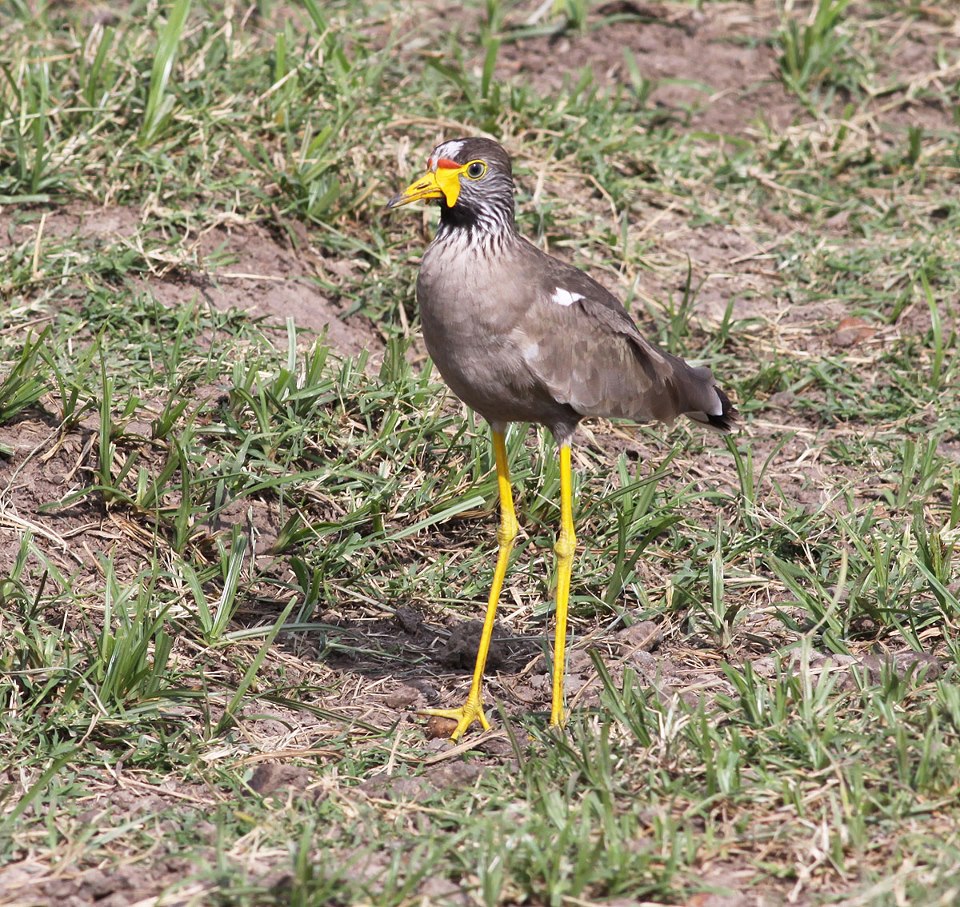
Wattled Plover (Vanellus senegallus)

Wattled Plover (Vanellus senegallus)
Photo@Raymond Galea

Wattled Plover (Vanellus senegallus)

A large and very distinctive Plover. Both the male and female have long yellow facial wattles as well as smaller red ones on the forehead. As with all the lapwings of the genus Vanellus, the Wattled Plover has a white wing stripe (visible in flight) and a white base to its tail. These birds are fairly common in the Maasai Mara and can also be found around Lake Victoria. Although they are residents of swamps, streams and lakes they are only occasionally seen near the Rift Valley Lakes

Goliath Heron(Ardea goliath)

Goliath Heron

Photo@Yan Van Dainne

Goliath Heron

The Goliath heron is Africa largest heron, standing 53-to-55 inches tall, with a wingspan of six-to-seven feet. Male and female look similar, with an overall covering of slate gray and chestnut feathers. The head and its bushy crest, face, back and sides of the neck are chestnut. The chin, throat, foreneck and upper breast are white, with black streaks across the foreneck and upper breast. The lower breast and belly are buff with black streaks. The upper mandible is black and the lores and orbital areas are yellow with a greenish tinge. The eyes are yellow and legs and feet are black. Juveniles look similar to the adults, but are paler.

The Goliath heron is territorial, usually living alone near water. A diurnal and often rather inactive feeder, the heron hunts by standing in the shallows, or on floating vegetation, intently watching the water at its feet. As prey appears, the heron rapidly spears it with open mandibles.

Goliath heron nests are found in trees overhanging water, on the ground and in low bushes. Both sexes build the stick and reed platform nest, which measures three-to-four feet across. Both parents incubate two-to-four pale blue eggs for 29 days. The chicks are covered with long white down.

Lake Baringo Birdwatching Chitchat for Early July, 2012

Birding in and around Lake Baringo

July was a stormy month with thunder rattling the very foundation of building and impressive fiery displays of sheet lighting illuminated the whole area whilst sizzling streaks of forked lightning hit the far hills of Tugen and Laikipia. Torrential rains had the lugga’s in full spate and subsequently the ever surging lake rose again swamping the shoreline grassland and acacias dominated lake shore.

Birds flocked back to Baringo. At first, while the grasses were still low, enthralling hours could be spent looking over this rewarding bird rich area for each day something new was sighted. African Jacana, Allen’s Gallinule, Little Bittern, Northern Red Bishop, Long-toed, Spur-winged and Blacksmith Lapwing; Squacco, Grey, Purple and Goliath Heron; Great white, Yellow-billed, little and Cattle Egret;  Hamerkop,  Sacred and Hadada Ibis; White-faced and Fulvous Duck. Egyptian Geese were plentiful and with them were often a few knob-billed Duck , and lastly the Red-knob coot was recorded swimming in the middle of the lake.

Pied Kingfishers were not uncommon and a malachite Kingfisher was seen perched on a long grass stalk. Wood and Common Sandpipers and Barn Swallow were sighted, either  early arrivals from  Europe or birds which over summered in Africa. One evening a large flock of Open-billed Storks flew in and overnighted  here. All the above were seen but now the grasses are tall and the general shore flooded, most of the birdlife is hidden from view.

Birds wasted no time nesting and many fledglings are already trying their wings. A Grey-headed Bush Shrike killed a weaver, decapitated it and took the head for its young to feed on. The young bird wedged the head in a forked branch were it shredded and ate it. On other occasion a Gey-headed Bushshrike attempted to take eggs from sitting White-bellied Go-Away Bird but the Go-Away Birds flocked to the scene and averted the crime by chasing the Shrike off.

Cuckoo’s are searching for nests in which to lay their eggs. Great-Spotted Cuckoo’s particularly favour Bristle-crowned Starlings nests. Rufous Chatteres are host to Black & White Cuckoo’s and it was interesting to note that Brown Babblers got very agitated when a Black & White Cuckoo invaded their territory. Didric Cuckoo’s  parasitise Weaver nests, Red-chested Cuckoo’s invariably leaves their young to be raised by the poor little Spotted Morning Thrush. When Cuckoo’s are around they are constantly being chased by their angry hosts.

The Fish Eagle appears to have one young on their nest in the top branches of the Kapok tree. As this is an early hatching it is hoped the young will survive the August storms.

One morning a pair of Pygmy Kingfisher and a pair of Red-fronted Tinkerbirds were darting  around the bushes calling and courting. This caused a certain amount of dilemma for both species are so enchanting it was difficult to decide which pair to watch.

One evening  the Verreaux’s Eagle Owls could be heard calling in the acacia woodland south of the Camp. The next day the pair was together.  As no sighting had been had of the male for some time it was good to know he was still around. The not so young juvenile was then spied flying towards its parents and for several days the family stayed on an acacia in Robert’s Camp main house. Pearl Spotted Owlet was also spotted , it is so small it is difficult to find but its distinctive call can be heard in the early morning hours.

Enjoy your birding.

Joseph Aengwo,

Resident Ornithologist

 

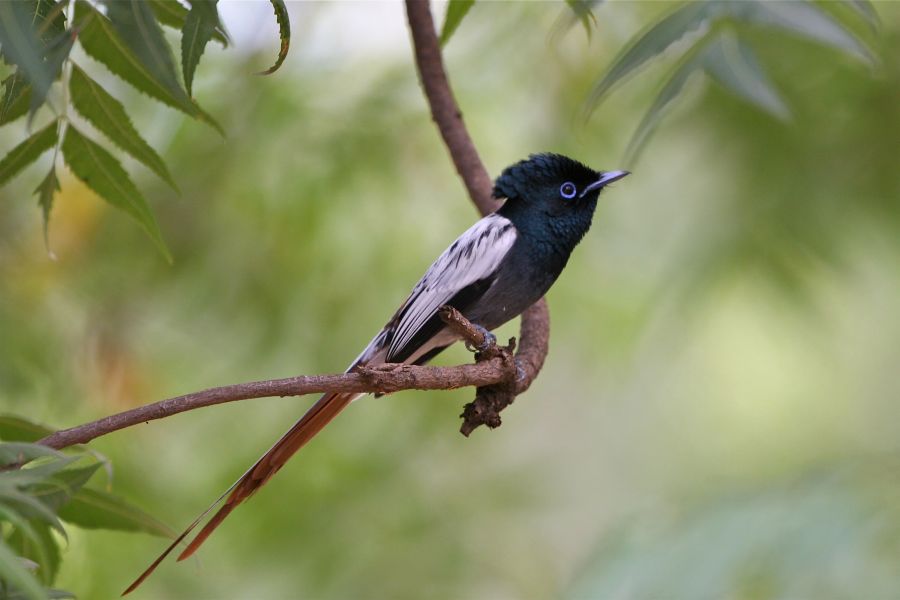
African Paradise-flycatcher (Terpsiphone virisidis)

 African Paradise-flycatcher (Terpsiphone virisidis)

Photo@Yan Van Dainne

African Paradise-Flycatcher is a beautiful bird with very long tail which allows sometimes detecting the bird among the foliage.
Plumage is very variable, from rufous to white, with five colours recognized.

Adult male (of all types) has rufous upperparts, upperwing and tail, with variable amount of black and white and greyish underparts.
Head is glossy blue-black with a crest. Central tail feathers are very elongated. In breeding plumage, the upper mandible and the eye-rings become electric-blue.

The male of nominate race has deep rufous upperparts. Wings show conspicuous white edgings.
Underparts are glossy blue-black on throat and breast. Belly is duller, mostly dark grey. Undertail coverts and tail are rufous.
Head is glossy blue-black with dark, thick crest on the crown.
Bill is cobalt-blue with black tip. Eyes are dark brown with thick bright cobalt-blue eye-ring. Legs and feet are bluish-black.

Pel’s Fishing-Owl (Scotopelia peli)

Pel's Fishing-Owl (Scotopelia peli)

Photo@Yan Van Dainne

Fish owls differ from other owls in that they have no feathers on their feet. Additionally, they lack the noiseless flight typical of owls, perhaps because their submerged prey is less able to hear their approach.  Three species of fish owl occurs in Africa . Pel’s Fishing Owl snatch their prey while skimming the water surface. In Kenya it is found in Maasai Mara and Samburu national reserve along the the Mara rive and Ewaso Ngiro rivers.

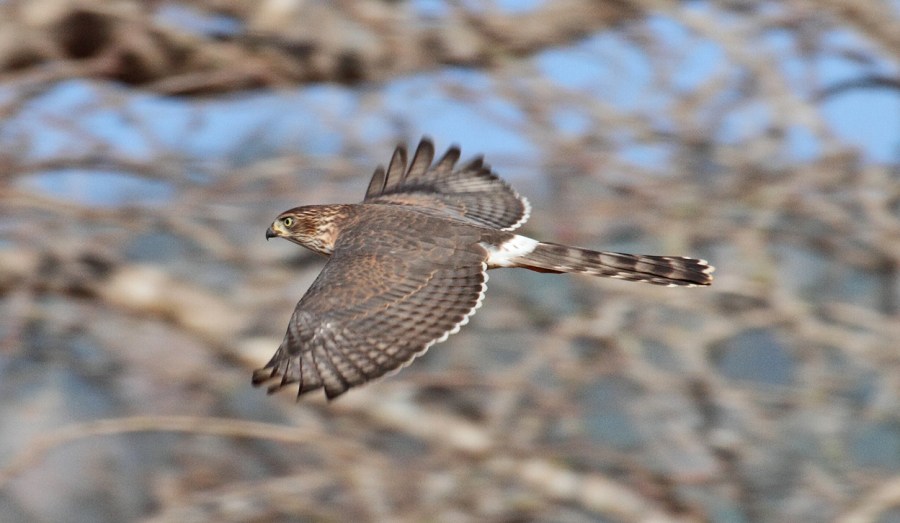
Gabar Goshawk (Micronisus gabar)

Gabar Goshawk (Micronisus gabar)

Photo@Michael Sammut

Gabar Goshawk is smaller than other Goshawks. We can observe two morphs, one grey and one almost black. This melanistic form represents about 6 to 25 % of population. The photo shown above is of a juvenile bird.

In typical grey morph, adult has plain grey upperparts and white rump. Tail is grey, barred with black.Underparts are plain grey on chest. Belly is white, barred with grey. Vent is white. Flight feathers are sooty-grey with very pale grey bars. Tail is white with broad dark grey bars.
Head is grey. Bill is black, with red cere and gape. Eyes are deep dark red. Long bare legs and stocky toes are bright red.

Gabar Goshawk lives in savannahs and semi-arid scrub with scattered trees. It avoids too dense forests and driest deserts. It is rather found in drier thorn savannah, and also along watercourses.In Kenya it is commonly seen in Lake Baringo and Bogoria, Tsavo West and East National and Samburu National Reserve.