Fan-tailed Widowbird (Euplectes axillaris)

Fan-tailed Widowbird (Euplectes axillaris)

Photo@Tony Crocetta

This is an adult male fan-tailed widowbird, Euplectes axillaris, a member of the avian family Ploceidae, the weaver birds. One of its cousins is the red-billed quelea, Quelea quelea, the most abundant bird in the world.This species has an extremely large range, so incidence of you spotting it while birding in Kenya is very high. They exhibit sexual dimorphism and female appears brown, with the distinctive red-shoulders which clear when the bird air-bone.
In Kenya this species is mostly seen in Masai Mara, mostly a long the northern part of the reserve around the Musiara Swamp.

Hammerkop (Scopus umbretta)

The Hammerkop (Scopus umbretta), about the size of a small egret, is entirely brown, with a robust crest which gives its head a hammer-like appearance. This pronounced head crest makes it unmistakable. The bill is long, laterally compressed, blade-like and tipped with a sharp hook. Its legs are strong and endowed with narrowly webbed toes.

This bird is related to the storks but is different enough to be placed in a separate family (Family Scopidae) of which it is the only member species.Perhaps what the hammerkop is knowned for is massive nest built mostly on a tall V-shaped branched acacia tree.Hammerkops feed mostly on frogs,fish and tadpoles, and they also take small crustaceans, grasshoppers, and aquatic insects. They often rest during the day and become active at twilight, when they are most often encountered, often alone. They range throughout Kenya.

Bar-Tialed Trogon (Apaloderma vittatum)

Bar-Tialed Trogon (Apaloderma vittatum)
Stratton Hatfield


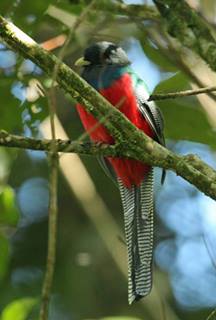
The Bar-Tailed Trogon is a stunning secretive long tailed forest bird that sits motionless for long periods often high in the canopy.It is similar to the more widespread Narina Trogon  found both in Forest and bushlands, but with blue breast band and barred tail.

The Bar-Tailed Trogon has the following features that aid identification.The adult bird has dark green and red plumage with a blue band across the breast.From behind the Bar-Tailed Trogon has a narrow tail with black and white edges while underneath the tail is entirely barred.That’s where it gets its name from.The adult female has dull brown head and breast while the immature ones have pale-tipped wing coverts. Due to its secretive nature, the bird is rarely seen in location like Kakamega forest, Kieni Forest, Mt.Kenya and Aberadare National Park.


Egyptian Vulture (Neophron percnopterus)

Image
Photo@Michael Sammut

The Egyptian Vulture is the smallest of all the African Vultures.This vulture flies with more wingbeats than most vultures, but takes off much more gracefully, as it is built lighter and smaller.  Once gliding, the bird holds its wings flat, shifting them very little.  The bird posesses great endurance, and is able to fly up to 70 kilometers in search of food.Egyptian vultures are specialists in egg-eating.  They are among the only known birds in the world to use stones as tools.  They will repeatedly strike at an abandoned ostrich egg with stones, then use their beak to enlarge the hole and penetrate membrane.  This behavior is not instinctive, but learned from other vultures, as the species is very intelligent.

This species of vulture is a very adaptable, inhabiting various habitat types, and slowly estblishing territories closer and closer to humans. That is the reason they are mostly affected my human poisoning of vulture using Furudan, a lethal insecticide.  In Kenya they are found in mostly in Wider Tsavo East and West National Park,where this photo was taken.Other than that there records of the species from Maasai Mara, Lake Nakuru, Amboseli, Samburu and Meru National Parks.

White-browed Scrub Robin (Erythropygia leucophrys)

White-browed Scrub Robin (Erythropygia leucophrys)@Michael Sammut

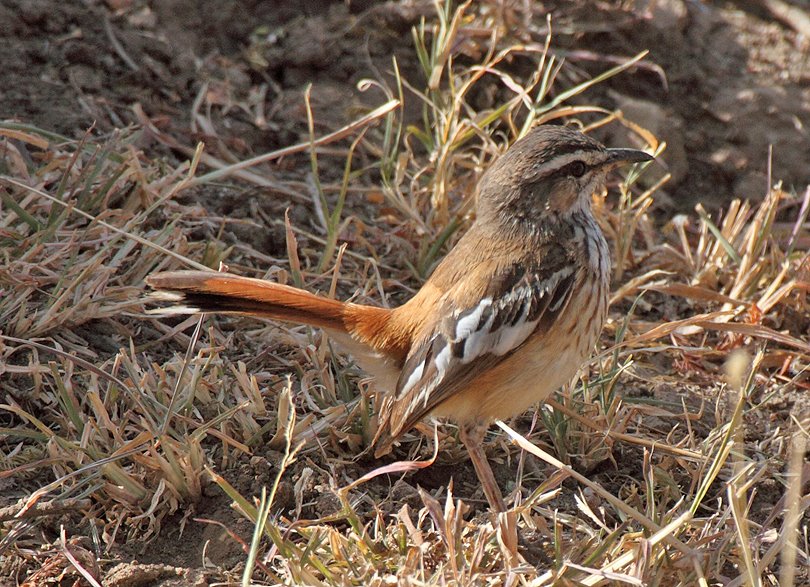
For the last two weeks, a pair of White-browed Scrub Robin have been nesting very close to my house! I have been observing them carefully and indeed I am impressed by the intelligence!!The timing of the breeding period is incredible, in the middle of a big rainy  season  and there was plenty of insect, which meant the young one will not go hungry  and I supplied them with a bath bowel in form of a modified stone which they like it a lot.The good news is two days ago, the eggs were hatched and  two chicks with a bright cream- white gape.This morning when I visited them in the nest, the chicks were developing fast and their tiny bodies were covered by feather.I wish them well as they continue with their parental responsibilities which up to now, they seem to be doing it perfectly.

Red-backed Scrub Robin, as this species is sometimes refered Lives mainly in the woodlands and savannah with thickets and tall grass. Fairly common resident in much of arid and semi-arid areas of East Africa. This small bird is light brown with darker streaks above. The rump is bright brown to orange; the tail is blackish tipped with white. Below it is white streaked with black. The eyes are reddish brown, the bill blackish brown and the legs and feet are pinkish brown it nests from September to January in building a bulky cup of course material near the ground in a grass tuft, shrub or thick clump of vegetation. The cup is lined with finer material. It usually lays three eggs, which are coloured white spotted with light brown and grey. Will foraging for its prey on the ground and takes insects in flight. The food consists of insects and spiders as well as berries and nectar.

Common in Lake Baringo and Bogoria, Tsavo West and East, Amboseli, Meru National park and Samburu National Reserve.Mostly call on top on trees parched.

crimson-rumped-waxbill (Estrilda rhodopyga centralis)

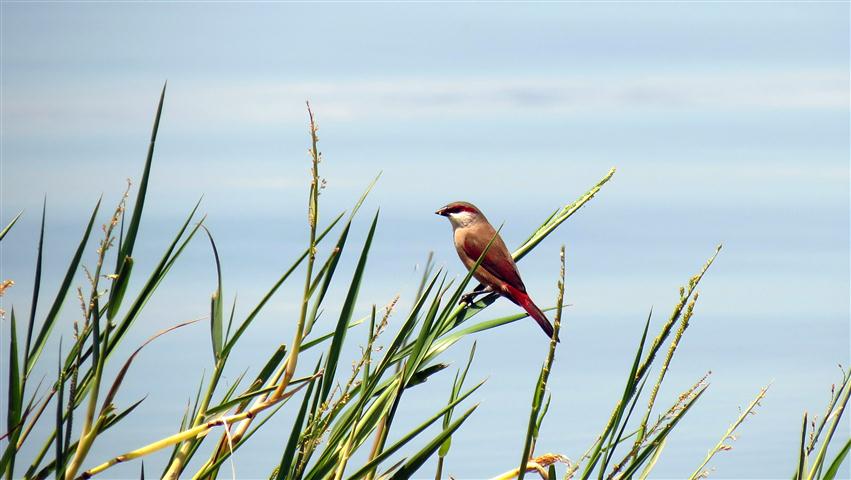
Crimson-rumped Waxbill is a typical firefinch type of a bird who most of the time prefer spending its time within the grass top close to wetland habitat.The photo above was taken in Teddy bear Island at Lake Baringo. A Red-rumped waxbill has a slate-grey or black bill. This species is monomophic. Adult bird is warm brown above, with indistinct narrow barring;rumped and upper taile-tailed coverts red;tiled dusky brown, with central feathers tinged crimson, as are the wing-coverts. Broad red streak from bill through the eye. Juvenile bird is similar to an adult bird but lacks red streak through the eye.

Black-necked Weaver (Ploceus nigricollis)

@Michael Sammut

Black-necked Weaver appear in two races, P.n. nigricollis and P.n.melanoxanthus. Both species are widespread in moist secondary growth of western Kenya in area around Kakamega, Bunguma,  Lake Victoria and Masai Mara Game reserve.While spp menaloxanthus is uncommon in dry bush and woodland of Tsavo west and east, Amboseli,Lake Magadi, and Samburu. Male has deep golden-yellow head with black eyes;throat patch and nape also black with red-brown eyes with a back bill.Female has a prominent yellow supercilliary  stripes and not throat patch . Black-necked weaver is very similar to Dark-backed weaver (forest weaver) and Baglafecht Weaver.

Crested Guinea Fowl (Guttera pucherani)

Photo@Raymond Galea

Crested Guinea fowl has a wide range in Kenya and northern Tanzania. In Kenya it is found mostly in western tropical rain forest remnant of Kakamega forest and Lake Manyara national park in Northern Tanzania, Body plumage is much like a typhical Guinea Fowl, with whitish spot; most recognizable features is the short, curly “mop” of black feathers on the head, the rest of the head and neck are bare with blue skin, red skin arond the eyes and on the neck;eyes are red;legs dark brown to black.The species is mono morphic.

Golden-winged Sunbird (Nectarinia reichenowi)

Photo@Jacqui Harrington

Golden-winged Sunbird has a bright yellow tail and wings, the shoulders are dark gray, the dark gray extending to the nape and throat, while the head and downturned beak are lighter gray. The tail is long and ends in two long, very narrow parallel feathers.These birds are found in East Africa; Kenya, Tanzania, and Uganda.Golden-winged sunbirds live in grassland, bamboo thickets, and tropical mountain forest.

In Kenya this species if found in Lake Nakuru and Naivasha,Nyahururu,Mt.Kenya and Aberdare National Park.