Bar-Tialed Trogon (Apaloderma vittatum)

Bar-Tialed Trogon (Apaloderma vittatum)
Stratton Hatfield


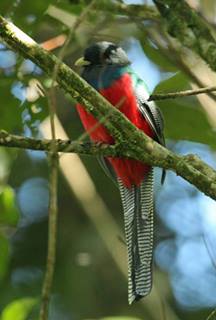
The Bar-Tailed Trogon is a stunning secretive long tailed forest bird that sits motionless for long periods often high in the canopy.It is similar to the more widespread Narina Trogon  found both in Forest and bushlands, but with blue breast band and barred tail.

The Bar-Tailed Trogon has the following features that aid identification.The adult bird has dark green and red plumage with a blue band across the breast.From behind the Bar-Tailed Trogon has a narrow tail with black and white edges while underneath the tail is entirely barred.That’s where it gets its name from.The adult female has dull brown head and breast while the immature ones have pale-tipped wing coverts. Due to its secretive nature, the bird is rarely seen in location like Kakamega forest, Kieni Forest, Mt.Kenya and Aberadare National Park.


Black-necked Weaver (Ploceus nigricollis)

@Michael Sammut

Black-necked Weaver appear in two races, P.n. nigricollis and P.n.melanoxanthus. Both species are widespread in moist secondary growth of western Kenya in area around Kakamega, Bunguma,  Lake Victoria and Masai Mara Game reserve.While spp menaloxanthus is uncommon in dry bush and woodland of Tsavo west and east, Amboseli,Lake Magadi, and Samburu. Male has deep golden-yellow head with black eyes;throat patch and nape also black with red-brown eyes with a back bill.Female has a prominent yellow supercilliary  stripes and not throat patch . Black-necked weaver is very similar to Dark-backed weaver (forest weaver) and Baglafecht Weaver.

Yellow-billed Stock (Mycteria ibis)

Yellow-billed Stock (Mycteria ibis)

Yellow-billed Stork is an African species but there are records from Spain and Eastern Europe  which may relate to wild vagrants. This is the mostly seen and easily identified stork in Kenya wetlands after Marabou Stork.Breeding adult birds are brightly coloured, while the juvenile one are greyer with a bit of a dull bills.In Kenya they mostly concentrated in the Rift-Valley Lakes, Amboseli National park, Lake Victoria and the coastal wet areas.

Crested Guinea Fowl (Guttera pucherani)

Photo@Raymond Galea

Crested Guinea fowl has a wide range in Kenya and northern Tanzania. In Kenya it is found mostly in western tropical rain forest remnant of Kakamega forest and Lake Manyara national park in Northern Tanzania, Body plumage is much like a typhical Guinea Fowl, with whitish spot; most recognizable features is the short, curly “mop” of black feathers on the head, the rest of the head and neck are bare with blue skin, red skin arond the eyes and on the neck;eyes are red;legs dark brown to black.The species is mono morphic.

Golden-winged Sunbird (Nectarinia reichenowi)

Photo@Jacqui Harrington

Golden-winged Sunbird has a bright yellow tail and wings, the shoulders are dark gray, the dark gray extending to the nape and throat, while the head and downturned beak are lighter gray. The tail is long and ends in two long, very narrow parallel feathers.These birds are found in East Africa; Kenya, Tanzania, and Uganda.Golden-winged sunbirds live in grassland, bamboo thickets, and tropical mountain forest.

In Kenya this species if found in Lake Nakuru and Naivasha,Nyahururu,Mt.Kenya and Aberdare National Park.

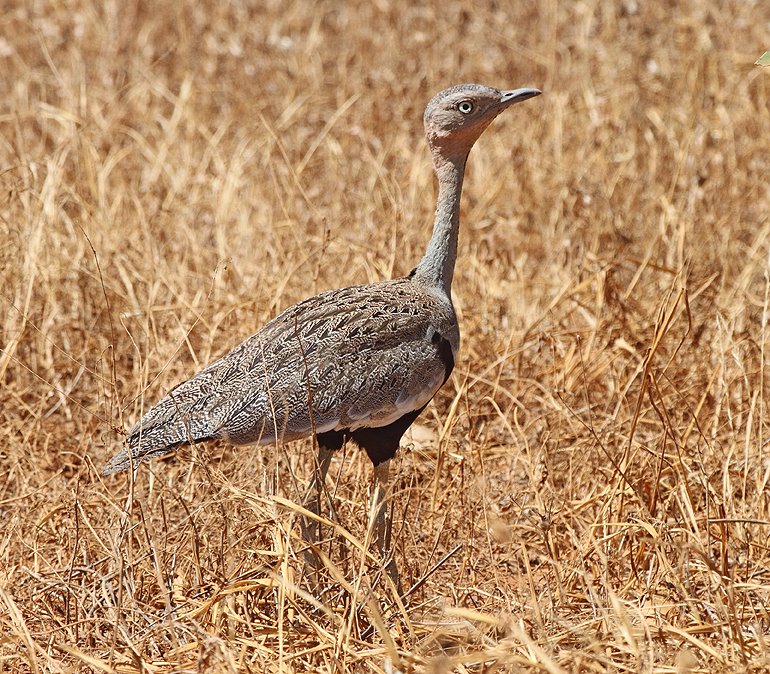
Buff-crested Bustard (Eupodotis gindiana)

Photo@Raymond Galea.Taken in Samburu National Reserve.

Buff-crested bustards are small in size compared to other species that we have in Kenya. They are cryptically colored to help them blend into their environment. They also are sexually dimorphic. Male buff-crested bustards have an olive colored crown, a black stripe down the front of the neck, and a black chest and belly. The upper feathers contain light orange-brown coloration. The females have brown heads, a much reduced crest, and are buff colored in the throat, chin, and breast area.The buff-crested or crested bustard prefers drier acacia scrub and woodland of northern arid and semi-arid regions of Kenya, especially in regions like Samaburu and Meru National park, Lake Baringo and Bogoria  and further north in areas like Kapedo.


Magpie Starling (Speculipastor bicolor)


The magpie starling is a northeast African endemic and an occasional non-breeding visitor to northeastern Tanzania. The male is black and white; the female, brown and white both with bright red eye which aid identification a great deal. The best place to see them in Kenya is Lake Baringo where is frequently spotted feeding in big fig trees along the cliffs.

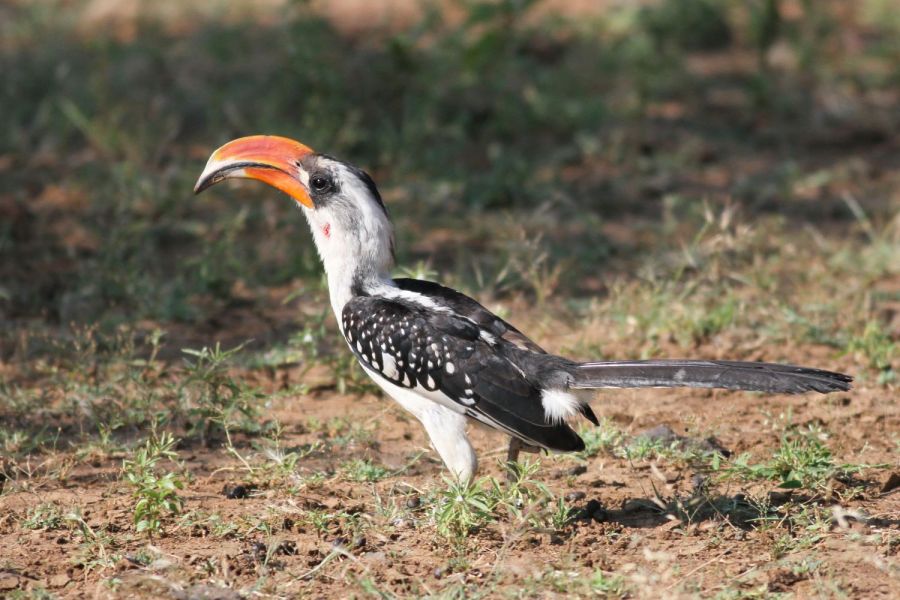
Jacson’s Hornbill (Tockus jacksoni)

Image

Similar to other hornbills, Jackson’s hornbills have a unique and nearly predator proof way of raising their offspring. Before she lays her eggs, the female is sealed in a tree cavity by her mate. During this time, he passes her food through a narrow slit.The species is an example of sexual dimorphism, meaning there is a difference in form between males and females of the same species. The male Jackson’s hornbill has a red billed with a yellow tip (see above) and the female has a black bill.

In Kenya they are found in Lake Baringo, Lake Bogoria, Kapedo and the the  upper part of the Rift Vally mostly in Turkana area.

Black-faced Sandgrouse (Pterocles decoratus)

Image

The sandgrouse are distributed across northern, southern and eastern Kenya, Specifically in desert and semi-arid areas of Samburu, Meru, Marsabit, Turkana,Lake Baringo,Tsavo west and east, and Amboseli

Sandgrouse have compact bodies, but small, pigeon-like heads and necks. The different species range in length from 24 – 40 cm and weigh from 150 – 500 g.

Males and females look alike, Some species are also polymorphic .

They have long pointed wings and short legs that are feathered down to the toes, and members of the genus Syrrhaptes also have feathered toes.

Sandgrouse mostly feed on seed and are often seen in large feeding flocks with up to 100 birds.

Sandgrouse are monogamous (form life-long pair bonds). They make their nest on a slight depression in the ground. The average clutch consists of 2 eggs, occasionally up to 4. The male and female share the incubation duties; with the male incubating during the night and early mornings, and the female taking over during the day.

The young hatch after about 20 – 25 days; and are able soon able to leave the nest.

They are able to feed themselves from the day they hatch, but have to learn foraging skills from their parents for several months.